Document revision date: 24 June 2002
[hp] [Go to the documentation home page][How to order documentation][Help on this site][How to contact us]
[OpenVMS documentation]
CompaqTCP/IP Services for OpenVMS
Concepts andPlanning
AA-Q06TF-TE
This manual supersedes DIGITALTCP/IP Services for OpenVMS Concepts and Planning, Version 5.0.
Compaq TCP/IP Servicesfor OpenVMS Version 5.3
OpenVMS Alpha Version 7.2–2, 7.3;
OpenVMS VAX Version7.2, 7.3
April 2002
Compaq Computer Corporation
Houston Texas 
© 2002 Compaq Information Technologies Group,L.P.
This manual describes concepts and planningtasks to prepare you to use the Compaq TCP/IP Services for OpenVMS product.
Compaq, the Compaq logo, Alpha, OpenVMS, Tru64, VAX, VMS, andthe DIGITAL logo are trademarks of Compaq Information Technologies Group,L.P. in the U.S. and/or other countries.
Microsoft, MS-DOS, Visual C++, Windows, and Windows NT are trademarks of Microsoft Corporation in the U.S. and/or other countries.
Intel,Intel Inside, and Pentium are trademarks of Intel Corporation in the U.S.and/or other countries.
Motif, OSF/1, and UNIX are trademarks of The Open Group in theU.S. and/or other countries.
Java and all Java-based marks are trademarks or registered trademarks of Sun Microsystems, Inc., in the U.S. and other countries.
Allother product names mentioned herein may be trademarks of their respectivecompanies.
Confidential computer software. Valid license from Compaq requiredfor possession, use, or copying. Consistent with FAR 12.211 and 12.212, CommercialComputer Software, Computer Software Documentation, and Technical Data forCommercial Items are licensed to the U.S. Government under vendor’sstandard commercial license.
Compaq shall not be liable for technical or editorial errors oromissions contained herein. The information in this document is provided "asis" without warranty of any kind and is subject to change without notice.The warranties for Compaq products are set forth in the express limited warrantystatements accompanying such products. Nothing herein should be construedas constituting an additional warranty.
ZK6523
The Compaq OpenVMS documentation set is available on CD-ROM.
Contents
Compaq TCP/IP Services for OpenVMSConceptsand PlanningReader’s CommentsConventions
Chapter 1 Introducing Compaq TCP/IP Services for OpenVMS
1.1 Overviewof TCP/IP Services


Chapter 2 Understanding OpenVMS and UNIX Implementations
2.1 Evaluatingthe Computing Environment


2.4 DeterminingWhich File System to Use
Chapter 3 OpenVMS Server and Network Configurations
3.1 UnderstandingOpenVMS VAX and Alpha Systems


Chapter 4 OpenVMS Operating System TCP/IP Features
4.1 TCP/IPManagement Control Program
 
4.4.1 OPCOM


Chapter 5 Network Server Services


Chapter 6 Mail Services


Chapter 7 Connectivity Services
7.2 PPPand SLIP


Chapter 8 Domain Name System/BIND (DNS/BIND)
8.1 Overviewof the BIND Service8.4 DomainNames


Preface
An open communications standard defined by theworldwide networking community, TCP/IP consists of numerous application, routing,transport, and network management protocols. These protocols enable any connectedhost to communicate with any other connected host, without needing to knowdetails about the other host or the intervening network topology. Computersand networks from different manufacturers running different operating systemscan interoperate seamlessly.
The Compaq TCP/IP Services for OpenVMS productis Compaq’s implementation of the TCP/IP networking protocol suite andinternet services for OpenVMS Alpha and OpenVMS VAX systems.
Thismanual introduces the TCP/IP Services product and provides conceptual andplanning information to help you configure and manage the product.
Intended AudienceThismanual is for anyone who needs an overview of the TCP/IP Services product. Seethe Compaq TCP/IP Services for OpenVMS User’sGuide for information on using TCP/IP Services applications and the Compaq TCP/IP Services for OpenVMS Management guidefor details on configuring and managing the TCP/IP Services product.Document StructureThismanual contains the following chapters:
Chapter 1 provides an overview of the TCP/IP Servicesproduct.
Chapter 2 describes the network implementationdifferences between UNIX and OpenVMS.
Chapter 3 describes the many decisions you needto make about OpenVMS configuration options before configuring TCP/IP Services.
Chapter4 describes OpenVMS operating system features that support the TCP/IP environment.Chapter5 describes key concepts of network server features: NTP, routing, BOOTP andDHCP, FTP, and SNMP.
Chapter 6 describes mail services: Post OfficeProtocol (POP), SMTP, and IMAP.
Chapter 7 discusses ways to connect to the network,such as TELNET, PPP and SLIP, DECnet-over-TCP/IP, NFS, and XDM.
Chapter8 describes the TCP/IP Services implementation of the Berkeley Internet NameDomain (BIND) service.
Chapter 9 provides guidelines, scenarios, and checklistsfor deploying IPv6 on a single system in a network.
TheGlossary defines terms and acronyms related to TCP/IP Services.
Related DocumentationThefollowing table lists the documents available with this version of CompaqTCP/IP Services for OpenVMS:
Manual
Contents
CompaqTCP/IP Services for OpenVMS Concepts and Planning
Thismanual introduces TCP/IP Services and provides conceptual and planning informationto help you configure and manage the product.
This manual alsoprovides a glossary of terms and acronyms, lists the RFCs associated withthis product, and documents how to register your network and domain and nameservers.
CompaqTCP/IP Services for OpenVMS Release Notes
Thistext file describes new features and changes to the software, including installation,upgrade, configuration, and compatibility information. These notes also describenew and existing software problems and restrictions, and software and documentationcorrections.
Printthis text file at the beginning of the installation procedure and read itbefore you install Compaq TCP/IP Services for OpenVMS.
CompaqTCP/IP Services for OpenVMS Installation and Configuration
Thismanual explains how to install and configure the Compaq TCP/IP Services forOpenVMS product.
CompaqTCP/IP Services for OpenVMS User’s Guide
Thismanual describes how to use the applications available with Compaq TCP/IPServices for OpenVMS, such as remote file operations, e-mail, TELNET, TN3270,and network printing. This manual also explains how to use these servicesto communicate with systems on private internets or on the worldwide Internet.
CompaqTCP/IP Services for OpenVMS Management
Thismanual describes how to configure and manage the Compaq TCP/IP Services forOpenVMS product.
Use this manual with the CompaqTCP/IP Services for OpenVMS Management Command Reference manual.
CompaqTCP/IP Services for OpenVMS Management Command Reference
Thismanual describes the Compaq TCP/IP Services for OpenVMS management commands.
Usethis manual with the Compaq TCP/IP Servicesfor OpenVMS Management manual.
CompaqTCP/IP Services for OpenVMS ONC RPC Programming
Thismanual presents an overview of high-level programming using open network computingremote procedure calls (ONC RPC). This manual also describes the RPC programminginterface and how to use the RPCGEN protocol compiler to create applications.
CompaqTCP/IP Services for OpenVMS Sockets API and System Services Programming
Thismanual describes how to use the Sockets API and OpenVMS system services todevelop network-based applications.
CompaqTCP/IP Services for OpenVMS SNMP Programming and Reference
Thismanual describes the Simple Network Management Protocol (SNMP) and the SNMPapplication programming interface (eSNMP). It describes the subagents providedwith TCP/IP Services, utilities provided for managing agents, and how to buildyour own subagents.
CompaqTCP/IP Services for OpenVMS Management Command Quick Reference Card
Thisreference card lists the TCP/IP management commands by component and describesthe purpose of each command.
CompaqTCP/IP Services for OpenVMS UNIX Command Reference Card
Thisreference card contains information about commonly performed network managementtasks and their corresponding TCP/IP management and Compaq Tru64 UNIX commandformats.
CompaqTCP/IP Services for OpenVMS Tuning and Troubleshooting
Thismanual provides information about how to isolate the causes of network problemsand how to tune the TCP/IP Services software for the best performance.
CompaqTCP/IP Services for OpenVMS Guide to IPv6
Thismanual describes the IPv6 environment, the roles of systems in this environment,the types and function of the different IPv6 addresses, and how to configureTCP/IP Services to access the 6bone network.
For additional information about TCP/IP Servicesfor OpenVMS, access the Compaq OpenVMS World Wide Web site at the followingURL:
http://www.openvms.compaq.com
This manual describes concepts that are specificto the Compaq TCP/IP Services for OpenVMS implementation of TCP/IP. If youare looking for a comprehensive overview of the TCP/IP protocol suite, youmight find the following useful:
• Comer, Douglas E. Internetworkingwith TCP/IP Volume 1: Principles, Protocols, and Architecture. 4thedition. Englewood Cliffs, NJ: Prentice Hall; ISBN: 0130183806, 2000.
• Stevens, W. Richard. UNIXNetwork Programming Volume 1: Networking APIs: Sockets and XTI. Secondedition, Prentice Hall PTR; ISBN: 013490012X, 1997

Reader’sComments

Compaq welcomes your comments on this manual.Please send comments to either of the following addresses:
Internet: openvmsdoc@compaq.comMail: Compaq Computer CorporationOSSG Documentation Group, ZKO3-4/U08110 Spit Brook Rd.
Nashua, NH 03062-2698

How to Order Additional Documentation

Visitthe following World Wide Web address for information about how to order additionaldocumentation:
http://www.openvms.compaq.com

Conventions

Thefollowing conventions are used in this manual:
Ctrl/ x
Indicates that you must hold down the key labeledCtrl while you press another key or a pointing device button.
PF1xA sequence such as PF1x indicatesthat you must first press and release the key labeled PF1 and then pressand release another key or a pointing device button.
[Return]
In an example, a key name enclosed in a box indicatesthat you press that key.
A horizontal ellipsis in examples indicates oneof the following possibilities:
• Additional optional argumentsin a statement have been omitted.
• The preceding item or items can berepeated one or more times.
• Additional parameters, values, orother information can be entered.
A vertical ellipsis indicates the omission of items from a code example orcommand format; the items are omitted because they are not important to thetopic being discussed.
( )
In command format descriptions, parentheses indicate that you must enclose choices in parentheses if you specify more than one.
[ ]
In command format descriptions, brackets indicateoptional choices. You can choose one or more items or no items. Do not typethe brackets on the command line. However, you must include the bracketsin the syntax for OpenVMS directory specifications and for a substring specificationin an assignment statement.
|
In command format descriptions, vertical barsseparate choices within brackets or braces. Within brackets, the choicesare optional; within braces, at least one choice is required. Do not typethe vertical bars on the command line.
{ }
In command format descriptions, braces indicaterequired choices; you must choose at least one of the items listed. Do nottype the braces on the command line.
Type
This typeface represents the introduction of anew term. It also represents the name of an argument, an attribute, or areason.
italics
Italic text indicates important information, completetitles of manuals, or variables. Variables include information that variesin system output (Internal error number),in command lines (/PRODUCER=name), and in command parameters in text (where (dd)represents the predefined par code for the device type).UPPERCASE TEXT
Uppercase text indicates a command, the name ofa routine, the name of a file, or the abbreviation for a system privilege.
Monospace text
Monospacetype indicates code examples and interactive screen displays.
In the C programming language, monospace typein text identifies the following elements: keywords, the names of independentlycompiled external functions and files, syntax summaries, and references tovariables or identifiers introduced in an example.
A hyphen at the end of a command format description,command line, or code line indicates that the command or statement continueson the following line.
numbers
All numbers in text are assumed to be decimalunless otherwise noted. Nondecimal radixes—binary, octal, or hexadecimal—areexplicitly indicated.
1    Introducing Compaq TCP/IP Services for OpenVMSTheCompaq TCP/IP Services for OpenVMS product is the OpenVMS implementation ofthe industry-standard TCP/IP suite of communications protocols. With TCP/IPServices, users, administrators, and programmers can perform tasks from anywherein the network, such as:
• Network file access: accessing fileson remote hosts
• Sending e-mail: exchanging messagesbetween hosts
• Application development: developingTCP/IP applications for communication between local and remote hosts
• File transfer: exchanging files betweenhosts
• Accessing user information: accessinginformation about other users logged onto local or remote hosts
• Remote management: managing and monitoringthe network and applications from remote hosts
• TELNET: logging on to a remotehost
• Remote command execution: issuingcommands to remote hosts
• Remote printing: sending print jobsto a remote printer, and receiving print jobs from a remote host
• Networking booting: providing bootservice for a remote host
Users can perform internetworking tasks seamlesslywithout worrying about the hardware details of each individual network. TheTCP/IP Services provides interoperability and resource sharing between OpenVMSsystems, UNIX systems, and other systems that support the TCP/IP protocolsuite and Sun Microsystems Network File System (NFS). Internet hosts sharedata and resources by using standard TCP/IP protocols over a number of networkhardware configurations including Ethernet, Fiber Distributed Data Interface(FDDI), Token Ring, and asynchronous transfer mode (ATM).
This chapter discusses the following topics. Moredetails about these topics are provided elsewhere in this manual and in otherCompaq TCP/IP Services for OpenVMS and OpenVMS documentation set manuals.
• Overview of TCP/IP Services• Other Compaq OpenVMS products thatrequire TCP/IP
• Application programming interfaces(APIs)
• Requests for Comments (RFCs)

1.1  Overview of TCP/IP Services

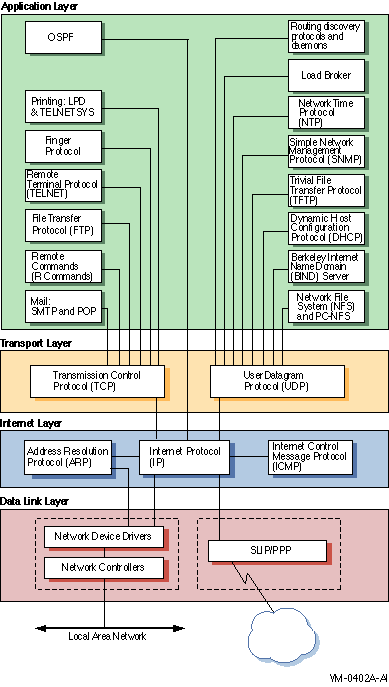
TCP/IPServices provides support for several protocols at every level of the TCP/IPmodel’s protocol layers.
• Data Link layer
• Internet layer
• Transport layer
• Application layerFigure1–1 shows the various layers and protocols of the TCP/IP model. A descriptionof each layer and protocol follows the figure.
Figure 1–1    The TCP/IP Model
Q:\ati-artlib\gif\vm-0402a.gif

1.1.1  Data Link Layer

At the base of the TCP/IP layers, the Data Linklayer formats data and provides services that directly access the physicalnetwork.
This layer also receives data that is routed fromthe Internet layer and transmits the data to its destination, converting logicalIP addresses to physical addressesof the network adapter or network interface cards (NICs) usingthe Address Resolution Protocol (ARP).
Some commonly used network architectures designedfor the physical network are Ethernet and its variants, Token Ring, FDDI,and ATM.
Asingle host computer can have multiple NICs. This configuration is termeda multihomed host.Depending on your network setup, the Data Link layer’s configurationmay vary. For more information, see Chapter 3.

1.1.2  InternetLayer

The Internet layer moves data around the internet.The Internet Protocol uses addressing to deliver and route packetsacross networks independently of the network cabling.
Atthis level, the protocols are:
• Internet Protocol (IP)
• Internet Control Message Protocol(ICMP)
• Address Resolution Protocol (ARP)
Theprotocol also encapsulates datagram headers, sends ICMP error and controlmessages, and maps ARP address conversions.
Routing protocols at this layer are:
• Routing Information Protocol (RIP)Versions 1 and 2
• Open Shortest Path First (OSPF) Version2
• Exterior Gateway Protocol (EGP)
• Border Gateway Protocol (BGP)• Router DiscoveryFormore information about these protocols, see Chapter 5.

1.1.3  TransportLayer

The Transport layer enables a flow of data betweentwo hosts. The protocols at this layer are either connectionoriented, in whichthe protocol establishes and maintains the connection between communicatinghosts to prevent errors, or connectionless, in which a one-way datagram is sent to a destinationhost.
The TCP/IP Services supports both transport protocols:
• Theconnection-oriented protocol, Transmission Control Protocol (TCP) providesa reliable data flow between two hosts. TCP is used for complex, large packetsthat have an IP address.
• Theconnectionless protocol, User Datagram Protocol (UDP) provides a much simplerservice to the Application layer than TCP but does not guarantee reliability.UDP is used for simple, small packets and requests for dynamic IP addressassignment. UDP packets have a MAC address.

1.1.4  ApplicationLayer

The top layer of the TCP/IP protocol suite, theApplication layer handles the details of the particular application, protocol,or user command; it is not concerned with the movement of data across thenetwork.
TCP/IP Services supports the following TCP/IP applications,protocols, and user services:

Remote Computing Services

Remotecomputing applications enable networked users to run software on remote systems.TCP/IP Services include the following remote computing application components:• TELNET enablesremote login to other hosts in the network. Compaq TCP/IP Services providessimultaneous multiple sessions, IBM3270 terminal emulation (TN3270) and twointerface formats: DCL style and UNIX style.
• Remote, or R, commands are use for the following:
– RLOGIN for remote login– RSH for remote shell capabilities– REXEC to execute commands to a remotehost
– RMT/RCD to read magnetic tapes orCD-ROMs from remote hosts
• XDM is a network-based graphics window system based on theclient/server application model. It enables a system to display informationoutput from an application that is running on another system in the network.
• The FINGER utility is used to display userinformation for the network.

File Transfer Services

TCP/IPServices includes the following components that let users transfer data filesbetween local and remote hosts:
File Transfer Protocol (FTP) transfersfiles between hosts.
Trivial File Transfer Protocol (TFTP) downloadsand transfers files. Compaq TCP/IP Services supports downloading of systemimage and other information to client hosts.

ResourceServices

Line printer/line printer daemon (LPR/LPD) providesprinting services to local and remote hosts.
TELNET print symbiont (TELNETSYM) provides remote printing servicesthat enable OpenVMS printing features not available with the LPR/LPD printservice. Network File System (NFS) is a protocol that allows computersto access remote files as if they were local files, regardless of operatingsystem, hardware type, or architectural differences between the local andremote systems. This is accomplished in a client/server environment wherespecific implementations on NFS exist on both the client and server machines.PC-NFS is a daemon that enables accessto the NFS server from a PC by providing authentication services to PC-NFSclients.

ElectronicMail Services

Communication functions such a electronic mailare vital both within an organizational internet and across the Internet worldwide.The electronic mail components of TCP/IP Services are:
SimpleMail Transfer Protocol (SMTP) is the TCP/IP standard protocol for transferring electronicmail messages from one system to another.
IMAP is the Internet Message AccessProtocol. IMAP enables clients to access email messages and folders from anIMAP server and synchronize them locally. This enables a client to organizeemail messages and folders without continuous access to the server.
Post Office Protocol (POP) is a mail repository used primarilyby PCs.

1.2  Application Support

Beyond the industry-standardTCP/IP application services, TCP/IP Services provides support for the followingCompaq products:
• PATHWORKS or Advanced Server
• DECnet-Plus

1.2.1  PATHWORKS and DECnet-over-TCP/IP Support

TheCompaq TCP/IP Services for OpenVMS software includes the PWIP driver and the PWIPACP networkancillary control process (ACP).The PWIP driver enables communication between OpenVMS systems running bothPATHWORKS server and TCP/IP Services software, and personal computers runningPATHWORKS client software. It also enables the DECnet-over-TCP/IP feature,which is included with the DECnet-Plus for OpenVMS Version 6.0 and later software.For more information, see Chapter 7.

1.3  APIs

Networkapplications specific to the Compaq TCP/IP Services can use the followingapplication programming interfaces (APIs):
• Berkeley Sockets Interface
• OpenVMS QIO System Services interface• ONC RPC programming interface• SNMP programming interface1.3.1  Berkeley Sockets Interface
Socketshave become a popular programming interface. The Berkeley Sockets Interfaceis a programming interface that provides applications with access to networkcommunication protocols. A socket is a generalized UNIX communication endpoint on which the TCP/IP protocolshave been implemented. Using the socket programming interface makes it easyto implement network applications.
OpenVMS provides support for the socket interfacethrough the C programming language and the Compaq C Run-Time Library. Thebenefits of using the socket interface on the OpenVMS platform include:
• Ease of porting network applicationsfrom other platforms to the OpenVMS platform. A sockets interface can be generic.• Many application developers are familiarwith the programming environment.
• In addition to the TCP/IP protocols,there are options for other types of protocols.
Formore details, refer to the Compaq TCP/IPServices for OpenVMS Sockets API and System Services Programming manual.
1.3.2  OpenVMS QIO System Service InterfaceThestandard I/O programming interface on OpenVMS uses the QIO (queue input/output)system services. QIO services provide a rich set of functions for controllingdevices, and connections and for performing input (read) and output (write)operations.
The benefits of using the OpenVMS QIO interfaceinclude:
• Support for the QIO interface in thefollowing programming languages:
MACRO-32
Compaq C
Compaq Fortran
Compaq Ada
Compaq and VAX BASIC
VAX BLISS-32
Compaq COBOL
VAX Pascal
Compaq PL/1
• Ability to handle complex applicationswith many concurrent connections.
• Efficient input/output operations.
• Robust asynchronous event handling.(While sockets offer the ability to do nonblocking I/O operations, they donot offer the ability to perform asynchronous I/O.)
• Ease of DECnet applicationsportability to TCP/IP protocols.
For more details, refer to the CompaqTCP/IP Services for OpenVMS Sockets API and System Services Programming manual.
SRIQIO Compatibility
TCP/IP Services provides support for customer applicationsusing the INETDRIVER QIO interface developed at Stanford Research Institute(SRI) in 1980-81. An SRI QIO emulator that translates non-TCP/IP ServicesQIO interfaces into TCP/IP Services QIO programming interfaces can be configuredby using the TCPIP$CONFIG procedure.

1.3.3  ONC RPC Programming Interface

TheRPC programming interface is an industry-standard, portable API that is anefficient alternative to using sockets for application development. Programmersdo not need an in-depth knowledge of networking protocols to use RPC.
Onestrong point of the RPC interface is its ability to distribute functions acrossthe network. This is done in an architecture-independent manner, thereby avoidingproblems with floating-point formats and byte-address ordering that oftenoccur when interacting between architectures.
ThisAPI includes:
• Library of RPC function calls.
• Portmapper service, which is a service that clientprograms can use to determine the port number that another service uses. Clientsuse the Portmapper Service for NFC, PC-NFS, and RPC applications.• External data representation (XDR)routines.
For more details, refer to the CompaqTCP/IP Service ONC RPC Programming manual.

1.3.4  SNMPProgramming Interface

The Extensible Simple Network Management Protocol(eSNMP) API provides routines for developing applications that remotely manageand collect data from network devices such as routers, bridges, and hosts.
Thesenetwork devices run software that carries out management commands that eitherget information from devices or set operating parameters for devices.Othernetwork applications send commands to network devices to perform configurationmanagement, monitor network traffic, or troubleshoot network problems.TheSNMP API provides routines for the following functions: • Establish, maintain, and terminatecommunication with the master agent
• Manipulate, reformat, extract, andcompare data
• Control information that is writtento log files
The SNMP API routines are almost identical in functionand interface with the routines in the Compaq Tru64 UNIXAPI.
For more details, refer to the CompaqTCP/IP Services for OpenVMS SNMP Programming and Reference manual.
1.4  UnderstandingRFCs
Although TCP/IP is monitored by a number of organizations,no single entity owns this protocol; its specifications are publicly availableand are constantly growing as communications requirements evolve.
Theprocess by which the specifications evolve is through a mechanism called Requestsfor Comments (RFCs). When someone has an idea for a new or improved capabilityfor TCP/IP, he or she writes a proposal, posts it on the Internet as an Internetdraft, and requests comments from the networking community. After a reviewand revision cycle, working code is developed and an RFC becomes a standardprotocol.
RFCs are available on the Internet from the InternetNetwork Information Center (InterNIC). The following web site provides linksto several RFC international repositories, lists all RFCs, and explains howyou can obtain copies:
http://www.rfc-editor.org
Notethat, although RFCs recommend implementation guidelines, the actual implementationof an RFC can and must differ from the RFC in minor ways. When product documentationrefers to specific RFCs, be aware that the RFC only sets the standard fordevelopment. Product developers must design their software for the specificenvironment and requirements of their customers.

2    Understanding OpenVMS and UNIX Implementations

An important step in planninga network host implementation is to gain an understanding of the computingenvironments in which the network services will run. Compaq Tru64 UNIXimplementations of TCP/IP Services are often ported to OpenVMS. As a result,they often appear to be identical. However, there are many significant differences.This chapter describes key implementation differences between UNIX and OpenVMSnetworks. The following topics are discussed:
• Evaluating the computing environment
• File compatibility• Portability
• Determining which file systemto use

Things to Consider

In planning your TCP/IP Services environment, considerthe following:
• Do I need to migrate from one operatingsystem to the other?
• Do I need to set up a system thatcoexists with multiple operating systems?
• Should I choose a Files–11file system or a container file system?

2.1  Evaluating the Computing Environment

Theissues of working in a heterogeneous computing environment that includes OpenVMSand Tru64 UNIX operating systems are complex. Consider these concepts whenevaluating or implementing an interoperability strategy:• Migration occurs when software applicationsare rewritten as necessary to be ported from one operating system to the other.In a general sense, not only the applications but also the users migrate toanother system. Migration implies a gradual replacement of the original systemwith the new system.
• Coexistence occurs when two or more systems,such as OpenVMS and Tru64 UNIX, are maintained as part of a larger, heterogeneouscomputing environment. The amount of interoperability varies with the individualconfigurations. It is possible to set up nearly identical network configurations,thereby reducing maintenance.

2.1.1  Understandingthe Open Systems Concept

The client/server model of computing means thatusers running applications on their PCs and workstations are networked withlarger departmental systems. The departmental systems provide a variety ofservices to the clients, such as access to common database, print, and backup/archiveservices.
To best serve this model of computing, the systemsmust be open. Open environments support interoperability and application portabilityand enable developers and users to easily use different platforms. The OpenVMSoperating system is an open system with an extensive list of functions.
Anopen system allows the OpenVMS operating system, whether powered by Alphaor VAX, to interoperate efficiently with Compaq Tru64 UNIX and with othervendors’ operating systems, particularly with Windows NT and other UNIXoperating systems.

2.1.2  Understandingthe Middleware Concept

Implementing open systems means using the right middleware betweenthe operating system and the hardware platform and applications. Consistentmiddleware affords interoperability and portability when and where it is needed.An open systems strategy involves a consistent middleware approach that isbased on standards and is embodied in layered software and in individual operatingsystems, such as OpenVMS and UNIX. Compaq DCE is an example of middleware, with standard interfacessupported on both OpenVMS and UNIX. Compaq DCE, or Distributed ComputingEnvironment, is an architecture of standard programming interfaces, conventions,and server functions that transparently distributes applications across heterogeneousnetworks.
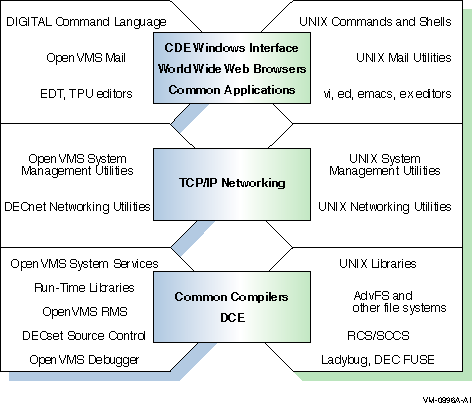
As shown in Figure 2-1, OpenVMS and UNIX interoperateefficiently, especially in areas that are common to both platforms: windowinginterface, standard POSIX and DCE programming interfaces, compilers, networkingproducts, and applications.
Figure 2–1   Comparisonof OpenVMS and UNIX
Q:\ati-artlib\gif\vm-0896a.gif
2.2  File Compatibility
The Network File System, or (NFS) provides a standardfor the exchange of data between machines running different operating systems.NFS enables users to access directories and files on remote computers transparently,as if they were on the local system. NFS accomplishes this because it is implementedon the both the remote and the local computer.
NFSprotocol achieves portability between different machines, operating systems,network architectures, and transport protocols through the use of Remote ProcedureCall (RPC) and External DataRepresentation (XDR). Formore information about RPCs and XDR, refer to the CompaqTCP/IP Services for OpenVMS ONC RPC Programming manual.
UsingNFS is simple. Configuring and implementing NFS, however, are more complex.For NFS concepts and considerations, as well as detailed configuration andimplementation information, refer to the CompaqTCP/IP Services for OpenVMS Management guide.
TCP/IPServices accommodates the numerous key differences between UNIX and OpenVMSto make user interaction between the two operating systems appear transparent.This enables all systems on a heterogeneous network to store and share filesand applications regardless of file specification and structure differences.
Thissection discusses:
• Directory hierarchies
• File specifications• Linking files
• File structures
• File ownership
• File protection
• UNIX style file system on TCP/IP Serviceshosts

2.2.1  DirectoryHierarchies

Unlike OpenVMS, the UNIX hierarchy appears as onetree (starting from the root directory, or “/”) that can be locatedon more than one device. Table 2-1 describes the differences between the OpenVMSand Tru64 UNIX directory hierarchies.
Table 2–1   DirectoryHierarchy Differences
OpenVMS
UNIX
Resideon one volume having one root above all directories on the volume.
Canreside on multiple volumes.
Devicenames included in file specifications.
Devicenames not included in file specifications.
Figure 2-2 illustrates the differences betweena UNIX file structure and an OpenVMS file structure.
Figure 2–2   Comparison of UNIX Directory and OpenVMS Directory Hierarchies
2.2.2  FileSpecifications
There are basic differences between OpenVMS andUNIX file specifications. Table 2–2 summarizes the differences.
Table 2–2   File Specification Differences
OpenVMS
UNIX
Filesare delimited in the following way:
• A colon (:) separates the device fromthe directory.
• Square brackets ([ ]) or angle brackets(< >) enclose the directory and any subdirectories.
• A period (.) separates directoriesfrom subdirectories and separates the file name from the file type.
• A semicolon (;) or period (.) separatesthe file type from the version number.
The ODS-5 file system implements extended filespecifications and is a step toward improving interoperability. ODS-5 is describedlater in this chapter.
For complete details about the ODS-5 file specification,refer to the OpenVMS product documentation.
Theslash (/) is the only delimiter that the UNIX file specification format uses.
Thefirst slash in a UNIX file specification represents the root directory. Subsequentslashes separate each element of the file specification (the directories fromthe other directories and the file name). In theory, there is no limit tothe number of directory levels in a UNIX file specification.

OpenVMS file specification format

Ona standard Files-11 On-Disk Structure Level 2 (ODS-2) volume,an OpenVMS file specification has the following format:
device:[directory.subdirectory]filename.type;version

UNIX file specification format

Ona UNIX system, the file specification has the following format:/directory/subdirectory/filename 2.2.3  Absoluteand Relative File Specifications
OpenVMS and UNIX both have two types of file specificationsor pathnames: absolute and relative. Table 2–3 describes the differencesbetween the two platforms.
Table 2–3   Absoluteand Relative File Specification Differences
OpenVMS
UNIX
Therelative path for file calc;1 indirectory usr:[jones] is:
[.accounting.calc;1]Theabsolute path is:
usr:[jones.accounting.calc;1]
Therelative pathname for file calc indirectory /usr/jones is
accounting/calcTheabsolute pathname is
/usr/jones/accounting/calc
On UNIX systems, absolute pathnames use the entiredirectory path that leads to the file, beginning with the root, which is representedby an initial slash.
The root directory is the first directory in thefile system. All other files and directories trace their ancestry back tothe root. Relative pathnames begin the directory path with the current workingdirectory and exclude the current working directory name in the pathname.There is no initial slash in a relative pathname.

2.2.4  File Specifications

There are fundamental differences between filenames specified in OpenVMS and in UNIX. Table 2–4 describes those differences.
Table 2–4   File Specification Differences
OpenVMS(ODS-2)
UNIX
Includes,in this order:
1. the file name
2. the file type
3. an optional version number
An OpenVMSfile specification can have a maximum of 255 characters.
Thefile name and file type can have up to 39 characters each and are separatedby a period. For example:
FILE_NAME.TXT;1
Valid characters in an OpenVMS file name or typeinclude: A–Z, a–z, 0–9, underscore (_), hyphen (-), anddollar sign ($). The version number (preceded by a semicolon) is a decimalnumber from 1 to 32767; it differentiates versions of the same file.
Containsup to 1024 characters, with each element of the pathname containing up to255 characters. UNIX file specifications have the following format:
file_name.txtSomeolder versions of the UNIX operating system limit the size of one elementto 14 characters, or have other limits that you can change if you recompilethe kernel.
Intheory, you can use any ASCII character in a UNIX pathname except for theslash (/) and null characters. For example, a valid file name in UNIX canbe:
report.from.january_24
However,avoid characters (such as the pipe (|) character) that can have special meaningto the UNIX shell.

2.2.5  Case Sensitivity

Case sensitivity differs between the two operatingsystems. Table 2–5 describes the difference.
Table 2–5   Case-Sensitivity Differences
OpenVMS(ODS-2)
UNIX
Storeseverything in uppercase. For example, any case variations of the followingfile name is stored in uppercase: CHAPTER_ONE.TXT;1
Regardsuppercase and lowercase characters as different characters.
 
Forexample, on a UNIX system, the following file names represent three differentfiles:
• CHAPTER_ONE.TXT
• Chapter_One.Txt
• chapter_one.txt

2.2.6  File Types

Table 2–6 describes the file type differencesbetween OpenVMS and UNIX.
Table 2–6   FileType Differences
OpenVMS
UNIX
Importantin OpenVMS file identification
The file type usually describes the kind of datain the file.
UNIXsystems do not use file types. However, UNIX has certain naming conventionsthat resemble OpenVMS file types.
Forexample, a text file typically has a file type of .TXT.
AllOpenVMS directories have a file type of .DIR.
Forexample, file names ending in txt aretext files.
UNIXdirectories do not have file types.

2.2.7  VersionNumbers

Table 2–7 describes file version number differencesbetween OpenVMS and UNIX.
Table 2–7   VersionNumber Differences
OpenVMS
UNIX
Everyfile has a version number.
When a file is created, the system assigns it aversion number of 1. Subsequently, when a file is edited or when subsequentversions of that file are created, the version number automatically increasesby 1. Therefore, many versions of a file with the same file name can existin the same directory.
TheUNIX file system does not support automatic creation of multiple versions.In most cases, if you edit a UNIX file, the system saves only the most recentlyedited copy.
Forexample:
FILE_NAME.TXT;1
FILE_NAME.TXT;2
FILE_NAME.TXT;3
Forexample:
file_name.txt

2.2.8  Linking Files

A link is a directory entry that refers to a fileor another directory. Table 2–8 describes the differences between OpenVMSand UNIX file linking.
Table 2–8   LinkFiles Differences
OpenVMS
UNIX
Filescan exist without links.
Filescannot exist without links.
HardLinks
OpenVMSsystems allows you to perform a function similar to hard links with the SETFILE/ENTER and SET FILE/REMOVE commands.
The OpenVMS operating system does not maintaina count of links to a file. As a result, you can delete a file without deletingits links.
HardLinks
Hardlinks allow users to share the same file under different pathnames. A hardlink cannot span file systems.
On UNIX systems, any changes to the file are independentof the link used to refer to the file. The UNIX system maintains a count ofthe number of links to each file. If removing a link results in the link countbecoming zero, the file is deleted. A file can be deleted only by removingall of its links.
SymbolicLinks
OpenVMSfile systems do not support symbolic links.
Symbolic Links
A symbolic link is a file that contains the nameof the file to which it is connected. Symbolic links provide a path to theoriginal file.
A UNIX symbolic link can span file systems. Unlikea hard link, a symbolic link does not maintain a link count. In addition,symbolic links can exist after the file is deleted. However, the system returnsan error if the symbolic link file is accessed after the file it names isdeleted.

2.2.9  FileStructures

Table 2–9 describes the differences betweenthe OpenVMS and UNIX file structures.
Table 2–9   FileStructure Differences
OpenVMS
UNIX
Supportsthree file structures: indexed, relative, and sequential. OpenVMS also supportsthe following record formats and record attributes:
• Fixedlength
• Variable length
• Variable with fixed-length control(VFC)
• Stream (including STREAM_LF and STREAM_CR)
• Undefined
• Carriage return/carriage control
• Fortran carriage control • VFC carriage control
Supportsbyte streams only.
The records in UNIX text files have the same formatas the OpenVMS Record Management Services (RMS) STREAM_LF record format.

2.2.10  FileOwnership

The OpenVMS and UNIX operating systems use differentmechanisms for file ownership. Table 2–10 describes those differences.
Table 2–10   File Ownership Differences
OpenVMS
UNIX
TheOpenVMS operating system controls file ownership and access through a useridentification code (UIC). A UIC is a 32-bit value that consists of a 14-bitgroup number, a 16-bit member number, and 2 reserved bits. Each user of thesystem has a UIC defined in the SYSUAF file. Access to objects depends onthe relationship between the UIC of the accessing process and the UIC of theobject (the file or directory).
OpenVMS controls file access through an accesscontrol list (ACL). You candeny or grant read, write, execute, delete, and control access to a user orgroup of users who have the identifier specified by the ACL. For additionalACL information, refer to the OpenVMS documentation set.
The NFS protocol does not provide ACL support. Therefore,the NFS client is unaware of ACLs that the NFS server applies to the file.Consequently, the NFS client cannot use an ACL to control file access. Accesscontrol is determined through standard file protections. For more information,see Chapter 2.
TheUNIX operating system controls access to files with user identification (UID)and group identification (GID). Tru64 UNIX uses 32-bit UIDs and GIDs. Forcompatibility, NFS also recognizes 32–bit UIDs and GIDs.

2.2.11  FileProtections

The OpenVMS and UNIX operating systems use similarfile protection schemes, as shown in Table 2–11.
Table 2–11    Comparison of File Protection
Mechanism
OpenVMS
UNIX
Userclassifications
SYSTEM(S)
OWNER(O)
GROUP(G)
WORLD(W)
Classificationdepends on the relationship between the UIC of the accessing process and theobject.
user(u) --- The user has a matching UID
group (g) --- The user has a matching GID
other (o) --- Any other user
System categoryis not used; system administrators always have access to UNIX files.
Protectionlevels
READ(R)
WRITE(W)
EXECUTE(E) – Controls file execution and directory search access
DELETE(D)
read(r) — The user has a matchingUIC
write(w) — Controls unlinking filesto the directory.
execute (x) — Controlsfile execution and directory search access
A file is deleted if it is unlinked from the directoryand had no links in other directories. Write access to the directory is refused.
Syntax
s:rwed,o:rwed, g:rwed, w:rwed
rwxrwxrwx
Theprotection levels are divided into groups of three characters:• First three characters: protectionlevels for the owner.
• Second three characters: protectionlevels for the group.
• Last three characters: protectionlevels for all other users.

2.3  Portability

The TCP/IP Services allows you to create a logicalUNIX style file system on an OpenVMS host. Remote UNIX hosts that have NFSsoftware can then access this file system. When a remote UNIX system accessesfiles, these files conform to UNIX file system rules, not to the OpenVMS rules.This ensures that existing UNIX applications work without change. The logicalUNIX file system resides on a Files-11 formatted disk and is represented asa set of Files-11 files called a container file system. For information about creatinga UNIX file system on an OpenVMS host, refer to the CompaqTCP/IP Services for OpenVMS Management guide.
TheUNIX file names and attributes are catalogued in the container file, one ofthe files in the container file system. The container file also has a representationof the UNIX directory hierarchy and a pointer to the data file for each filename. In addition to its UNIX name, each file in the container file systemhas a valid Files-11 file name assigned by the system. An OpenVMS directoryexists for each UNIX directory stored in the container file. All files cataloguedin a UNIX directory are also catalogued in the corresponding OpenVMS directory.However, the UNIX directory hierarchy is not duplicated in the OpenVMS directoryhierarchy. Each UNIX file is represented as an OpenVMS data file. Therefore,OpenVMS utilities, such as BACKUP, can use standard methods to access thesefiles.

2.4  Determining Which File System to Use

Thefirst step in managing your TCP/IP Services system is to decide which filesystem to use. NFS on OpenVMS enables you to set up and export three differentkinds of file systems:
• OpenVMS On-Disk Structure(ODS-2) file system,in which devices, directories, and files are stored on a Files-11 formatteddisk
• OpenVMS On-Disk Structure(ODS-5) file system,which enables creation and storage of files with extended file names for compatibilitywith other file systems, such as Windows.
• UNIX, or container, file system,built on top of an OpenVMS system. If you are not familiar with OpenVMS filesystems, refer to the OpenVMS System Manager’sManual: Essentials to learn how to set up and initialize a Files-11disk. As Figure 2–2 shows, both file systems are structured as hierarchical,multilevel directories. On OpenVMS systems, the top level is called the master file directory, or MFD. This directory contains all the directories and reservedsystem files. The directory is named [000000]. On UNIX systems, the top-leveldirectory is called the root, or / .
Table 2–12 lists the NFS server featuresavailable to non-OpenVMS clients based on file system choice.
Table 2–12   NFS Server Features Available to Non-OpenVMS Clients
Features
ODS-2
OD2–2with name conversion
ODS-5
Containerfile system
Fileseasily shared between remote clients and local OpenVMS users
Yes
Yes
Yes
No
Mixedcase, special characters, and extra dots in file names
No
Yes
Yes
Yes
Longfile names
No
No
Yes
Yes
Filenames look the same to remote clients and local OpenVMS users
Uppercaseto local users, lowercase to remote clients
No
Yes
N/A
Supportfor hard links, symbolic links, special files
No
No
No
Yes
UNIXcompatible timestamps
No
No
No
Yes
Case-sensitivelookup
N/A
Yes
No
Yes
The dual cataloguing of files to both OpenVMS filesystems limits the set of DCL commands. OpenVMS utilities, such as BACKUP,can use standard methods to access the files. However, except for backingup and restoring files, you should not use DCL commands to manipulate filesin a container file system.

   DecisionPoint
Your file system choice depends on your environmentand the user needs on the NFS client host. Consider using an OpenVMS filesystem if:
• Your users share most files betweenyour OpenVMS system and another OpenVMS host, or between your OpenVMS systemand a UNIX client.
• Your client users need to maintainmultiple versions of files.
• You share files between users on OpenVMSand users on NFS clients.
• File sharing between your OpenVMSsystem and a UNIX client is minimal.
• Client applications use symbolicor hard links or special files.

For More Information

Formore information about the following topics, refer to the CompaqTCP/IP Services for OpenVMS Management manual:
• Setting up container file systems
• Configuring and implementing the NFSserver
For a list of commonly used Tru64 UNIX commandsand their equivalents on OpenVMS, refer to the CompaqTCP/IP Services for OpenVMS Tuning and Troubleshooting manual.
Formore details about interoperability between UNIX and OpenVMS, refer to the OpenVMS and Compaq UNIX Interoperability and MigrationGuide. This guide discusses products and services, available both fromCompaq and from other vendors, that might provide solutions to interoperabilityproblems.
For more information about RPCs and XDR, referto the Compaq TCP/IP Services for OpenVMSONC RPC Programming manual.
For additional ACL information, refer to the OpenVMSdocumentation set.
3    OpenVMSServer and Network Configurations
There are several server and network configurationsto consider before installing TCP/IP Services for OpenVMS. This chapter describesthe following concepts that will enable you to make informed decisions aboutthese configuration options:
• OpenVMS VAX and Alpha similaritiesand differences
• Cluster environments
• Multiple interfaces and multihoming
• Pseudointerfaces• Serial lines
Q:\adept8\entities\note.eps   Note
VAX development has limited continued support.VAX users should consider migrating to Alpha, if possible.
Thingsto Consider
In planning your TCP/IP Services for OpenVMS configurations,consider the following:
• Does the network contain VAX or Alphasystems, or both?
• Is my system running a DHCP server?
• Is my system running a DHCP client?• How many interfaces does the systemhave?
• Do I have serial lines in my network?If so, for which systems are they used?

3.1  Understanding OpenVMS VAX and Alpha Systems

Youneed to consider several issues when you plan to add one or more OpenVMS Alphasystems to your OpenVMS VAX computing environment. For full details aboutthe similarities and differences between OpenVMS Alpha and OpenVMS VAX, referto the OpenVMS Compatibility Between VAXand Alpha guide, which is available on line at:
http://www.openvms.compaq.com/doc
3.1.1  User Environment
The user environment on OpenVMS Alpha is virtuallythe same as that on OpenVMS VAX. Table 3–1 describes the similaritiesand differences.
Table 3–1   OpenVMSVAX and OpenVMS Alpha Similarities and Differences
ComponentSimilarities
OpenVMSVAX Differences
OpenVMSAlpha Differences
DIGITALCommand Language (DCL)
Essentially the same on both systems.
None
Referto the few exceptions in the OpenVMS CompatibilityBetween VAX and Alpha guides available on line.
DCLHelp
MostDCL help text is common to both systems.
System-specificinformation is identified by the phrase “On VAX.”
System-specificinformation is identified by the phrase “On Alpha.”
DCLcommand procedures
Most DCL command procedures, with commands, qualifiers,and lexical functions, work on both systems.
None
Afew command procedures contain qualifiers not available on OpenVMS Alpha.
Databases
Standarddatabases, such as Oracle Rdb, function the same on both systems.
None
Mostthird-party databases available for OpenVMS VAX are also available for OpenVMSAlpha.
Formore information, refer to the OpenVMS CompatibilityBetween VAX and Alpha guide, available on line.

3.1.2  System Management Environment

MostOpenVMS VAX system management utilities, command formats, and tasks are identicalon OpenVMS Alpha, with the following exceptions:
• On VAX, use of the POLYCENTER SoftwareInstallation utility is limited to the installation of layered products, suchas Compaq TCP/IP Services for OpenVMS.
• On Alpha, the POLYCENTER SoftwareInstallation utility is also used to install both the OpenVMS operating systemand layered products.
For more information about implementation differencesbetween OpenVMS VAX and OpenVMS Alpha, refer to the OpenVMSSystem Manager’s Manual.

3.1.3  ProgrammingEnvironment

The same types of programming development toolsthat OpenVMS VAX programmers use are available on OpenVMS Alpha systems, suchas the Linker utility, the Librarian utility, the OpenVMS Debugger (also knownas the symbolic debugger), the Delta/XDelta Debugger, and run-time libraries.However, some TCP/IP Services components are available only on OpenVMS Alpha,including:
• BIND Version 9
• IMAP
• PPP
These components are introduced later in this manual.
Fordetails about the similarities and differences between the programming environmenton VAX and Alpha, refer to A Comparison ofSystem Management on OpenVMS AXP and OpenVMS VAX, which provides guidelinesfor developing applications that run on both OpenVMS VAX and OpenVMS Alpha,as well as additional guidelines for systems that run in a mixed-architectureOpenVMS Cluster.

3.2  OpenVMSCluster Configuration

Compaq TCP/IP Services for OpenVMS supports OpenVMSCluster systems and the use of cluster aliases. The network sees the clusteras one system with one name, the cluster alias. A remote host can use the cluster alias to addressthe cluster as one host, or it can use the host name of a cluster member toaddress a cluster member individually.
In a DECnet network, it is convenient to be ableto treat nodes within a homogeneous OpenVMS Cluster as though they were asingle node. You can do this by establishing an alias nodeidentifier for thecluster. You can specify the alias node identifier as either a unique nodeaddress or a corresponding node name. Any member node can elect to use thisspecial node identifier as an alias while retaining its own unique node identification.For more information on the use of the optional cluster alias node identifier,refer to the DECnet for OpenVMS NetworkingManual.
Q:\adept8\entities\note.eps   Note
DECnet–Plus software is not required in anOpenVMS Cluster configuration. However, DECnet–Plus is necessary ifinternode process-to-process communication using DECnet mailboxes is needed.For more information about DECnet-Plus in an OpenVMS Cluster configuration,refer to the Guidelines for OpenVMS ClusterConfigurations manual.
For load balancing, anOpenVMS Cluster can consist entirely of OpenVMS Alpha nodes or of a combinationof OpenVMS VAX and OpenVMS Alpha nodes.
You can have numerous OpenVMS Cluster configurations.For complete information about supported devices and configurations, referto Guidelines for OpenVMS Cluster Configurations andthe OpenVMS Cluster Software Software ProductDescription (SPD). For complete information about setting up and usingan OpenVMS Cluster environment, refer to the OpenVMSCluster Systems manual.

3.2.1  Failover Capability

Failover capability is the hallmark of a clusterenvironment. If one computer , or node, in the cluster fails, the others canassume its functionality and continue. This is called automaticfailover.
Each node (asa member of the host configuration in the cluster) retains a separate IP address.This is beneficial for troubleshooting the individual node because you can ping the specific node tosee whether it is running.
All of the TCP/IP services support automatic failoverand can run on multiple nodes in an OpenVMS Cluster. For example, if morethan one node in the cluster is running the NFS server, the cluster can appearto the NFS client as a single host. For more information about configuringa specific service for cluster failover, refer to the particular service inthe Compaq TCP/IP Services for OpenVMS Management guide.
3.2.2  Connection Load Balancing
Loadbalancing using the TCP/IP Services is defined by the loadbroker. The load brokeris a configurable, calculated, load-balancing mechanism for distributing thework load among DNS (DomainName System, which maintains and distributes information about Internet hosts)cluster members. For more information about DNS, see Chapter 5.
Unlike round-robin scheduling (thedefault method used by most DNS name servers, in which each individual nodein the cluster is polled in a continual, specific order), the load brokertakes into account the load on all DNS cluster participants. The load brokerpolls DNS cluster members and updates the metric server accordingly.Whenthe load broker starts, it reads its configuration file and starts pollingDNS cluster members. The load broker exchanges messages with DNS cluster membersthat run the metric server, which calculates the current load on a DNS clusterhost by using a specific equation. The metric server calculates the currentrating and reports it when polled by the load broker. Periodically, the loadbroker sorts the list of addresses based on metric rating reports, drops thesystems that do not respond after being polled three times, and compares asubset of the list with the name server information.
Todo the comparison, the load broker sends a host lookup request to the specifiedname server. If the lists are the same, the load broker does not make changes.If the lists are different, the load broker updates the name server data bysending a dynamic update request to the specified name server. The name serveruses round-robin scheduling to further balance the load across the membersof a DNS cluster. Thus, every consecutive request for translating the DNScluster name results in a returned list, is rotated by one.
Forspecific information about configuring the load broker, starting and stoppingthe metric server, and troubleshooting, refer to the CompaqTCP/IP Services for OpenVMS Management guide.

3.3  Multihomingand Multiple Interfaces

Although host computers can have several networkinterface cards (NICs) installed, you can configure the host through a single,primary interface. This section introduces the following concepts:
• Multihomed computers• Primary interface• Pseudointerfaces

3.3.1  Multihomed Computers

Individual host computers can have multiple networkinterface cards per computer.Such a computer is called multihomed. These physical interfaces can be connected to differenttypes of networks, such as Ethernet, FDDI, Token Ring, asynchronous transfermode (ATM), Gigabit Ethernet, and serial communications lines. Each physicalinterface is associated with one device driver (network interface). A singlenetwork interface can have more than one IP address.
Q:\adept8\entities\note.eps   Note
If a host has multiple interfaces under DHCP (DynamicHost Configuration Protocol) control and receives a different host name froma DHCP server on each of the DHCP-controlled interfaces, the DHCP client usesthe host name it receives on the primary interface to configure the host namefor the client. For more information about DHCP, see Chapter 5.
3.3.2  Primary Interface
Although you can have multiple physical interfaceson a single computer, some of the parameters that are configurable by DHCPare interface specific. Examples of interface-specific parameters are theIP address and subnet mask. However, most DHCP configurable parameters aresystemwide configurable parameters. Examples of systemwide parameters arethe host name and DNS domain name. The TCP/IP Services DHCP client supportscontrolled configuration of systemwide configurable items by designation ofa primary interface.
Theprimary interface is the interface on which the DHCP client uses systemwideparameters received from the DHCP server to configure the system. Systemwideparameters received on an interface that is not designated as primary arenot configured on your system by the server. Although only one interface ona system is designated as the primary DHCP interface, the system is not requiredto have any interface designated as primary.
If a system has multiple interfaces and only oneis under DHCP control, you can configure the systemwide parameters manually.DHCP client uses the following rules to resolve conflicts:
• The only-one-primary-interface ruleThis rule solves the potential conflict betweentwo DHCP controlled interfaces on a host getting different systemwide parametervalues. To resolve the conflict, you designate one interface to be the primaryinterface and the parameters that you receive on that interface are the valuesthe DHCP client uses to configure the system. TCP/IP Services does not letyou designate two primary interfaces.
• The primary-interface-not-requiredrule
This rule solves the problem of DHCP configuringinterfaces with an IP addressbut also keeping manual control of the systemwide parameters. In this case,the DHCP client does not designate the interface as the primary interface,and it ignores any systemwide parameters it receives from a DHCP server.
Fordetails about configuring multiple interfaces, refer to the CompaqTCP/IP Services for OpenVMS Management guide.

3.3.3  Pseudointerfaces

To use extended routing, you can define pseudointerfaces.A pseudointerface is a data structure that extendssubnet routing using a network interface. Each network interface has one nameand at most nine pseudointerface names. Each network interface and pseudointerfacehas its own IP address, network mask, and broadcast mask.
Likean interface, the name of an internet pseudointerface consists of three alphabeticcharacters, followed by the pseudointerface unit number in the range of 0through 255. The first two characters are the same as the two characters inthe internet interface name (interface type and interface class). The thirdcharacter identifies the controller letter that corresponds to the OpenVMShardware controller. For more information about interface names, refer tothe Compaq TCP/IP Services for OpenVMS Management guide.3.4  Serial Line Connections
A serial connection is made between two systems using modems and telephonelines or other serial lines. TCP/IP Services supports serial connections usingPPP (Point-to-Point Protocol) and SLIP (Serial Line Internet Protocol). SLIPincludes CSLIP (compressed SLIP). You can use any standard OpenVMS terminaldevice as a PPP or a SLIP line. However, PPP is available for OpenVMS Alphasystems only.
One of the largest applications for IP over seriallines is dialup access. With this type of configuration, your OpenVMS hostanswers calls and establishes a connection initiated by a user on a clienthost. The client host can be another OpenVMS system, a UNIX system, or a PC.Alternatively, users on your host can originate the dialup connection to aremote host or terminal server that is running the same protocol. Dedicatedserial lines running PPP or SLIP can also be used to connect separate LANsinto a single WAN. In such a configuration, the host at each end of the serialconnection is always the same; no other hosts are allowed to connect to eitherserial device.
If your OpenVMS system is part of a large network,you will probably use both PPP and SLIP for your serial connections. As anInternet standard, PPP is often preferred because it ensures interoperabilitybetween systems from a wide variety of vendors. PPP provides a way for yourOpenVMS Alpha system to establish a dynamic IP network connection over a serialline without additional router or server hardware.
SLIPhas been in use for a longer period of time than PPP and is available formost terminal servers and in most PC implementations of TCP/IP. Because SLIPand PPP do not communicate with each other, hosts must use the same protocolin order to communicate. For example, if your terminal server supports onlySLIP, remote hosts that connect through this server must also use SLIP. Formore information about configuring serial lines, refer to the CompaqTCP/IP Services for OpenVMS Management guide.

ForMore Information

For more information about the following topics,refer to the Compaq TCP/IP Services for OpenVMSManagement guide.
• Configuring and troubleshooting OpenVMSClusters, including load balancing and failover configurations
• Configuring multiple interfaces andmultihomed systems
• Details about pseudointerfaces
• Configuring serial linesFordetailed descriptions of OpenVMS Alpha and VAX similarities and differences,refer to A Comparison of System Managementon OpenVMS AXP and OpenVMS VAX.
For complete information about supported devicesand configurations, refer to the Guidelinesfor OpenVMS Cluster Configurations and the OpenVMSCluster Software Software Product Description (SPD). For complete informationabout setting up and using an OpenVMS Cluster environment, refer to the OpenVMS Cluster Systems manual.

4    OpenVMSOperating System TCP/IP Features

The OpenVMS operating system contains a numberof features that are of specific benefit to the TCP/IP environment. This chapterdiscusses the following topics related to these features:
• TCP/IP management commands• Using logical names• OpenVMS System Dump Analysis (SDA)Tool
• Accessing system messages throughoperator communication manager (OPCOM) and log files
• Comparison of ODS-5 and ODS-2file structures
• Print queues (network printers)
Thingsto Consider
In planning your TCP/IP Services for OpenVMS, considerthe following:
• Should I use ODS-5? For which disks?
• Where should I store the log files?• Which printers in my system are networkshareable? How will users access them?
• Which printers in my systemare on a serial line?
• Should I configure PATHWORKS sharesfor printers?

4.1  TCP/IP Management Control Program

TheTCP/IP Services Management Control Program is a comprehensive, easy-to-usenetwork management tool that includes more than 100 OpenVMS commands. TCP/IPServices provides this management command interface to configure and modifyparameters of components, configure customer-developed services, enable anddisable running components, and monitor the running software
Tostart the management control program, enter the following command:$TCPIP
TCPIP>
At the TCPIP> prompt, you can enter commands such as the following:
SHOWSERVICES
 
SHOWCONFIGURATION
 
HELP
 
SETHOST
 
COPY
 
DIR
 
You can also use UNIX management commands to managesome components of TCP/IP Services.
To use UNIX management commands at the DCL prompt,run the following command procedure:
$ @SYS$MANAGER:TCPIP$DEFINE_COMMANDS
Thenenter UNIX commands as you would on a Tru64 UNIX system.
TCP/IPmanagement commands are described fully in the CompaqTCP/IP Services for OpenVMS Management Command Reference manual, andin the TCP/IP Services online help.
TCPIP> HELP
To exit the management control program, enter thefollowing command:
TCPIP> EXIT
To obtain information about TCP/IP Services, enterthe following command at the DCL prompt:
$ HELP TCPIP_SERVICES

4.2  Defining Logical Names

Logical names allow you to customize componentbehavior. Logical names can point to directories, database files, and logfiles.
To define a logical name, enter the following DCLcommand:
$ DEFINE logical-name
Formore information about these logical names, refer to the CompaqTCP/IP Services for OpenVMS Management guide.
TheTCPIP$CONFIG database predefines logical names for various databases. Duringthe menu-driven installation procedure, the software configures either thecomponents you select or all of the TCP/IP Services software components. Thesedefaults are designed to get your system up and running as an internet hostwith minimal effort. TCPIP$CONFIG creates the database files.
Afterthe initial configuration of a component, you can use logical names to modifythe settings of the component-specific parameters. Many logical names aredefined as “existence logical names”; that is, they can be eitheron or off. Any value associated with them is ignored. Others require a valueof text string as a definition. Every logical name has a default setting.Formore information about how TCP/IP Services components uses logical names,see relevant chapters in this manual and refer to the CompaqTCP/IP Services for OpenVMS Management guide.

4.3  OpenVMSSystem Dump Analysis (SDA) Tool

TCP/IP Services for OpenVMS provides network-specificenhancements to the OpenVMS System Dump Analysis (SDA) tool. For more informationabout SDA enhancements, refer to DCL online help.
Ifyour system fails, you can run the SDA tool on system reboot to analyze thesystem crash dump. You can do this by adding command lines to the SYSTARTUP_VMS.COMprocedure.
If you are unable to analyze a process dump withthe debugger, use the System Dump Analyzer (SDA) utility. Refer to the ANALYZE/CRASHcommand in online help for more information. For example:
$ANALYZE/CRASH billsystem.dmp
OpenVMS (TM) Alpha systemdump analyzer
...analyzing a compressed processdump...
Dump taken on 24-JUL-2002 12:03:40.95
SDA>
Fordetails, refer to the OpenVMS VAX SystemDump Analyzer Utility Manual and the OpenVMSAlpha System Dump Analyzer Utility Manual.

4.4  SystemMessages

You can keep log files of events, changes, andother configuration data in two ways.
• Using OPCOM (operator communication manager) —available only if you have system privileges.
• Using log files that most componentsestablish when they are configured.
System messages are saved to either one of theseutilities. Both are described in this section.

4.4.1  OPCOM

Any terminal that is connected to the operatingsystem can be established as an operator’s terminal if OPCOM (operatorcommunication manager) is running. When an operator who is logged in to anaccount with OPER privilege enters the REPLY/ENABLE command at the designatedterminal, that terminal can be used to respond to user requests and to monitordevice status. Operator messages are displayed on the system console terminalunless the terminal is explicitly disabled as an operator’s terminal.
Toset up a terminal to receive OPCOM messages, enter the following command:$REPLY/ENABLE

4.4.2  Log Files

Eventlogging can help you manage the TCP/IP Services software. By default, user-definedservices do not log events, but event logging is enabled by default for allsupplied services. You can configure the product to log events to the operator’sconsole or to a log file, or to both. Every component has a default log file.For more information about log files, refer to the CompaqTCP/IP Services for OpenVMS Management guide.
Toset up event logging, enter the following command:
TCPIP> SETSERVICE service-name /LOG_OPTIONS=ALL
Fora list of all the logging options, refer to the SET SERVICE command descriptionin the Compaq TCP/IP Services for OpenVMSManagement Command Reference manual.
Some product components provide additional eventlogging capabilities. For more information, see the relevant chapters in thismanual.

4.5  ODS-5 and ODS-2 File Structures

OpenVMSimplements On-Disk Structure Level 5 (ODS-5). This structure provides thebasis for creating and storing files with extended file names. The formatwas introduced for compatibility with other file systems, such as Windows.You can choose whether or not to convert a volume to ODS-5 on your OpenVMSAlpha systems.
The ODS-5 volume structure provides the followingfeatures:
• Long file names
• More legal characters in filenames
• Preservation of case in file names
Thesefeatures are described in detail in the OpenVMS product documentation.ODS-5provides enhanced file-sharing capabilities for TCP/IP Services as well asfor Advanced Server for OpenVMS (or PATHWORKS for OpenVMS), DCOM, and Java™applications. Once ODS-5 volumes are enabled, some of the new capabilitiescan impact certain applications or layered products as well as some areasof system management.
The following sections summarize how the enablingof ODS-5 volumes can impact system management, users, and applications.
4.5.1  Considerations for System ManagementRMSaccess to deep directories and extended file names is available only on ODS-5volumes mounted on OpenVMS Alpha Version 7.2 systems and higher. Compaq recommendsthat ODS-5 volumes be enabled only on homogeneous OpenVMS Alpha clusters.If ODS-5 is enabled in a mixed-version or mixed-architecture OpenVMS Cluster,the system manager must follow special procedures and must be aware of thefollowing specific restriction: users must access ODS-5 files and deep directoriesfrom OpenVMS Alpha systems only because these capabilities are not supportedon earlier versions of the operating system.

4.5.2  Considerations for Users

Users on OpenVMS Alpha systems can take advantageof all Extended File Specifications capabilities on ODS-5 volumes that aremounted on those systems. A user on a mixed-version or mixed-architectureOpenVMS Cluster is subject to some limitations in ODS-5 functionality.
Fordetailed information about mixed-version or mixed-architecture support, referto the OpenVMS product documentation.

4.5.3  Considerationsfor Applications

You can select ODS-5 functionality on a volume-by-volumebasis. If ODS-5 volumes are not enabled on your system, all existing applicationswill continue to function as before. If ODS-5 volumes are enabled, be awareof the following changes:
• OpenVMS file handling and command-lineparsing are modified to enable them to work with extended file names on ODS-5volumes and maintain compatibility with existing applications. The majorityof existing, unprivileged applications will work with most extended file names,but some applications might need modifications to work with all extended filenames.
• Privileged applications that performfilename parsing and need to access ODS-5 file names or volumes should beanalyzed to determine whether they require modification.
OnODS-5 volumes, existing applications and layered products that are coded todocumented interfaces, as well as most DCL command procedures, should continueto work without modification.
However, applications that are coded to undocumentedinterfaces or that include any of the following might need to be modifiedto function as expected on an ODS-5 volume:
• Internal knowledge of the filesystem, including knowledge of:
Data layout on the disk
Contents of file headers
Contents of directory files
• File name parsing tailoredto a particular on-disk structure.
• Assumptions about the syntax of filespecifications, such as the placement of delimiters and legal characters.
• Assumptions about the case of filespecifications. Mixed-case and lowercase file specifications are not convertedto uppercase. This can affect string-matching operations.4.6  Network Printers
Resource sharing lets users access network printersas if they were directly connected to the user’s local systems. Withresource sharing, users can access these resources directly after making theinitial connection. This is different from file transfer programs in whichfiles must be transferred completely from the remote system before they canbe used.
The printer-sharing components of TCP/IP Servicesinclude:
• Line printer/line printer daemon (LPR/LPD),which provides print services to remote and local hosts.
• The TELNET print symbiont (TELNETSYM)provides remote printing services that enables OpenVMS printing features notavailable with the LPR/LPD print service.
• Serial line connection.
• PC-NFS, which provides authenticationand print services for personal computers running PC-NFS.Ifa printer is on the network, you must set it up like any OpenVMS printer.For information about setting up OpenVMS printers, refer to the relevant OpenVMSdocumentation.

4.6.1  Line PrinterDaemon (LPD) Service

The Compaq TCP/IP Services for OpenVMS softwareprovides network printing through LPR/LPD. The LPR/LPD service has both aclient component (LPR) and a server component (LPD). LPD provides remote printingservices for many client hosts, including OpenVMS, UNIX, and Windows NT clienthosts. Each print queue is either local or remote. Local print queues handleinbound jobs; remote print queues handle outbound jobs for remote printers.
Theprint setup utility (TCPIP$LPRSETUP) does the following:• Updates the related printcap database.• Creates and starts queues.• Allows you to add commands to theautomatic startup and shutdown command procedures.
To print, users at an OpenVMS client enter theDCL command PRINT.
Users working on UNIX clients typically enter the lpr command.
Touse the Compaq TCP/IP Services for OpenVMS network printer services, you needthe following:
• The remote host name.
• The name of the remote print queueor the local queue name. (LPD accepts both local and remote entries.)• Compaq PrintServer extensions to usethe PRINT/PARAMETERS=options=value command.
• TCP/IP Services for OpenVMSinstalled and LPR/LPD enabled on your OpenVMS system.
Boththe client component (LPR) and the server component (LPD) are partially includedin an OpenVMS queue symbiont. The client is activated when you use one ofthe following commands
• PRINT—to submit a print jobto a remote printer whose queue is managed by the LPD symbiont.
• LPRM—to remove (cancel) a pendingprint job that was previously spooled.
• LPQ—to view the queueof pending jobs for a remote printer
The LPD server is activated when a remote usersubmits a print job to a printer that is configured on the OpenVMS server.The LPD server consists of the following two components:
• LPD receiver—a process thathandles the incoming request from the remote system over the network. TheLPD receiver copies the control file (CF) and data file (DF) that representthe print job to the requested printer’s LPD spool directory, and placesthe control file in the print queue for further processing. The receiver alsohandles LPQ and LPRM functions from remote clients.
• LPD symbiont—parses theprint job’s control file, and submits the data files to the designatedlocal printer’s print queue.
The same LPD symbiont image is used for both clientand server. It acts as the client on queues that are set up for remote printers,and it acts as the server on the local LPD queue. The LPD uses the printcapdatabase to process print requests. The printcap database, located in SYS$SPECIFIC:[TCPIP$LPD]TCPIP$PRINTCAP.DAT,is an ASCII text file that defines the print queues. The printcap entriesare similar in syntax to the entries in a UNIX /etc/printcap file.
Use the printer setup program LPRSETUP to configureor modify printers. The setup program creates spool directories and log filesbased on the information you supply. For more information and example setuplistings, refer to the Compaq TCP/IP Servicesfor OpenVMS Management guide.
For more information about the following networkprinting services, refer to the Compaq TCP/IPServices for OpenVMS User’s Guide:
• Sending print jobs to a printer connectedto a remote internet host
• Displaying print queue status
• Canceling print jobs• Receiving on local (OpenVMS system)print queues print jobs initiated from a user on a UNIX system• Getting a "finished" notificationthrough SMTP mail

4.6.2  TELNETPrint Symbiont

The TELNET print symbiont (TELNETSYM) providesremote printing services that enables OpenVMS printing features not availablewith the LPR/LPD print service. With TELNETSYM, the local OpenVMS system drivesa remote printer as if it were directly connected. This is achieved by attachinga printer to a remote TCP/IP terminal server. The TELNET print symbiont hasthe following functions:
• Transfers record-oriented data toand from disks and printers.
• Configures printers attached to terminalservers that support TELNET.
• Supports outbound functions (to aremote printer), and offers preformatting to outbound print jobs.
   NoteTELNET does not work with terminal servers thatuse only the local area transport (LAT) protocol. The terminal server mustsupport TCP/IP.
The system that originates the print jobs handlesthe standard print control functions, such as header-page generation, pagination,queuing, and handling of multiple forms. TELNETSYM extends the OpenVMS printsymbiont by redirecting its output to a network channel.
EachTELNETSYM process can control up to 16 print queues. You can control the maximumnumber of print queues by defining the TCPIP$TELNETSYM_STREAMS logical.Fordetailed information about configuring and managing TELNETSYM, refer to the Compaq TCP/IP Services for OpenVMS Management guide.4.6.3  Serial Line Printer Connections
Aserial connection for a remote printer is made between a system and a serialline printer. Compaq TCP/IP Services for OpenVMS supports serial connectionsusing the PPP (Point-to-Point Protocol) and SLIP (Serial Line IP), or CSLIPprotocols. You can use any standard OpenVMS terminal device as a PPP or aSLIP line. If the remote system is configured as a gateway to a network, localusers can also reach other systems on that network through the serial connection.For more information about serial line configurations, see Chapter 3.
4.6.4  Sharing Network Printers Using PATHWORKS (Advanced Server)Becauseeveryone on a network uses print services, make sure that network print operationsare set up efficiently and cost effectively. The choices that you need tomake might include the following:
• Which printers to use
• Which computers to use as print servers• How to configure shared printers formaximum use
Determine which printers you want to make availableto your server community. Some considerations regarding printers include:
• Location
Selectprinters that are closest to the physical location of users who require theiroutput.
• Cost of use
Youmight want to restrict access to expensive-to-use printers rather than makethem available to all network users. Conversely, using one network printerfor several groups in a building is less expensive than using separate printersfor each group in the building.
• Resolution
Userswho frequently print graphics require printers with higher resolution. Groupswho usually print text files can use lower-resolution printers.
Acomputer can act simultaneously as a print server and a file server. The decisionto combine print and file servers might depend on security concerns. Althoughprinters should always be available to their users, you might want to locatea file server in a secure place. Regardless of the size of your network, youmost likely will install printers on a few select computers. The only specialhardware requirement for print servers is that, if you are using parallelor serial printers, the print servers must have the correct output ports.Unlikeparallel and serial devices, printers with built-in network adapter cardsdo not have to be adjacent to the print server. Network-interface printersare attached to the network through a built-in adapter card. The locationof this type of printer has no effect on printing performance, provided thatusers and printers are not on opposite sides of a network bridge. A CompaqAdvanced Server print server can control a virtually unlimited number of network-interfaceprinters.
The Compaq Advanced Server makes printers availableto network users through print shares. In addition, you can use a genericqueue when several like printers are available to the user. A generic queuecan point to several execution queues and is used to distribute printer workload among several like printers by routing a print job to the first availableprinter through that printer’s execution queue. (If you manage the sharedprinters from Windows NT, the Advanced Server allows you to set up a printerpool, which is similar in function to an OpenVMS generic queue.)
Youcan use the Advanced Server ADMINISTER command line interface to add printers(as print queues) and print shares to the Advanced Server and to manage them.Alternatively, beginning with Version 7.3 of the Advanced Server for OpenVMS,you can configure the server to allow management of shared printers from WindowsNT using the Windows NT print services. The default is to use the AdvancedServer ADMINISTER command line interface.
Each print share points to a single print queuewith the same name as the share. Permissions that you assign to the shareare applied automatically to the associated print queue. As with any othershared resource, a share can be accessed over the network by users who havethe appropriate permissions. Four types of permissions apply to print shares:Print (the default), None (no access), Manage Documents, and Full (full control).
Formore information about sharing network printers, refer to the CompaqAdvanced Server for OpenVMS Concepts and Planning Guide.4.6.5  PC-NFS
The PC-NFS server provides authentication and printservices for PCs running NFS. Users on a PC client can associate the nameof the PC printer with an OpenVMS print queue and can print files to the associatedqueue. However, Compaq recommends that PC clients use other mechanisms foraccessing OpenVMS print queues.
To access the NFS server, PC users must have anentry in the proxy database and must have corresponding OpenVMS accounts onthe server. For more information about configuring PC-NFS, refer to the Compaq TCP/IP Services for OpenVMS Management guide.
ForMore Information
For detailed information about configuring andmanaging TELNETSYM, LPD, and PC-NFS, refer to the CompaqTCP/IP Services for OpenVMS Management guide.
Formore information about network printing services, refer to the CompaqTCP/IP Services for OpenVMS User’s Guide.
Formore information about the management control commands and for a list of allthe logging options within the SET SERVICE command, refer to the CompaqTCP/IP Services for OpenVMS Management Command Reference manual orto online help.
For complete information about ODS-5 features,refer to the OpenVMS documentation set.
For more information about sharing network printers,refer to the Compaq Advanced Server for OpenVMSConcepts and Planning Guide.
For more information about preinstallation tasksand the step-by-step installation, refer to the CompaqTCP/IP Services for OpenVMS Installation and Configuration guide.

5    NetworkServer Services

This chapter describes key concepts for the followingnetwork server features:
• Network Time Protocol (NTP)
• Routing
• Remote client management (BOOTP/DHCP)
• File Transfer Protocol (FTP)• SNMP

Thingsto Consider

In planning your TCP/IP Services for OpenVMS, considerthe following:
• Will the system serve as a time serverand at what stratum? Where does the authoritative time come from?
• Do I need to remote boot any clients?Which kinds?
• Will the system serve as a router?What kind?
• Which file transfer method shouldI use: FTP or RCP? What are the security needs, client types, and the purposesof the transfer?
• Will I need to service SNMP programs?
5.1  Network Time Protocol (NTP)
TheNetwork Time Protocol (NTP) synchronizes time and coordinates time distributionthroughout a TCP/IP network. TCP/IP Services NTP software is an implementationof the NTP Version 4 specification and maintains compatibility with NTP Versions1, 2, and 3.
Time synchronization is important in client/servercomputing. For example, systems that share common databases require coordinatedtransaction processing and timestamping of instrumental data.
Synchronizedtimekeeping means that hosts with accurate system timestamps send time quotesto each other. Hosts running NTP can be either a time server or a time client,although they often are both a server and a client. NTP does not attempt tosynchronize clocks to each other. Rather, each server attempts to synchronizeto Coordinated Universal Time (UTC) using the best available source and thebest available transmission paths to that source. NTP expects that the timebeing distributed from the root of the synchronization subnet is derived fromsome external source of UTC (for example, a radio clock). Ifyour network is isolated and you cannot access other NTP servers on the internet,you can designate one of your nodes as the reference clock to which all otherhosts will synchronize.
Running an NTP server is optional. If you do setup an NTP server, you must decide whether it will be the authoritative serveror whether you will get time from another server.

5.1.1  Time Distributed Through a Hierarchy of Servers

Inthe NTP environment, time is distributed through a hierarchy of NTP time servers.Each server adopts a stratum that indicates how far away it is operating froman external source of UTC. NTP times are an offset of UTC. Stratum 1 servershave access to an external time source, usually a radio clock. A stratum 2server is one that is currently obtaining time from a stratum 1 server; astratum 3 server gets its time from a stratum 2 server, and so on. To avoidlong-lived synchronization loops, the number of strata is limited to 15. Stratum2 (and higher) hosts might be company or campus servers that obtain time fromsome number of primary servers and provide time to many local clients. Ingeneral:
• Lower-stratum hosts act as time servers.
• Higher-stratum hosts are clients thatadjust their time clocks according to the servers.
Internettime servers are usually stratum 1 servers. Other hosts connected to an internettime server have stratum numbers of 2 or higher and may act as time serversfor other hosts on the network. Clients usually choose one of the lowest accessiblestratum servers from which to synchronize.

5.1.2  How the OpenVMS System Maintains the System Clock

TheOpenVMS system clock is maintained as a software timer with a resolution of100 nanoseconds, updated at 10-millisecond intervals. A clock update is triggeredwhen a register, loaded with a predefined value, has decremented to zero.Upon reaching zero, an interrupt is triggered that reloads the register, andrepeats the process.
The smaller the value loaded into this register,the more quickly it reaches zero and triggers an update. In such an instance,the clock runs more quickly. A larger value means more time between updates;therefore, the clock runs more slowly. The amount of time between clock updatesis known as a clock tick.

5.1.3  How NTPAdjusts System Time

Once NTP has selected a suitable synchronizationsource, NTP compares the source’s time with that of the local clock.If NTP determines that the local clock is running ahead of or behind the synchronizationsource, NTP uses a general drift mechanism to slow down or speed up the clockas needed. NTP accomplishes this by issuing a series of new clock ticks. Forexample, if NTP detects that the local clock is drifting ahead by +0.1884338second, it issues a series of new ticks to reduce the difference between thesynchronization source and the local clock.
If the local system time is not reasonably correct,NTP does not set the local clock. For example, if the new time is more than1000 seconds off in either direction, NTP does not set the clock. In thiscase, NTP logs the error and shuts down.
NTP maintains a record of the resets it makes alongwith informational messages in the NTP log file, TCPIP$NTP_RUN.LOG. For moredetails about event logging and for help interpreting an NTP log file, referto the Compaq TCP/IP Services for OpenVMSManagement guide.
Fore information regarding operating system anddaylight saving time issues, refer to the OpenVMS documentation set.
5.1.4  Configuring the Local Host
Asthe system manager of the local host, you determine which network hosts touse for synchronization and for populating an NTP configuration file witha list of the participating hosts.
You can configure NTP hosts in one or more of thefollowing modes:
• Client/server mode
This mode indicates that the local host wants toobtain time from the remote server and is willing to supply time to the remoteserver, if necessary. This mode is appropriate in configurations that involvea number of redundant time servers interconnected through diverse networkpaths. Most internet time servers use this mode.
• Client mode
This mode indicates that the local host wants toobtain time from the remote server but it is not willing to provide time tothe remote server. Client mode is appropriate for file server and workstationclients that do not provide synchronization to other local clients. In general,hosts with a higher stratum use this mode.
• Broadcast mode
This mode indicates that the local server willsend periodic broadcast messages to a client population at the broadcast/multicastaddress specified. Normally, this specification applies to the local serverthat is operating as a sender. To specify broadcast mode, use a broadcastdeclaration in the configuration file.
For information about additional modes, refer tothe TCP/IP Services release notes.

5.1.5  Using theDistributed Time Synchronization Service (DTSS)

Yoursystem might be using the Distributed Time Synchronization Service (DTSS).DTSS is provided as an option with DECnet-Plus and the Distributed ComputingEnvironment (DCE). If you are using DTSS, you must use the procedures suppliedwith DTSS to set time zone information.
If you are running Version 7.3 or later, you candisable DTSS in favor of running NTP. Define the logical name NET$DISABLE_DTSSto keep DECnet-Plus DECdts from starting.

5.2  Routing

Routing is the act of forwarding datagrams basedon information stored in a routing table. Routing allows traffic from yourlocal network to reach its destination elsewhere on the internet. Hosts andgateways on a network use routing protocols to exchange and store routinginformation.
If the hosts on your network need to communicatewith computers on other networks, a route through a gateway must be defined.All hosts and gateways on a network store information about routes in routingtables. With TCP/IP Services, routing tables are maintained on the disk andin dynamic memory.
The TCP/IP Services product provides two typesof routing. You can define routes manually (static routing), or you can enable routing protocolsthat exchange information and build routing tables based on the exchangedinformation (dynamic routing).
5.2.1  Static Routing
Because static routing requires manual configuration,it is most useful when the number of gateways is limited and when routes donot change frequently. For information about manually configuring routing,refer to the Compaq TCP/IP Services for OpenVMSManagement guide.

5.2.2  DynamicRouting

Complex environments require a more flexible approachto routing than a static routing table provides. Routing protocols distributeinformation that reflect changing network conditions and update the routingtable accordingly. Routing protocols can switch to a backup route when a primaryroute becomes unavailable, and can determine the best route to a given destination.
Dynamicrouting tables use information that is received by means of routing protocolupdates; when routes change, the routing protocol provides information aboutthe changes.
Routing daemons implement a routing policy, thatis, a set of rules that specify which routes go into the routing table. Arouting daemon writes routing messages to a routing socket, which causes thekernel to add a new route or delete , or modify, an existing route.
Thekernel also generates routing messages that can be read by any routing socketwhen events occur that might be of interest to the process (for example, theinterface has gone down or a redirect has been received).TCP/IPServices implements two routing daemons: the Routing Daemon(ROUTED) and the Gateway Routing Daemon (GATED). The following sections provide more information aboutthese daemons.

Routing Daemon (ROUTED)

TheROUTED daemon (pronounced “route-dee”) supports the Routing InformationProtocol (RIP). When ROUTED starts, it issues routing update requests andthen listens for responses. A system that is configured to supply RIP informationresponds to the request with an update packet. The update packet containsdestination addresses and routing metrics associated with each destination.After receiving a RIP update, the ROUTED uses the information to update itsrouting table.
For details about how to configure dynamic routingwith ROUTED, refer to the Compaq TCP/IP Servicesfor OpenVMS Management guide.
Q:\adept8\entities\note.eps   Note
ROUTED supports Routing Information Protocol (RIP)V1 only. ROUTED is considered older technology, and many system administratorsare replacing it with GATED.

Gateway Routing Daemon (GATED)

TheGATED daemon (pronounced “gate-dee”) supports interior and exteriorgateway protocols. It obtains information from several routing protocols andselects the best routes based on that information. You can configure GATEDto use one or more of the protocols described in Table 5–1.Table 5–1    GATED Protocols and RFCs
Protocol
Description
Describedin this RFC
RoutingInformation Protocol (RIP) supports both Versions 1 and 2
RIPis a commonly used interior protocol that selects the route with the lowestmetric (hop count) as the best route.
RFCs1058, 1723
OpenShortest Path First (OSPF) Version 2
Anotherinterior routing protocol, OSPF is a link state protocol (shortest path first).It is better suited than RIP for use in complex networks with many routers.
RFC1583
ExteriorGateway Protocol (EGP)
EGPexchanges reachability information between autonomous systems. An autonomoussystem is usually defined as a set of routers under a single administration,using an interior gateway protocol and common metric to route packets. Autonomoussystems use exterior routing protocols to route packets to other autonomoussystems.
RFC904
BorderGateway Protocol (BGP)
LikeEGP, BGP exchanges reachability information between autonomous systems butsupports nonhierarchical topologies. BGP uses path attributes to provide moreinformation about each route. Path attributes can include, for example, administrativepreferences based on political, organizational, or security considerations.
RFCs1163, 1267, 1771
RouterDiscovery
Thisprotocol is used to inform hosts of the availability of routers that it cansend packets to, and to supplement a statically configured default router.
RFC1256
   Note
The list in Table 5–1 is continually updated.For the latest details, refer to the CompaqTCP/IP Services for OpenVMS Software Product Description (SPD 46.46.xx).
The routing protocols described in Table 5–1are configured in the GATED configuration file, TCPIP$GATED.CONF. This filecontains statements that control tracing options, select routing protocols,manage routing information, and manage independent system routing.
UnderGATED, load balancing provides for identical routes based on the referencecount and use count (you can observe this through netstat-r). GATED chooses from among identicalroutes the one with the lowest reference count. If there is more than onelowest reference count, it uses the lowest use count.
AlthoughROUTED allows multiple default routes, it does not monitor interface states.Conversely, GATED monitors interface status changes; however, it does notallow multiple default routes.
For information about configuring dynamic routingwith GATED, refer to the Compaq TCP/IP Servicesfor OpenVMS Management guide.

5.3  Remote Client Management (BOOTP/DHCP)

DynamicHost Configuration Protocol (DHCP), a superset of the Bootstrap Protocol (BOOTP),provides a centralized approach to the configuration and maintenance of IPaddress space. DHCP allows system managers to configure various clients ona network from a single location.
DHCP allocates temporary or permanent IP addressesfrom an address pool to client hosts on the network. DHCP can also configureclient parameters (such as default gateway parameter), domain name server(DNS) parameters, and subnet masks for each host running a DHCP client.
WithDHCP, system managers can centralize TCP/IP network configurations and managementtasks involved with network connections. DHCP makes network administrationeasier by allowing:
• Consistent application of networkparameters, such as subnet masks and default routers, to all hosts on a network
• Support for both DHCP and BOOTP clients• Static (permanent) mapping of hardwareaddresses to IP addresses
• Dynamic (temporary) mapping of hardwareaddresses to IP addresses, where the client leases the IP address for a definedlength of time
Q:\adept8\entities\note.eps   Note
An OpenVMS system running TCP/IP Services can beconfigured as either a DHCP server or a client, but not as both. Moreover,do not attempt to configure both BOOTP and DHCP; if you do, the configurationgenerates a warning message.
In addition, the TCP/IP Services implementationof DHCP includes support for DHCP server failover in an OpenVMS Cluster environment.For more information about the OpenVMS Cluster environment, refer to Chapter3.
As a superset of BOOTP functionality, DHCP offersrobust configuration services, including IP addresses, subnet masks, and defaultgateways.
DHCP is built on the client/server model in thefollowing respects:
• The DHCP server is a host that providesinitialization parameters.
• The DHCP client is a host that requestsinitialization parameters from a DHCP server. A router cannot be a DHCP client.
5.3.1  How DHCP Operates
DHCP consists of two components:
• A mechanism for allocating networkaddresses to clients
• A set of rules for delivering client-specificconfiguration parameters from a DHCP server to a client
The server and client communicate to accomplishthe following steps:
1. When a DHCP client boots, it broadcastsa DHCP request, asking that any DHCP server on the network provide it withan IP address and configuration parameters.
2. A DHCP server on the network thatis authorized to configure this client sends the client a reply that offersan IP address.
3. When the client receives the offer, itcan accept it or wait for other offers from other servers on the network.
4. Once the client accepts an offer, it sendsan acceptance message to the server.
5. When the server receives the acceptancemessage, it sends an acknowledgment with the offered IP address and any otherconfiguration parameters that the client requested. (The server only respondsto specific client requests; it does not impose any parameters on the client.)
6. If the dynamic address allocation methodis used, the IP address offered to the client has a specific lease time thatdetermines how long the IP address is valid.
During the lifetime of the lease, the client repeatedlyasks the server to renew. If the client does not renew it, the lease expires.
Oncethe lease expires, the IP address can be recycled and given to another client.When the client reboots, it can be given the old address, if available, orit can be assigned a new address.
For more information about how DHCP operates, referto RFC 2131 and RFC 1534.

5.3.2  How DHCPAllocates IP Addresses

With TCP/IP Services, DHCP uses dynamic and staticIP address-mapping methods. Table 5–2 describes the allocation methodsthat service DHCP and BOOTP-only client requests.
Table 5–2   DHCP IP Address Allocation Methods
Method
ApplicableClient
Description
Dynamic
DHCPand BOOTP
TheDHCP server assigns an IP address from an address pool to a client for a specifiedamount of time (or until the client explicitly relinquishes the address).Addresses no longer needed by clients can be reused.
Use dynamic allocationwhen:
• Clients will be connected to the networkonly temporarily.
• You have a limited pool of IP addressesthat must be shared among clients that do not need permanent IP addresses.
• IP address are scare, and you needto reclaim retired addresses so you can assign them the new clients beingpermanently connected to the network.
For BOOTP clients, DHCP assigns dynamic IP addressesfrom the address pool and stores the addresses in the lease database by assigningeach lease a time of infinity.
Static
DHCPand BOOTP
Thesystem manager manually assigns an IP address to a client and uses DHCP topass the assigned address to the client.
Use static allocation in an error-prone environmentwhere it is desirable to manage IP address assignment outside of DHCP control.
Finite
BOOTP-only
TheDHCP server assigns an IP address from the pool to the BOOTP client and definesa lease time based on certain parameters you define in the SERVER.PCY file.When the lease expires, the DHCP server pings the IP address. If the serverreceives a reply, it extends the lease and does not offer the address to anew client. If not, the address is free and can be assigned to a new client.
The typical network uses a combination of staticand dynamic DHCP addressing. As the local system manager or network administrator,you must decide which IP addressing methods are appropriate for your specificpolicies and environment.
For detailed information about configuring thedifferent types of addressing for clients on your network, refer to the Compaq TCP/IP Services for OpenVMS Management guide.
5.3.3  Relationship Between DHCP and BOOTP
Fromthe client’s perspective, DHCP is an extension of the BOOTP functionality.DHCP allows existing BOOTP clients to operate with DHCP servers without havingto change the client’s initialization software.
Basedon the format of BOOTP messages, the DHCP message format does the following:
• Captures the BOOTP relay agents andeliminates the need for a DHCP server on each physical network segment.• Allows existing BOOTP clients to operatewith DHCP servers.
Messages that include a DHCP message-type optionare assumed to have been sent by a DHCP client. Messages without the DHCPmessage-type option are assumed to have been sent by a BOOTP client.
DHCPimproves the BOOTP-only functionality in the following ways:• DHCP allows the serial reassignmentof network addresses to different clients by assigning a network address fora finite lease period.
• DHCP allows clients to acquire allof the IP configuration parameters they need to operate.
   NoteBOOTP is considered older technology and many systemadministrators are replacing it with DHCP.

5.3.4  Client ID

With BOOTP, a client is identified by its uniquemedia access control (MAC) address,which is associated with the network adapter card.
DHCPuses a client identifier (ID) to uniquely identify the client and to associateit with a lease. The client creates the client ID from one of the followingtypes of addresses:
• The MAC address.
• A variation of the MAC address. Forexample, Windows clients create the client ID by prepending the hardware typeto the hardware address.
If the client does not include a client ID in therequest, the server uses the client’s MAC address.

5.4  File TransferServices

TCP/IP Services includes the following componentsenable users to transfer data files between local and remote hosts:
• FTP (File Transfer Protocol), whichtransfers files between hosts.
• Trivial File Transfer Protocol (TFTP),which downloads and transfers files.
• R commands, which copy filesto or from remote hosts.

5.4.1  FTP (FileTransfer Protocol)

FTP is a TCP/IP standard, high-level protocol usedto transfer files bidirectionally. FTP enables users to access files interactively,list directories on a remote host, delete and rename files on the remote host,and transfer files between hosts.
FTP also provides authentication control, whichrequires users or clients to correctly enter a login name and password tothe server before requesting file transfers. The server can refuse accessif login and password combinations are invalid.
FTPallows users who do not have a login name or a password to access certainfiles on a system using an anonymous login name. This functionality is called Anonymous FTP andmight include one or more of the following restrictions:
• Limited browsing through the filesystem. Users can access only the anonymous guest (or home) directory anda public directory. The public directory might contain general bulletin informationto which the user has read-only access.
• Access to files from (get)or copying files to (put) the guest directory only.
• Access to files (get) fromthe public directory only.
• Delete privileges for files in theguest directory that are owned by the anonymous account.
Formore information about setting up FTP, refer to the CompaqTCP/IP Services for OpenVMS Management guide.

5.4.2  Trivial FTP (TFTP)

TFTP provides a simple, unsophisticated file transferservice. It is intended for applications that do not need complex interactionsbetween a client and server. TFTP can be hardcoded in read-only memory toexecute a network bootstrap program. Once it begins execution, TFTP allowsthe bootstrap program to use the same underlying protocols that the operatingsystem uses. This makes it possible for one host to boot from a server onanother physical network.
TCP/IP Services supports downloading of systemimages and other types of information for client hosts with TFTP.
TFTPtransfers files from a TFTP server to diskless clients or other remote systems.The client initiates the file transfer. If the client sends a read requestto the TFTP server, the server attempts to locate this file. TFTPhas the following characteristics:
• TFTP clients are not registeredin a database.
• TFTP runs as an unprivileged userin the TCPIP$TFTP account and therefore is restricted to files that the unprivilegeduser can access.
• TFTP clients are not regulated bythe usual OpenVMS user security methods.
• No user name or password isrequired to use the TFTP service.
For information about how to set up TFTP, referto the Compaq TCP/IP Services for OpenVMSInstallation and Configuration manual.

5.4.3  R Commands

TheTCP/IP Services software includes client and server implementations of theBerkeley Remote (R) command applications. These applications provide userswith the following capabilities:
• RCP – Allows files tobe copied between remote hosts.
• RLOGIN — Provides interactiveaccess to remote hosts.
• RSH — Passes a command to aremote host for execution.
• REXEC – Authenticates and executesRCP and other commands.
• RMT/RCD – Provides remote accessto magnetic tape and CD-ROM drives.
In addition to password authentication, the R commandsuse a system based on trusted hosts and users. Trusted users on trusted hostsare allowed to access the local system without providing a password.
Trustedhosts are also called equivalent hosts because the software assumes that users who have accessto a remote host should be given equivalent access to the local host. Thesystem assumes that user accounts withthe same name on both hosts are ‘‘owned’’ by the sameuser. For example, the user logged in as BETHANY on a trusted system is grantedthe same access as a user logged in as BETHANY on the local system.Thisauthentication system requires databases that define the trusted hosts andthe trusted users. On UNIX systems, these databases are: • /etc/hosts.equiv — defines the trusted hosts and users forthe entire system.
• rhosts — defines the trusted hosts and users foran individual user account. This file is located in the user’s homedirectory.
On OpenVMS hosts, the proxy database TCPIP$PROXY.DATdefines trusted hosts and trusted users for the entire system.
Eachof these topics is covered in detail in the CompaqTCP/IP Services for OpenVMS Management guide.

5.4.4  Differences Between FTP and RCP

UnlikeFTP, the RCP protocol provides no method of transferring file type informationbetween the sender and the recipient. It transfers only length, a modifiedand created timestamp, protection mode, and the byte stream of file data.As a result, RCP is unable to determine the file type of a file it receives.
Torevert the file type to a usable format in transfers between OpenVMS systems,if the original file is fixed length or undefined, you can change the attributeson the Stream_LF copy to correspond to the format of the original file. Todo so, enter the DCL command SET FILE in the following format:SETFILE/ATTR=(file-attribute[...])
For example, the following command transfers anOpenVMS executable image file (with a fixed record length of 512-bytes, andmakes the file executable again.
$ SET FILE/ATTR=(rfm:fix, lrl:512) rcp-copied-file.exe
Youcan also use a logical name to change the behavior set by the options.AlthoughRCP uses secure authentication for security, it has file size limitationsthat FTP does not have. FTP has no security; passwords are sent in ASCII.RCP sends only the length of the file (in ASCII format). OpenVMS interpretsthis length as a signed 32-bit integer. Therefore, files transferred usingRCP must no more than (2 GB -1) bytes (0x7FFFFFF=2147483647 bytes or roughly1 byte less than 4194304 RMS 512-byte blocks).

5.5  SimpleNetwork Management Protocol (SNMP)

The Simple Network Management Protocol (SNMP) isnetwork management technology that facilitates the management of a TCP/IPnetwork or internet in a vendor-independent manner. SNMP enables a networkadministrator to manage the various network components using a set of well-knownprocedures understood by all components, regardless of the original manufacturers.
ConfiguringSNMP on your OpenVMS system allows a remote SNMP management client to obtaininformation about your host and to set system and network parameters.5.5.1  Configuring SNMP
Systems using SNMP fall into two categories:
• Management consoles (sometimes calledclients, network management stations, or directors)
• Agents (sometimes called servers)
Themanagement console is the system that issues a query; the agents run on thesystem being queried. Queries are sent and received in the form of protocoldata units (PDUs) inside SNMP messages, which are carried in user data protocol(UDP) datagrams. You can configure your host so that an SNMP client can obtaininformation about your host and perform updates on your host’s managementinformation base (MIB) data items. For example, you can configure your hostto:
• Respond to a client’s read requests(Gets) for network information.
• Process client write requests (Sets)on your host’s MIB data items.
• Send alert messages (Traps)to a client as a result of events that might need to be monitored (for example,an authentication failure).
Table 5–3 describes the SNMP components andthe sample code supplied for custom subagent development.
Table 5–3    SNMP Components
Component
Description
Masteragent SNMP Version 2
Processname: TCPIP$SNMP_n. Keeps track ofmanaged objects and allows objects to register themselves. Sends informationabout these objects to remote SNMP management consoles. Also maintains a smallset of variables for the MIB II component.
MIBII
Processname: TCPIP$OS_MIBS. Provides information about the TCP/IP protocol stackand other network activity.
HostResources MIB
Processname: TCPIP$HR_MIB. Provides information about the host system.
MIBconverter
Extractsa MIB definition in ASN.1 notation into a MIB definition (.MY) file.
MIBcompiler
Compilesa MIB-definition files (for example, CHESS_MIB.MY) into source code templatesfor use in building subagents.
SNMPutility programs
Actsas a simple client to obtain a set of values for a MIB and to listen for andsend trap messages. For information about using the MIB utility programs,refer to the Compaq TCP/IP Services for OpenVMSSNMP Programming and Reference guide.
SNMPsubagent example
Implementsan example based on the chess game; includes executable and source code.

5.5.2  Ensuring Access to Mounted Data

Ifthe proxy setup between the SNMP server and the NFS server is not correct,the host resources MIB subagent cannot access data that has been mounted.
Toensure access to mounted data, set up a proxy to an anonymous user (for example, to TCPIP$NOBODY) on the NFS server system.For more information about adding proxy entries, refer to the CompaqTCP/IP Services for OpenVMS Management guide.

ForMore Information

For detailed information about the following topics,refer to the Compaq TCP/IP Services for OpenVMSManagement guide:
• Event logging
• Help interpreting an NTP logfile
• Configuring static routing
• Configuring dynamic routing• Configuring the different types ofaddressing for clients on your network
• Configuring FTP
• Using R commandsFormore information about NTP OpenVMS issues, visit the OpenVMS FAQ web siteat:
http://www.openvms.compaq.com/wizard/
Searchon keyword NTP.For information about NTP time settings, refer to the OpenVMSSystem Manager’s Manual.

6    MailServices

Mail Services are an extremely important part ofTCP/IP Services. Everyone who uses the network — from administrators,to programmers, to users accesses — this service on a regular basis.This chapter describes Post Office Protocol (POP), SMTP, and IMAP.
Thingsto Consider
In planning your TCP/IP Services for OpenVMS mailservices, consider the following:
• Should I use POP or IMAP formy mail services?
• Can my SMTP clients and servers communicate?
• Will OpenVMS mail headers be translatedby the chosen protocol?
• What types of mail clients will Isupport?
• What types and sizes of files willthe mail system encounter?

6.1  Post Office Protocol (POP)

TheCompaq TCP/IP Services for OpenVMS Post Office Protocol (POP) server and theSMTP server work together to provide a reliable mail service. POP is a mailrepository used primarily by PCs to ensure that mail is accepted even whenthe PC is turned off. With POP, the PC user need not be concerned with configuringthe system as an SMTP server. The user logs on to the client system’smail application, and the POP server forwards any new mail messages from theOpenVMS NEWMAIL folder to the PC. The POP server is an OpenVMS implementationof the Post Office Protocol, Version 3 (RFC 1725) and is based on the IndianaUniversity POP server (IUPOP3).
The POP server is assigned port 110, and all POPclient connections are made to this port.

6.1.1  POP Server Process

The POP server is installed with SYSPRV and BYPASSprivileges and runs in the TCPIP$POP account, which receives the correct quotasfrom the TCPIP$CONFIG procedure. The POP server is invoked by the auxiliaryserver.
TCP/IPServices implements the UNIX internet daemon inetd function, through the security and event loggingof the auxiliary server process. The auxiliary server simplifies applicationwriting and manages overhead by reducing simultaneous server processes onthe system. In addition, the auxiliary server does the following:• Eliminates high overhead resultingfrom nonstop running of all service processes.
• Uses proxy and service databasesto provide system security through authentication of service requests.
• Supports event and error logging.ThePOP server uses security features provided in the protocol and in the OpenVMSoperating system, as wellas additional security measures. These methods provide a secure process thatminimizes the possibility of inappropriate access to a user’s mail fileon the served system.
You can modify the POP server default characteristics,and you can implement new characteristics by defining logical names describedin the Compaq TCP/IP Services for OpenVMSManagement guide.

6.1.2  How toAccess Mail Messages from the POP Server

To access mail messages from the POP server, youconfigure a user name and password or the POP shared secret-password string,into your client mail application.
Your client system opens the TCP connection andattempts to access the server by entering applicable POP commands such asUSER (user name) and PASS (password), or APOP (shared secret password). Inaddition, POP supports the UID command, which some POP clients use, in whichthe UID (user identification) that POP creates for each mail message is aconcatenation of the user name and the date of arrival.
Bydefault, the POP server reads mail from the user’s OpenVMS NEWMAIL folder.If you do not instruct the POP server to delete the mail, the server eithermoves the mail to the MAIL folder (if the logical name TCPIP$POP_USE_MAIL_FOLDERis defined) or keeps it in the NEWMAIL folder (if the logical name TCPIP$POP_LEAVE_IN_NEWMAILis defined). These logical names are described in the CompaqTCP/IP Services for OpenVMS Management guide.

6.1.3  How the POP Server Handles Foreign Message Formats

POPcontains minimal support for mail messages that contain foreign formats. Suchmessages are usually binary and therefore are not transferred to the POP client.Instead, the POP server transfers the message headers, along with a briefmessage instructing the user to log in and extract the foreign message intoa file. Foreign messages are moved into your OpenVMS MAIL folder; the POPserver then never deletes.

6.1.4  How thePOP Server Authorizes Users

Table 6–1 describes the methods the POP serverprocess uses to authorize user access.
Table 6–1   POPUser Authorization Methods
Method
Description
Sharedsecret password
Mostsecure POP server access method. Initiated by the client system through theAPOP command.
Allows a user to become authorized by the POP serverwithout having to send a password over the network. Eliminates a potentialpath for unauthorized users to obtain a password and break into the system.
POPrequires a shared secret password from any user who wants to read mail usingthe APOP authorization method. For information about creating the shared secretpassword, refer to the Compaq TCP/IP Servicesfor OpenVMS User’s Guide.
Username and password
Leastsecure POP server access method. Initiated by the client system through theUSER and PASS commands.
The POP server authorizes the client to accessthe desired mailbox based on receipt of a valid user name and password.
OpenVMS SYSUAF settings on useraccounts
Accessto the POP server is not permitted if:
• Either the DISMAIL or DISUSER flagsare set for the account.
• The account has expired accordingto the SYSUAF expiration date.
• Access has been denied because ofan incorrect user name and password.
Abilityto disable the USER and PASS commands
Allowsthe system manager to use the APOP authorization method for all POP clients,the more secure means of user authorization. When you disable the USER andPASS commands (by defining the logical name TCPIP$POP_DISUSERPASS), the POPserver responds to the commands with a failure message.

6.1.5  Understanding POP Message Headers

Mailmessage headers sent by the POP server must conform to the standard specifiedfor SMTP in RFC 822. Because many of the messages received on an OpenVMS systemare not in SMTP format (for example, DECnet mail or mail from another messagetransport system), the POP server builds a new set of headers for each messagebased on the OpenVMS message headers.
Table 6–2 describes POP headers on forwardedmail messages.
Table 6–2   ForwardedPOP Mail Messages Header
POPMessage Header
ObtainedFrom
Date:
Arrivaldate of message. Changed to UNIX format.
From:
OpenVMSmessage From: field.Rebuilt to ensure RFC 822 compatibility.
To:
OpenVMSMail To: field.Not rebuilt.
CC:
OpenVMSMail CC: field.Not rebuilt.
Subject:
OpenVMSMail Subj: field.Not rebuilt.
X-VMS-From:
OpenVMSMail From: field.Not rebuilt.
X-POP3-Server:
Serverhost name and POP version information. Sent only if logical name TCPIP$POP_SEND_ID_HEADERSis defined.
X-POP3-ID:
MessageUID. Sent only if logical name TCPIP$POP_SEND_ID_HEADERS is defined.

How POP Rebuilds the OpenVMS Mail From: Field

Themost important message header is the From: header because it can be used as a destinationaddress if a reply is requested from the POP client. Therefore, the POP serverrebuilds the OpenVMS Mail From: fieldin compliance with RFC 822 before sending the header to the POP client. Table6–3 describes the types of addresses that can appear in the OpenVMSMail From: field.Table 6–3   OpenVMS Address Types
AddressType
AddressFormat
SMTP
SMTP%legal-address, where legal-address isan address that is compliant with RFC 822 and is commonly in the user@domain format.
DECnet
node::username
Username
username
DECnetaddress within quotation marks
node::"user@host"
Cluster-forwardingSMTP address
node::SMTP%”user@domain"
A host name is local if one of the following istrue:
• The host name is the same as the substitutedomain specified in the SMTP configuration.
• The host name is found in theTCPIP$SMTP_LOCAL_ALIASES.TXT file.
Some POP client systems are confused by the useof personal names when you attempt to reply to a mail message or when thename contains commas or other special characters. If you define the TCPIP$POP_PERSONAL_NAMElogical name described in the Compaq TCP/IPServices for OpenVMS Management guide, make sure you test the configurationcarefully with your POP client systems.
If the logical name TCPIP$POP_IGNORE_MAIL11_HEADERSis defined and the address is an SMTP address, the rebuilt From: field is not displayed to the user. In this case,the POP server sends the actual headers from the body of the mail as the mailheaders.

6.2  Simple Mail Transfer Protocol (SMTP)

Tobe reliable, electronic mail systems must be able to cope with situationsin which the recipient is temporarily unavailable; for example, if the recipient’shost is down or off line. Mail must also be able to handle situations in whichsome of the recipients on a distribution list are available and some are not. SimpleMail Transfer Protocol (SMTP) is the TCP/IP standard protocol for transferringelectronic mail messages from one system to another. SMTP specifies how systemsinteract and the format of the mail messages they exchange. The Compaq TCP/IPServices SMTP implementation uses the OpenVMS Mail utility. The OpenVMS Mailutility automatically recognizes an SMTP host address. For example:$MAIL
MAIL> SEND
To: jones@widgets.com6.2.1  How SMTP Clients and Servers CommunicateInmost implementations, SMTP servers listen at port 25 for client requests.In the TCP/IP Services implementation of SMTP, the SMTP receiver is invokedby the auxiliary server when an inbound TCP/IP connect arrives at port 25(if the SMTP service is enabled). The auxiliary server runs the command procedurespecified in the SMTP service database entry that runs the receiver. The receiverimage is SYS$SYSTEM:TCPIP$SMTP_RECEIVER.EXE. The receiver process runs inthe TCPIP$SMTP account.
The SMTP symbiont processes all mail on the host.It receives jobs one at a time from the generic SMTP queue and delivers themeither locally by means of OpenVMS Mail or remotely by means of SMTP.
Afterreceiving a client request, the SMTP server responds, indicating its status(available or not available). If the server is available, it starts an exchangeof control messages with the client to relay mail. (Like FTP, SMTP does notdefine a message format. SMTP commands are sent as ASCII text, and the SMTPserver at the remote host parses the incoming message to extract the command.)Thefollowing steps occur:
1. The auxiliary server listens for requests,starts the SMTP receiver, and accepts the TCP connection.
2. The client identifies itself by sendingits fully qualified domain name.
3. The server replies with its own fully qualifieddomain name.
4. The client sends the full e-mail addressof the sender enclosed in angle brackets; if the server is able to acceptthe mail, it returns a readiness code.
5. The client sends the full mail address(also enclosed in angle brackets) of the message’s intended recipient.
6. The client sends the body of the message.A minimum of five control message commands are required to conduct steps 1through 5.
Table 6–4 describes the control message commands.
Table 6–4   SMTP Client Commands
Command
Description
HELLO
Identifiesthe originating host to the server host. Use the /DOMAIN qualifier to providethe name of the originating host.
MAILFROM:<reverse-path>
Identifiesthe address at which undeliverable mail should be returned. Usually is theoriginating host.
RCPTTO:<forward-path>
Addressof the intended receiver. If sending mail to multiple recipients, use oneRCPT TO command for each recipient.
DATA
Signalsthe end of the RCPT TO commands and tells the recipient to prepare to receivethe message.
QUIT
Signalsthe end of the RCPT TO commands and tells the recipient to prepare to receivethe message.
These commands are described in detail in RFC 821.
Theconfiguration procedure TCPIP$CONFIG sets up the SMTP queues for you. Formore information about configuring SMTP, refer to the CompaqTCP/IP Services for OpenVMS Management guide.

6.2.2  Understanding How SMTP Translates OpenVMS Mail Headers

TheOpenVMS Mail utility contains up to four headers in a mail message:• From:• To:• Subj:• CC:SMTPsupports a large set of mail headers, including:
• Resent-Reply-To:
• Resent-From:• Reply-To:• Resent-Sender:• Sender:• ReturnPath:Whenit composes an OpenVMS Mail message, SMTP uses the text from the first SMTPheader in the list that it finds for the OpenVMS Mail From: header.

6.2.3  UnderstandingSMTP Addresses

SMTP addresses are of the form userID@domain.name, where domain.name isa domain for which there is a DNS Mail Exchange (MX) record. Mail Exchangerecords tell SMTP where to route the mail for the domain.
6.3  IMAP
IMAP is the Internet Message Access Protocol. TheIMAP Server allows users to access their OpenVMS Mail mailboxes by clientscommunicating with the IMAP4 protocol as defined in RFC 2060. The supportedclients used to access e-mail are PC clients running Microsoft Outlook orNetscape Communicator.
By default, the IMAP Server is assigned port number143. All IMAP clients connect to this port.
The following sections review the IMAP processand describe how the TCP/IP Services software implements IMAP. If you arenot familiar with IMAP, refer to RFC 2060 or introductory IMAP documentationfor more information.

6.3.1  IMAP ServerProcess

The IMAP Server is installed with SYSPRV, BYPASS,DETACH, SYSLCK, SYSNAM, NETMBX, and TMPMBX privileges. It runs in the TCPIP$IMAPaccount, which receives the correct quotas from the TCPIP$CONFIG procedure.The IMAP Server is invoked by the auxiliary server.
The IMAP Server uses securityfeatures provided in the protocol and in the OpenVMS operating system, aswell as additional security measures. These methods provide a secure processthat minimizes the possibility of inappropriate access to a user’s mailfile on the served system.
You can modify the IMAP Server default characteristicsand implement new characteristics by defining the configuration options describedin the TCP/IP Services release notes.

6.3.2  How OpenVMSMail Folder Names Map to IMAP Mailbox Names

OpenVMS Mail folders are presented to the IMAPclient as IMAP mailboxes. All mailboxes are presented to the client in lowercasecharacters, beginning with an initial capital letter, and with capital lettersfollowing each space, at sign (@), opening parenthesis ( "(" ),underscore (_), and hyphen (-).
The OpenVMS NEWMAIL folder requires special treatment. Because the IMAP protocol requires a top-level mailbox called Inbox, theNEWMAIL folder is mapped to Inbox. When the user opens the mailbox calledMail (which maps to file MAIL.MAI), the NEWMAIL folder is not listed so thatthe user is not confused by seeing the same folder listed twice.
OpenVMSMail folder names are usually in all uppercase characters but can containlowercase characters. Any lowercase characters are mapped to an underscore(_ ) followed by the character’s uppercase equivalent. Underscores aremapped to double underscores (_ _), and dollar signs are mapped to doubledollar signs ($$).
Table 6–5 shows the effects of folder-namemapping.
Table 6–5   OpenVMS Mail Folder-Name Mapping
OpenVMSMail Folder Name
IMAPMailbox Name
HELLO
Hello
Hello
H_e_l_l_o
HELLO-ALL
Hello-All
HELLO_ALL
Hello__All
HELLO$ALL
Hello$$All

6.3.3  How the IMAP Server Handles Foreign Message Formats

TheIMAP Server determines the correct format for common file types. It does thisby checking the beginning of the file for a recognizable file header thatmatches a set contained in the configuration file TCPIP$IMAP_HOME:TCPIP$IMAP_MAGIC.TXT(analogous to the magic files found on UNIX systems). If a matching file headeris found, the server can let the client know the MIME type and subtype ofthe file.

6.3.4  Understanding IMAP Message Headers

Mailmessage headers sent by the IMAP Server must conform to the standard specifiedin RFC 822. Because many of the messages received on an OpenVMS system arenot in the RFC 822, or Internet, format (for example, DECnet mail or mailfrom another message transport system), the IMAP Server builds a new set ofheaders for each message that is not RFC 822 format and that is based on theOpenVMS message headers.
Table 6–6 describes the headers on mail messagesthat are forwarded by the IMAP Server.
Table 6–6   IMAPServer Forwarded Message Headers
IMAPMessage Header
ObtainedFrom
Date:
Arrivaldate of message. Changed to Internet format, which shows the day of the week,the date, the time, and the time zone offset from Greenwich Mean Time (GMT).An example of the format is Wed, 30 May 01 16:19:53 +0100.
From:
OpenVMSmessage From: field.Rebuilt to ensure RFC 822 compatibility.
To:
OpenVMSMail To: field.Rebuilt to ensure RFC 822 compatibility.
CC:
OpenVMSMail CC: field.Rebuilt to ensure RFC 822 compatibility.
Subject:
OpenVMSMail Subj: field.Accented characters are RFC 2047 encoded, but the change is not visible tousers because IMAP clients reverse the encoding.
X-VMS-From:
OpenVMSMail From: field.Not rebuilt.
X-IMAP4-Server:
Serverhost name and IMAP version information. Sent only if configuration optionSend-ID-Headers is set to True.
X-IMAP4-ID:
MessageUID. Sent only if configuration option Send-ID-Headers is set to True.
The IMAP Server sends these message headers tothe IMAP Client unless both of the following conditions are true:
• The configuration option Ignore-Mail11-Headersis set to True or is not defined.
• The message text starts with SMTPheaders.

6.3.5  How IMAP Rebuilds OpenVMS Mail Address Fields

Itis important for the IMAP Server to rebuild the From: header, because this header can be used as a destinationaddress if a reply is requested from the IMAP client. The same is true for To: and CC: headers if the user requests that a reply be sentto other listed recipients. Therefore, the IMAP Server rebuilds these fieldsin compliance with RFC 822 before sending the header to the IMAP Client. Table6–7 describes the different types of addresses that can appear in theOpenVMS Mail address fields.
Table 6–7   VariousAddress Types
AddressType
AddressFormat
SMTP
SMTP%"legal-address",where legal-address is an addressthat is compliant with RFC 822 and is commonly in the format user@domain.
DECnet
node::username
Username
username
DECnet
address node::"user@host"
Clusterforwarding
node::SMTP%"user@domain" SMTP_address
A host name is local if one of the following conditionsis true:
• The host name is the same as the substitutedomain specified in the SMTP configuration.
• The host name is found in theTCPIP$SMTP_LOCAL_ALIASES.TXT file.
Some IMAP client systems are confused by the useof personal names when you attempt to reply to a mail message or when thename contains commas or other special characters. If you define the configurationoption Personal-Name described in the CompaqTCP/IP Services for OpenVMS Management guide, make sure you test theconfiguration carefully with your IMAP Client systems before going live toensure that message replies work successfully.

ForMore Information

For detailed information about the following topics,refer to the Compaq TCP/IP Services for OpenVMSManagement guide:
• Defining the system logical namesto modify the POP server default characteristics and implement new characteristics
• The logical names TCPIP$POP_USE_MAIL_FOLDERand TCPIP$POP_LEAVE_IN_NEWMAIL for storing POP mail.
• The TCPIP$POP_PERSONAL_NAMElogical name.
• SMTP
For more information about the TCP/IP managementcommands, refer to the Compaq TCP/IP Servicesfor OpenVMS Management Commands Reference manual.
Formore information about IMAP modifications, commands, and configurations, referto the TCP/IP Services release notes.
For more information about creating the sharedsecret string using the APOP authorization method, see the CompaqTCP/IP Services for OpenVMS User’s Guide.
Formore information about the SET MX_RECORDS command, see the CompaqTCP/IP Services for OpenVMS Management Command Reference Guide.

7    ConnectivityServices

Compaq TCP/IP Services provides several ways toconnect to the network. This chapter discusses the following connectivitymethods:
• TELNET
• PPP and SLIP
• NFS
• XDM
• DECnet over TCP/IP
Thingsto Consider
In planning your TCP/IP Services for OpenVMS configuration,consider the following:
• Should I configure SLIP or PPP?
• Should I configure for DECnet overTCP/IP?
• Do I need to set up NFS?
7.1  TELNET
TELNET is a standard protocol that provides remoteterminal connection or login service. TELNET enables users at one site tointeract with a remote system at another site, as if the user terminals wereconnected directly to the remote system. The Compaq TCP/IP Services for OpenVMSproduct implements TELNET to provide:
• Simultaneous multiple sessions
• IBM 3270 terminal emulation (TN3270)• Two supported interface formats: DCLstyle and UNIX style
For more information about managing TELNET, referto the Compaq TCP/IP Services for OpenVMSManagement guide. For more information about using TELNET, refer tothe Compaq TCP/IP Services for OpenVMS User’sGuide.

7.2  PPP and SLIP

At the Network Interface layer, standard encapsulationof IP packets are defined for the various hardware types. For example, Ethernetuses the Ethernet frame standard to enclose the data being sent with headerfields. Serial line connections use either the Serial Line Internet Protocol(SLIP or CSLIP) or the Point-to-Point Protocol (PPP) (Alpha only).
7.2.1  Assigning an IP Address to Your PPP or SLIP InterfaceEverynetwork interface must have its own unique IP address. Interfaces cannot shareIP addresses.
If you configure PPP interfaces for multiple remotehosts, the remote hosts can obtain their individual IP addresses from yourhost when they connect. Similarly, you can configure a PPP interface on yoursystem without knowing your own IP address, and you can obtain the IP addresswhen you connect to a remote system.
Before you establish SLIP communication with aremote host, however, you must obtain the IP address for the host’sserial interface and assign IP addresses for each interface you configureon the local host.
When using SLIP, consider placing each serial linein a separate subnetwork. You accomplish this by assigning the same subnetmask for the interfaces at either end of the link.
Ifyou need to use an address in the same subnetwork as your site LAN, use theproxy Address Resolution Protocol (ARP) feature. For more information aboutARP, refer to the Compaq TCP/IP Servicesfor OpenVMS Management guide.

7.2.2  SerialLine Internet Protocol (SLIP)

SLIP sends a datagram across the serial line asa series of bytes. Table 7–1 shows how SLIP uses the following charactersto determine when a series of bytes should be grouped together.
Table 7–1   SLIP Characters
Character
Function
HexadecimalValue
DecimalValue
END
Marksthe end of the datagram. When the receiving SLIP encounters the END character,SLIP knows that it has a complete datagram.
C0
192
ESC
Indicatesthe end of the SLIP control characters.
DB
219
SLIP starts by sending an END character. If ENDis encountered within the datagram as data, SLIP inserts an escape character,sending the two character sequence DB DC instead. If the ESC character appearswithin the datagram as data, it is replaced with the two-character sequenceDB DD. The datagram ends with the END character after the last byte in thepacket is transmitted.
There is neither a standard SLIP specificationnor a defined maximum packet size for SLIP. The TCP/IP Services implementationof SLIP accepts 1006-byte datagrams and does not send more than 1006 bytesin a datagram.
Compressed SLIP provides header compression thatis beneficial for small packets and for low-speed serial links. Header compressionimproves packet throughput. You can enable CSLIP by using the /COMPRESS qualifierwhen you enter the SET INTERFACE command.

7.2.3  Point-to-PointProtocol (PPP)

PPP uses a frame format that includes a protocolfield. The protocol field identifies the protocol (for example, IP, DECnet,or OSI) to be used for communication between the two hosts. The PPP definesthe network frame in a 5-byte header and 3-byte trailer. A PPP frame startsand ends with the control byte 7E hexadecimal (126 decimal). The address andcontrol bytes are constant. The 2-byte protocol field indicates the contentsof the PPP frame.

7.3  Network File System (NFS)

TheNetwork File System (NFS) server software lets you set up file systems onyour OpenVMS host for export to users on remote NFS client hosts. These filesand directories appear to the remote user to be on the remote host even thoughthey physically reside on the local system.
After the NFS server is installed on your computer,you must configure the server to allow network file access.
   NoteIf your network includes PC clients, you mightwant to configure PC-NFS.
NFS software was originally developed and usedon UNIX machines. For this reason, NFS implementations use UNIX conventionsand characteristics. The rules and conventions that apply to UNIX files, filetypes, file names, file ownership, and user identification also apply to NFS.
Becausethe TCP/IP Services product runs on OpenVMS, the NFS software must accommodatethe differences between UNIX and OpenVMS file systems, for example, by convertingfile names and mapping file ownership information. You must understand thesedifferences to configure NFS properly on your system, to select the correctfile system for the application, and to ensure that your file systems areadequately protected while granting access to users on remote hosts.7.3.1  Clients and Servers
NFS is a client/server environment that allowscomputers to share disk space and allows users to work with their files frommultiple computers without copying them to their local system. The NFS servercan make any of its file systems available to the network by exporting the files and directories. Userson authorized client hosts access the files by mounting the exported files and directories.The NFS client systems accessing your server might be running UNIX, OpenVMS,or some other operating system.
The NFS client identifies each file system by thename of its mount point on the server. The mount point is the name of the device ordirectory at the top of the file system hierarchy that you create on the server.An NFS device is always named DNFSn.The NFS client makes file operation requests by contacting your NFS server.The server then performs the requested operation.

7.3.2  NFS File Systems on OpenVMS

TheOpenVMS system includes a hierarchy of devices, directories and files storedon a Files–11 On-Disk Structure Level 2 (ODS-2) or Level 5 (ODS-5) formatteddisk. OpenVMS and ODS-2 define a set of rules that govern files within theOpenVMS file system. These rules define the way that files are named and cataloguedwithin directories.
If you are not familiar with OpenVMS file systems,refer to the OpenVMS System Manager’sManual: Essentials to learn how to set up and initialize a Files–11disk.
You can set up and export two different kinds offile systems: a traditional OpenVMS file system or a UNIX style file systembuilt on top of an OpenVMS file system. This UNIX style file system is calleda container file system
Each file system is a multilevel directory hierarchy:on OpenVMS systems, the top level of the directory structure is the masterfile directory (MFD). The MFD is always named [000000] and contains all thetop-level directories and reserved system files. On UNIX systems or with acontainer file system, the top-level directory is called the root.
Forinformation about container file systems and about selecting a file system,refer to Chapter 2.

7.3.3  How theServer Grants Access to Users and Hosts

Once a disk on the OpenVMS system is mapped toa pathname, the MFD or any directory below it can be exported. The serveruses the following database files to grant access to users on client hosts:
• The export database, TCPIP$EXPORT.DAT, is a collectionof entries that store information about the file systems you want to makeavailable to users on client hosts.
Each entry specifies a directory on the local systemand one or more remote hosts that are allowed to mount that directory. A useron a client host can mount any directory at or below the export point, aslong as OpenVMS allows access to the directory. Exporting specific directoriesto specific hosts provides more control than exporting the root of a filesystem (or the MFD in an OpenVMS system) to all hosts.
• The proxy database, TCPIP$PROXY.DAT,is a collection of entries that register the identities of users on clienthosts. To access file systems on your local server, remote users must havevalid accounts on your OpenVMS host.
The proxy entries map each user’s remoteidentity to a corresponding identity associated with each user’s OpenVMSaccount. When a user on the client host initiates a file access request, theserver checks the proxy database before granting or denying the user accessto the file.
These database files are created by TCPIP$CONFIGand can be shared by all OpenVMS Cluster nodes running TCP/IP Services. Tocontrol access to these database files, set the OpenVMS file protections accordingly.By default, world access is denied.
For more information about how to create thesedatabase files on your server, refer to the CompaqTCP/IP Services for OpenVMS Management guide.

7.3.4  How the Server Maps User Identities

BothOpenVMS and UNIX systems useidentification codes as a general method of resource protection and accesscontrol. Just as OpenVMS employsuser names and UICs for identification, UNIX identifies users with a username and a user identifier (UID) and one or more group identifiers (GIDs).Both UIDs and UICs identify users on a system.
Theproxy database contains entries for each user who accesses a file system onyour local server. Each entry contains the OpenVMS user name, the UID/GIDpair that identifies the user’s account on the client system, and thename of the client host. This file is loaded into dynamic memory when theserver starts.
When a user on the OpenVMS client host requestsaccess to a file, the client searches its proxy database for an entry thatmaps the requester’s identity to a corresponding UID/GID pair. (Proxylookup is performed only on OpenVMS servers; UNIX clients already know the user by its UID/GID pair.) If the clientfinds a match, it sends a message to the server that contains the following:
•  Identity of the requester as a UID/GIDpair
•  Requested NFS operation and any dataassociated with the operation
The server searches its proxy database for an entrythat corresponds to the requester’s UID/GID pair. If the UID maps toan OpenVMS account, the server grants access to the file system accordingto the privileges set for that account. In the following example, the proxyentry maps a client user with UID=15/GID=15, to the OpenVMS account namedACCOUNT2. Any files owned by user ACCOUNT2 are deemed also to be owned byuser UID=15 and GID=15.
OpenVMSUser_name
TypeUser_ID
Group_ID
Host_name
ACCOUNT2
OND
15
15 *
After the OpenVMS identity is resolved, the NFSserver uses this acquired identity for all data access, as described in the Compaq TCP/IP Services for OpenVMS Management guide.
7.3.5  Granting Access to PC-NFS Clients
TCP/IPServices provides authentication services to PC-NFS clients by means of PC-NFS.As with any NFS client, users must have a valid account on the NFS serverhost, and user identities must be registered in the proxy database.
BecausePC operating systems do not identify users with UID/GID pairs, these pairsmust be assigned to users. PC-NFS assigns UID/GID pairs based on informationyou supply in the proxy database. The following describes this assignmentsequence:
1. The PC client sends a request for its UID/GIDpair. This request includes the PC’s host name with an encoded representationof the user name and password.
2. PC-NFS responds by searching the proxydatabase and SYSUAF for a matching entry and by checking the password. Ifa matching entry is located, PC-NFS returns the UID/GID pair to the PC client.The PC stores the UID/GID pair for later NFS requests.
3. If PC-NFS does not find an entryfor the PC client in the proxy database, it maps the PC client to the defaultuser TCPIP$NOBODY account. In this case, the client may abort the mount attempt.If the client does complete the mount, restricted access may be granted basedon privileges established for the default user account.
Formore discussion about the default user, refer to the CompaqTCP/IP Services for OpenVMS Management guide.

7.4  X DisplayManager (XDM)

The X Window System, developed at the MassachusettsInstitute of Technology, is a network-based graphics window system based onthe client/server application model. The X protocol, throughwhich the client and server communicate, runs on UNIX domain sockets, TCP/IP,or DECnet. This means that an X display on one system can display informationoutput from an application running on another system in the network.
AnX display is a graphic output device that is known by the X Display Manager(XDM). These devices can include:
• An X terminal
• A workstation that has the X WindowSystem software installed and configured
• A PC running Windows or WindowsNT and some X Window System software, such as eXcursion or Exceed
TheX Display Manager (XDM) is an X client that manages the login process of auser’s X window session. XDM is responsible for displaying a login screenon a display specified by an X server, establishing an X window session, andrunning scripts that start other X clients. When the user logs out of theX session, XDM is responsible for closing all connections and for resettingthe terminal for the next user session.
An earlier version of XDM had limitations thatwere resolved with the introduction of the XDM Control Protocol (XDMCP). BeforeXDMCP, XDM used the XSERVERS file to keep track of the X terminals for whichit managed the login process. At startup, XDM initialized all X terminalslisted in the XSERVERS file. If the X terminal was turned off and then turnedon again, XDM had no way of knowing that a new login process should be initiatedat the X terminal. To reinitialize the X terminal, the XDM process had tobe restarted. XDMCP solves this problem.
With XDMCP, XDM can listen for management requestsfrom X terminals as well as use the XSERVERS file for the X terminals thatwere not XDMCP compatible. (Most X terminals today are XDMCP compatible.)
TheTCP/IP Services implementation of XDM is based on the X11R6.1 release fromX Consortium.

7.5  DECnet over TCP/IP

TCP/IP Services software includes the PATHWORKSInternet Protocol (PWIP) driver and the PWIP ancillary control process (PWIP_ACP).The PWIP driver allows OpenVMS systems that are running DECnet over TCP/IP,which is included with the DECnet-Plus for OpenVMS Version 6.0 and later software.
Ina multiprotocol networking environment, DECnet-Plus enables OSI and DECnetapplications to run over an IP network backbone. The OSI over TCP/IP (usingRFC 1006) software enables OSI applications such as FTAM, Virtual Terminal,and X.400 to run over TCP/IP. The DECnet over TCP/IP (using RFC 1859) featureallows traditional DECnet applications to run over TCP/IP. Examples of traditionalDECnet applications are mail, cterm, and fal.
WithRFC 1006 and RFC 1859, OSI and DECnet applications can accept IP names andaddresses. These names and addresses are translated by BIND servers. The DECnetand OSI applications include those supplied by Compaq, third-party applications,and user-written applications.
RFC 1006 is a standard of the Internet community.It defines how to implement ISO 8073 Class 0 on top of TCP. Hosts that implementRFC 1006 are expected to listen on TCP port 102.
DECnetover TCP/IP uses RFC 1859, which defines how to implement ISO 8073, TransportClass 2 Non-Use of Explicit Flow Control on Top of TCP (RFC 1006 Extension).Hosts that implement RFC 1859 are required to listen on well-known TCP port399.
   DecisionPoint
Use DECnet over TCP/IP if you need to:
• Link DECnet nodes using TCP/IP.• Join two existing DECnet networkswithout renumbering.
• Run IP-only traffic in part of thebackbone and continue using DECnet applications and user interfaces withoutextra costs and retraining.
When running DECnet over TCP/IP, you can use anIP host name such as the one in the following example:
$ set hostremotehst6.acme.com
For more information about making connections usingDECnet over TCP/IP, see the DECnet-Plus for OpenVMS documentation.
ForMore Information
For detailed information about the following topics,refer to the Compaq TCP/IP Services for OpenVMSManagement guide:
• Managing TELNET
• The proxy Address ResolutionProtocol (ARP) feature
• Commands to use to edit the containerfile system files
• Backing up and restoring files orsetting up container file systems
• Creating specific database files onyour server.
• The acquired identity that NFS serveruses for all data access
• Instructions for modifying SYSCONFIGvariables to change the default values
• Disabling the default usermapping and setting additional security controls
• Setting ACLs to deny access
• The default userFormore information about using TELNET, refer to the CompaqTCP/IP Services for OpenVMS User’s Guide.
Formore information about access checking, refer to the OpenVMSGuide to System Security.
To learn how to set up and initialize a Files–11disk, refer to the OpenVMS System Manager’sManual: Essentials.
8    Domain Name System/BIND (DNS/BIND)
TCP/IP Services for OpenVMS software supports theBerkeley Internet Name Domain (BIND) service, which is a popular implementationof the Domain Name System (DNS). BINDhas been ported to many platforms, including UNIX, Windows NT, and OpenVMS.
Beforeyou add BIND servers to your network, you should understand the basic BINDservice concepts as they apply to the TCP/IP Services for OpenVMS product.They are described in this chapter in the following topics:
• Overview of the BIND Service • BIND Service Components• Domains
• Domain Names
• Zones
• Reverse Domain
• BIND Server Functions• BIND Server Configuration File• BIND Server Database Files • BIND Resolver
Q:\adept8\entities\note.eps   Note
BIND Version 9 is supported on Alpha systems only,and future support of BIND Version 8 on VAX systems will be limited. Therefore,if you are using BIND Version 8 on a VAX system, Compaq recommends that youupgrade your BIND server to an Alpha system.

Thingsto Consider

In planning your TCP/IP Services for OpenVMS configuration,consider the following:
• Should I configure BIND as a resolveronly?
• Should I configure BIND as a nameserver only?
• Should I configure BIND and both aresolver and name server?

8.1  Overview of the BIND Service

DNShas a hierarchical, distributed namespace that makes it easy for people toremember and locate the many hosts located throughout the Internet. Sincecomputers remember and locate the same hosts through a numerical address,computers need a method for converting the host name to a numerical address.
BINDis a lookup service that maps host names to IP addresses and IP addressesto host names in response to queries from other BIND servers and clients inthe network. BIND can also provide information on available mail servers andwell-known services for a domain.
Based on a client/server model, BIND servers maintaindatabases of host names, IP addresses, mail records, text records, and othernetwork objects. When client systems require this information, they querythe servers.
IP address space allocation is one of the manyduties for which ICANN (Internet Corporation for Assigned Names and Numbers),a nonprofit corporation, assumes responsibility. ICANN also manages protocolparameter assignment, domain name system management, and root server systemmanagement functions, which were previously performed under U.S. Government.
8.2  BIND Service Components
The BIND service contains two parts: the BIND resolverand the BIND server.
• BIND resolver — client softwareinterface that:
– Formulates queries.
– Sends queries to BIND servers foranswers.
– Interprets the server’s answer.
– Returns the information to the requestingnetwork application.
• BIND server — server softwarethat responds to client queries by providing:
– Authoritative or nonauthoritativeanswers to queries about host names and IP addresses for which the serverhas an answer.
– Information about other authoritativeservers that can answer queries about host names/IP addresses for which theserver does not have an answer.
– Information about how to get closerto the answer if the server does not have either an answer or informationabout other authoritative servers
– Information about mail servers andother network application servers (for example, FTP, TELNET).
8.3  Domains
The Internet name space is based on a hierarchicaltree structure. Each node in the tree is referred to as a domain ora subdomain. A domain is an administrative entity thatallows for decentralized management of host names, addresses, and user information.Domains can refer to an administrative point in the name space tree or a specifichost. A domain is identified by a domain name and includes the name spaceat or below the domain name. A subdomain is every domain in the name spacebelow the root domain.
Typically, each domain has a domain administratorresponsible for coordinating and managing the domain. The domain administratorregisters a second-level or lower domain by interacting with the domain administratorin the next higher-level domain.
The domain administrator’s duties include:
• Ensuring reliable service• Ensuring that the BIND data is current • Taking prompt action when necessary,for example, if protocols are violated or other serious issues occurs• Controlling the assignments of thehost and domain names
The domain administrator furnishes users with accessto names and name-related information both inside and outside the local domain.
8.4  Domain Names
The InterNIC assigns names for all top-level domainsas well as domains directly below the top-level domains. Individuals are responsiblefor assigning lower-level domains and host names.
Eachdomain has a label. For example, the label for the top-level domain for commercialorganizations is com.A label is unique within its parent domain.
The concatenation of all the domain labels fromthe top-level domain to the lowest-level domains is called a fullyqualified domain name. The labels are listed from right to left andare separated by dots. Forexample, the domain name for a subdomain within the com domain would be abc.com; abc isthe label for the ABC company’s subdomain, and com is the label for the commercial domain. This structureallows administration and data maintenance to be delegated down the hierarchicaltree.
   Note
The term domain name is sometimes used to refer toa specific domain label. The name of the root domain of the name space isa dot (.).

8.4.1  Types of Domain Names

There are two types of domain names: the fullyqualified name and the relativename.
• The fully qualified name representsthe complete domain name. This is also known as the absolute or canonical name. For example:
boston.cities.compaq.com
A domain name that is fully qualified is absolute.You should not append further BIND extensions to the name.• The relative name represents the startingname (label) of an absolute domain name. Relativenames are incomplete but are completed by the BIND service using knowledgeof the local domain. Relative host names, such as boston.cities, are automatically expanded to the fully qualifieddomain name when given in a typical command.

8.4.2  Domain Name Format

The format of domain and host labels have the followingcharacteristics::
• Contains characters, digits, or ahyphen.
• Must begin with a character or digit.
• Must not end with a hyphen.• Has a maximum of 63 characters foreach label.
• Has a maximum of 255 characters ina fully qualified domain name.
Although label names can contain up to 63 characters,it is best to choose names that are 12 characters or less because the canonical(fully qualified) domain names are easier to keep track of if they are short.The sum of all the label characters and label lengths cannot exceed 255.
   NoteDomain names are not case sensitive. However, thecase of entered names is preserved whenever possible.
Forexample, the fully qualified domain name euro.sales.compaq.com is broken down as follows (from right to left):
• The com label refers to the commercial top-level domain.• The compaq label refers to the compaq domain, a subdomain of the commercial domain.• The sales label refers to the sales domain, a subdomain of the compaq domain. • The euro label refers to the host called euro, a subdomain of the sales domain.

8.5  Zones

For management reasons, a domain can be dividedinto zones, which are discrete, nonoverlapping subsetsof the domain. A zone usually represents an administrative or geographic boundary,and authority for the zone may or may not be delegated to another responsiblegroup or person. Each zone starts at a designated level in the domain nametree and extends down to the leaf domains (individual host names) or to apoint in the tree where authority has been delegated to another domain.
Acommon zone is a second-level domain, such as abc.com. Many second-level domains divide their zonesinto smaller zones. For example, a university might divide its domain namespace into zones based on departments. A company might divide its domain namespace into zones based on branch offices or internal divisions. Authorityfor the zone is generally delegated to the department or branch office. Thedepartment or branch office then has the responsibility for maintaining thezone data.
All the data for the zone is stored on the masterserver in zone files.

8.5.1  Delegation

Whena zone is very large and difficult to manage, authority for a portion of thezone can be delegated to another server; the responsibility for maintainingthe zone information is also delegated.
For example, the edu zone contains many educational organizations.Each organization is delegated the authority for managing their portion ofthe edu zone,thereby creating subzones. For example, both rpi.edu and uml.edu are subzones of the edu zone and each organization has the responsibilityfor maintaining the zone information and the master and slave servers fortheir respective zones.

8.6  Reverse Domains

The Internet has a special domain used for locatinggateways and supporting internet address-to-host name lookups. The mappingof internet addresses to domain names is called reverse translation.The special domain for reverse translation is the IN-ADDR.ARPA domain.
8.7  BIND Server Functions
If a network consists of relatively few hosts,host name to IP address translations can be accomplished by using a centralizedhosts database file.
As soon as a network connects to another network,or when the number of hosts grows large, a more robust method for performinghost name/IP address translation is required. In particular, when a networkis part of the worldwide internet, no single database can keep track of alladdressing information. A considerable number of hosts and network domainsare added, changed, and deleted every day.
BIND uses different types of name servers to ensurethat all queries are resolved quickly and efficiently:
• Root servers
• Master name servers
• Slave name servers• Forwarder servers• Caching-only servers Whena client makes a query, a name server can be in one of three possible states:• It knows the IP address authoritatively,based on addresses residing in its data files.
• It knows the IP address butnot authoritatively, from data cached in its memory from a previous query
• It does not know the address and mustrefer the query to another server.
The following sections discuss the different typesof name servers and their primary responsibilities in the distributed environmentof BIND and DNS.

8.7.1  Root NameServers

Root name servers are the master name servers forthe top-level domains of the internet root zone. If the root name server isnot the authority for a zone, it knows whom to contact to find out which serveris the authority.
If a nonroot server receives a request for a namethat is not within its zone, the server starts name resolution at the rootzone and accesses the root servers to get the needed information.
TheInterNIC determines root servers for the top-level domain, such as A.ROOT_SERVERS.NET,which is a current server name (formerly, ns.internic.net). These servers change from time to time. Youcan obtain the up-to-date list by:
• Copying the named root filemaintained at the InterNIC by using FTP anonymous login to ftp.rs.internic.net (198.41.0.6). The file is in the domain subdirectory.
• Using the dig utility.
• Using the online registrationprocess at the InterNIC web site.
These servers know about all the top-level DNSdomains on the Internet. You must know about these servers when you make queriesabout hosts outside of your local domain. The host names and internet addressesof these machines change periodically. Therefore, check with the InterNICto obtain changes, and store them in the hints file of the BIND name servers(usually called ROOT.HINT ona TCP/IP Services system).

8.7.2  MasterName Server

There are two types of master servers: a mastername server and a slave name server (also called a secondary master name server).
Themaster server is the primary authority for the zone. The master server hascomplete information about the zone, and it stores the information in itsdatabase files. If network information changes, those changes are capturedin the master server’s database files.
A server can be a master server for more than onezone, acting as the master name server for some zones and a slave name serverfor others.
You can have more than one master server; however,maintaining two sets of database files requires making the same changes toboth sets of files. A more efficient solution is to have one master serverand one or more slave servers that obtain their zone information from themaster server.

8.7.3  Slave NameServer

A slave name server is an administrative conveniencethat provides redundancy of information and that shares the load of the mastername server. A slave name server receives its authority and zone data froma master name server. Once it is running, a slave name server periodicallychecks with the master name server for zone changes. If the slave’sserial number is less than the master’s serial number, the slave requestsa zone transfer.
The slave name servers poll the master server atpredetermined intervals specified in the zone database files. A time lapsebetween changing the master server’s databases and the slave name serversrequesting the update may exist.

8.7.4  ForwarderServers

Often it is beneficial to limit the traffic tothe Internet. The reason might be a slow internet connection or you are beingcharged by the number of packets.
Funneling DNS Internet queries through one nameserver can reduce the number of queries going out to the Internet. A nameserver that performs this function is a forwarder.The forwarder handles all off-site queries and in doing so builds up a cacheof information; this reduces the number of queries that the forwarder needsto make to satisfy a query.
Forwarder servers have access to the Internet andare able to obtain information regarding other servers that is not currentlyfound in local caches. Because a forwarder server can receive requests fromseveral slave servers, it can acquire a larger local cache than can a slaveserver. All hosts in the domain have more information available locally becausethe forwarder servers have a large cache. This means that the server sendsfewer queries from that site to root servers on networks outside the internet.
8.7.5  Caching-Only Servers
All servers cache the information they receivefor use until the data expires. The length of time a server caches the informationis based on a time-to-live (TTL) field attached to the data the server receives.
Caching-only servershave no authority for any zone, and thus do not have complete informationfor any zone. Their database contains information acquired in the processof finding answers to clients’ queries.

8.7.6  Configurations Without Internet Access

Youcan run the BIND service on a local network that does not have internet access.In this configuration, the servers resolve local queries only. Any requestthat depends on Internet access goes unresolved.

8.7.7  Zone Transfers

Zone transfers are the process by which slave serversobtain their zone data. When a slave server starts up and periodically thereafter,the server checks whether its data is up to date. It does this by pollinga master server to see whether the master server’s zone database serialnumber is greater than the slave’s. If so, the slave performs a zonetransfer over the network.
An essential point in this polling environmentis that whenever a change is made to a master server’s zone databasefile, the zone’s serial number must be incremented for the change topropagate to other servers. If the serial number does not change, the slaveserver does not know it should perform a zone transfer.

ZoneChange Notification

In addition to slave servers polling to determinethe necessity for a zone transfer, BIND provides a mechanism for a masterserver to notify slaves of changes to a zone’s database.
Whena master server determines that a change has been made to a database, it willsend a NOTIFY message to all the slave servers for the zone. The slave serversrespond with a NOTIFY response to stop any further NOTIFY messages from themaster before they query the master server for the start ofauthority (SOA) record of the zone. When the query is answered, theslave checks the serial number in the SOA record and if the serial numberchanges, the slave transfers the zone. This interrupt feature combined withpolling provides a good balance between slow propagation of data because oflong refresh times and periods of inconsistent data between authority serverswhen zone data is updated.

Dynamic Update

DNS Dynamic Update, a BIND feature, provides forzone changes in real time, without having to change a database file and thensignal the master server to reload the zone data. Most often, these changescome from other network applications, like DHCP servers, which automaticallyassign an IP address to a host and then want to register the host name andIP address with BIND.
Dynamic Update provides for:
• Adding and deleting individual resourcerecords
• Deleting a set of resource recordswith the same name, class, and type
• Deleting all records associated witha given name
• Specifying that prerequisite recordsexist before adding an address record
Dynamic updates are remembered over system rebootsor restart of the BIND server. Whenever the BIND server starts up, it looksfor and reads the file where it logged updates (typically, domain.db_jnl) and merges the updates into its cache of zonedata. While running, the BIND server occasionally writes any pending dynamicupdates to the zone database file.
Q:\adept8\entities\note.eps   Note
You should not manually edit the zone databasefile of a zone that is being dynamically updated.

8.8  BIND ServerConfiguration Files

BIND reads information from an ASCII file calledTCPIP$BIND.CONF. On UNIX systems, the file name is named.conf. This configuration file consists of statementsthat specify:
• The location of each BIND databasefile
• Global configuration options
• Logging options
• Zone definitions
• Information used for authentication8.9  BIND Server Database Files
Filesresiding on BIND server systems contain the database of information neededto resolve BIND queries. The following sections describe the four databasefiles used by the server:
• Master zone file
• Reverse zone file• Loopback interface files• Hints file
Fordetailed information about how to create and name these files, refer to the Compaq TCP/IP Services for OpenVMS Management manual.
8.9.1  Master Zone File
A master server maintains the master zone file.This file contains:
• Start-of-authority (SOA) records,which specify the domain name for the zone, a serial number, refresh time,retry and other administrative information
• NS records, which specify allthe servers for the zone
• Address resource (A) records for eachhost in the zone
• MX records for mail servers
• CNAME records for specifying aliasnames for hosts
• Other various resource records
Thereis one master zone file for each zone for which the server has authority.8.9.2  Reverse Zone File
For every host with an A record in the master zonefile, an IP address must be mapped back to a host name. This is accomplishedby using a zone file for a special domain called the IN-ADDR.ARPA domain.
Thezone file for this domain contains PTR records that specify the reverse translations(address-to-host name) required for the zone. There is an IN-ADDR.ARPA zonefile for each network represented in the master zone file including the loopbackinterface.

8.9.3  LoopbackInterface Files

The loopback interface files define the zone ofthe local loopback interface, known as LOCALHOST. There is a master zone file and a reverse zonefile for LOCALHOST.The resource record for this file defines LOCALHOST with a network address of 127.0.0.1. TCP/IP Servicesfor OpenVMS configuration procedure creates these two files and calls them LOCALHOST.DB and 127_0_0.DB.
8.9.4  Hints File
The hints file contains information about the authoritativename servers for top-level domains. You can obtain this information from theInterNIC. However, the TCP/IP Services TCPIP$CONFIG procedure creates thisfile during the configuration procedure.

8.10  BIND Resolver

The BIND resolver is a set of routines that islinked into each network application that needs DNS name resolution services.The resolver formulates one or more queries based on the resolver’sconfiguration and information supplied by network applications; it sends thequeries to a server to obtain an answer.
You can configure the following resolver features:
• Define the default domain.• Specify a domain search list.• Specify the name servers to query.• Specify a transport (either UDP orTCP).
• Specify a timeout interval for requests.
The Compaq TCP/IP Services for OpenVMS Management guidecontains information about how to configure the resolver.8.10.1  Default Domain
The default domain is the domain in which the clienthost resides. When resolving a query when just the host name is supplied,the resolver appends the default domain to the host name and then processesthe query. This is a convenience for the user. It saves typing a fully qualifieddomain name.

8.10.2  SearchList

The search list is also another convenience forthe user. The default search list is derived from the default domain and isapplied if the user enters a domain name that is not fully qualified.
8.10.3  Name Servers
You can configure the resolver to query any nameserver, including the local host, and you can specify a maximum of three nameservers. The resolver queries each name server in the order listed until itreceives an answer or times out.

For More Information

Fordetailed information about DNS/BIND, refer to the CompaqTCP/IP Services for OpenVMS Management guide.

9    IPv6

InternetProtocol Version 6 (IPv6), as defined in RFC 2460, is the replacement Networklayer protocol for the Internet and is designed to replace Internet ProtocolVersion 4 (IPv4). IPv6 also changes the structure of the Internet architecture.This does not mean that you have to deploy IPv6 all at once across your network;rather, you can make the change in stages because IPv6 and IPv4 were designedto interoperate. This chapter provides guidelines for deployment, deploymentscenarios, and checklists for you to consult before you configure a singlesystem or your entire network.

Things to Consider

Beforeimplementing IPv6 into your network, consider the following:• Is my system part of an IPv6 network?• What is my internet/intranet scenario?9.1  Understanding IPv6
The following is a summary of IPv6 features:
• Addressing
TheIPv6 address is 128 bits in length (compared with the 32-bit IPv4 address)and uses a new text representation format. In addition, there are three typesof IPv6 addresses: unicast, anycast, and multicast. The unicast address consistsof an address prefix and a 64-bit interface identifier. For information aboutIPv6 addresses, refer to the Compaq TCP/IPServices for OpenVMS Guide to IPv6 manual and to RFC 2373.
• Neighbor discovery Neighbor discovery is a mechanism by which IPv6nodes on the same link discover each other’s presence, determine eachother’s link-local addresses, find routers, and maintain reachabilityinformation about paths to active neighbors and remote destinations. For moreinformation, refer to RFC 2461.
• Stateless address autoconfiguration
The process by which IPv6 nodes listen for routeradvertisement packets from routers and learn IPv6 address prefixes. The nodecreates IPv6 unicast addresses by combining the prefix with a datalink-specificinterface identifier that is typically derived from the datalink address ofthe interface. The OpenVMS operating system performsthis process automatically. For more information, refer to RFC 2462.9.1.1  Mobile IPv6
TCP/IP Services enables an OpenVMS node to operateas a mobile IPv6 correspondent node as defined in the Internet draft “MobilitySupport in IPv6” (David B. Johnson and Charles Perkins). For more informationabout this proposed standard, refer to:
http://www.ietf.org/ietf/1id-abstracts.txt
Q:\adept8\entities\note.eps   Note
This site lists Internet-Drafts documents, allof which are works in progress and subject to change at any time.
TheInternet Protocol Version 6 (IPv6) was designed to support mobility throughfeatures like its extensible header structure, address autoconfiguration,security (IPsec) and tunneling. mobile IPv6 builds upon these features.Ina mobile IPv6 environment, nodes can have the following roles:• Mobile node, which is a host or routerthat can change its point of attachment from one link to another while stillbeing reachable through its home address.
• Correspondent node, which isa peer node with which a mobile node is communicating. The correspondent node(host or router) can be either mobile or stationary.
• Home agent, which is a routeron a mobile node’s home link with which the mobile node registers itscurrent care-of address. (Currently, OpenVMS cannot operate as a home agent).
Amobile node on its home link has a home address. The subnet prefix of thisaddress is the home network’s subnet prefix. The mobile node is alwaysaddressable by its home address.
When the mobile node is away from home, on a foreignlink, it acquires a care-of address. The subnet prefix of this address isthe foreign network’s subnet prefix. A mobile node can have multiplecare-of addresses, the care-of address registered with the mobile node’shome agent is called its primary care-of address.
Theassociation of the mobile node’s home address with its care-of addressis called a binding. This association has a lifetime. Each node maintainsa cache of all bindings.
When the mobile node is on its home link, packetsfrom the correspondent node that are addressed to the mobile node’shome address are delivered through standard IP routing mechanisms.
Whenthe mobile node is on a foreign link, it configures a care-of address andregisters it with its home agent by sending the home agent a binding update.Packets sent by a correspondent node to the mobile node’s home addressarrive at its home link. The home agent intercepts the packets, encapsulatesthem, and tunnels them to the mobile node ’s registered care-of address. Afterthe mobile node receives the tunneled packets, the mobile node assumes thatthe original sending correspondent node has no binding cache entry for themobile node care-of address; otherwise the correspondent node sends the packetdirectly to the mobile node using a routing header.
Themobile node then sends a binding update to the correspondent node. The correspondentnode creates a binding between the home address and care-of address.
Packetsflow directly between the correspondent node and mobile node. This route optimizationeliminates what is commonly known as triangle routing, or congestion at the mobilenode’s home agent and home link. It also reduces the impact of any possiblefailure of the home agent, the home link, or intervening networks leadingto or from the home link, since these nodes and links are not involved inthe delivery of most packets to the mobile node.
Awayfrom home, the mobile node sends a home address option to inform the receiverof its home address enabling the receiver to correctly identify the connectionto which the packet belongs. When the mobile node returns to its home link,the mobile node sends a binding update to the home agent and to the correspondentnode to clear the bindings.
For more information about mobile IPv6, refer tothe TCP/IP Services release notes.

9.2  Understanding How Tunnels Work

TunnelingIPv6 packets in IPv4 is a mechanism that allows IPv6 nodes to interoperatewith IPv4 hosts and routers. This approach enables the gradual deploymentof IPv6 in your network.
OpenVMS systems can have both an IPv4 address andan IPv6 address. An end system with both addresses is considered a v4/v6 host;a router with both addresses is considered a v4/v6 router. A v4/v6 host canuse IPv6 to communicate with other v4/v6 hosts on the same communicationslink. However, when these hosts need to communicate over an IPv4 network,the hosts need to tunnel the IPv6 packets in IPv4 packets in order for theIPv4 routing infrastructure to route the packets to the destination host.
TheOpenVMS implementation of tunneling IPv6 packets in IPv4 uses bidirectionalconfigured tunnels to carry IPv6 packets through an IPv4 routing infrastructure;unidirectional tunnels are not supported. This means that a configured tunnelmust be created on the nodes at both ends of the tunnel. A bidirectional configured tunnel behavesas a virtual point-to-point link. For the remainder of this chapter, the termconfigured tunnel refers to a bidirectional configured tunnel. A configuredtunnel has a source IPv4 address and a destination IPv4 address. Table9–1 describes which configured tunnels are possible.Table 9–1   Tunnel Configurations
TunnelConfiguration
Description
Describedin...
Router-to-routertunnel
Thev4/v6 routers are connected by an IPv4 infrastructure. For end-to-end communications,this represents only one segment of the total path.
Section9.3.3
Host-to-routertunnel
Thev4/v6 host and v4/v6 router are connected by an IPv4 infrastructure. For end-to-endcommunications, this represents the first segment of the total path.
Section9.3.1
Host-to-hosttunnel
Thev4/v6 hosts are connected by an IPv4 infrastructure. For end-to-end communications,this represents the total path since the tunnel spans the total path.
 
Router-to-hosttunnel
Thev4/v6 router and v4/v6 host are connected by an IPv4 infrastructure. For end-to-endcommunications, this represents the final segment of the total path.
Section9.3.2
For more information about tunnels refer to Compaq TCP/IP Services for OpenVMS Guide to IPv6.
TCP/IPServices Version 5.3 includes support for a new tunnel IPv6 transition mechanismcalled 6to4, as defined in RFC 3056.
For more information about the 6to4 mechanism,refer to the TCP/IP Services release notes.

9.3  Developingan Implementation Plan

The following three scenarios, in order of increasingcomplexity, serve as models for deploying IPv6 in your network:
• Intranet
• Intranet-to-internet
• Intranet-to-internet-to-intranetThefollowing sections describe each scenario.

9.3.1  Intranet Scenario

In this scenario, you deploy IPv6 hosts on a smallsubnet in your network. These hosts communicate with each other using link-localaddresses. If you add an IPv6 router to the subnet and advertise an addressprefix, each IPv6 host autoconfigures a global IPv6 address and uses thataddress to communicate with other IPv6 hosts.
Asyou become more experienced with using IPv6, for the next phase you can addan IPv6 host or hosts on other subnets in your network. Communications betweenIPv6 hosts on different subnets occur using configured router-to-host tunnelsand host-to-router tunnels. The existing IPv4 routing infrastructure is usedto get the packets end to end.
The following figures illustrate an intranet scenarioin which a corporation has three departments in a local geographic area. DepartmentA has deployed v4/v6 hosts and a v4/v6 router. Departments B and C have deployedonly one v4/v6 host each, with a majority of v4 hosts.
InFigure 9–1, to communicate with host F, native IPv6 traffic is routedfrom host A to host F via router A.
Figure 9–1   RoutingIPv6 Traffic from Host A to Host F
Q:\ati-artlib\gif\vm-0950a.gif
InFigure 9–2, to communicate with host I, host A sends an IPv6 packetto router A. Router A forwards the IPv6 packet to router B. Router B encapsulatesthe IPv6 packet and sends the IPv4 packet over a router-to-host tunnel toHost I, which decapsulates the IPv4 packet. The IPv4 infrastructure routesthe packet to host I. For hosts, the host-to-router tunnel is more efficientbecause host A, host B, and host C administrators do not need to create individualhost-to-host tunnels for each destination host.
Figure 9–2   Routing IPv6 Traffic from Host A to Host I
InFigure 9–3, to communicate with host A, host I encapsulates the IPv6packet and sends the IPv4 packet over a host-to-router tunnel to router B.From there, router B decapsulates the IPv4 packet and routes the IPv6 packetto host A. For hosts, the host-to-router tunnel is more efficient becausethe host I administrator does not need to create individual host-to-host tunnelsfor each destination host.
Figure 9–3   RoutingIPv6 Traffic from Host I to Host A
Q:\ati-artlib\gif\vm-0952a.gif
9.3.2  Intranet-to-Internet Scenario
Inthis scenario, you add a v4/v6 router to your network and use it to communicatewith the global Internet. The IPv6 hosts communicate with the v4/v6 routerusing IPv6. For IPv6 traffic to v4/v6 hosts on the 6bone or the Internet,you configure router-to-host tunnels.
Figure 9–4 illustrates a scenario in whichthe corporation described in the chapter adds a connection from router A tothe Internet. Potential destination nodes are in turn connected to the Internet.
InFigure 9–4, to communicate with host J, host A sends the IPv6 packetto router A. Router A encapsulates the IPv6 packet and sends the IPv4 packetover a router-to-host tunnel to host J, which decapsulates the IPv4 packet.Figure 9–4   Routing IPv6 Traffic from Host A to Host JTocommunicate with the 6bone, host A sends the IPv6 packet to router A. RouterA encapsulates the IPv6 packet and sends the IPv4 packet over a router-to-hosttunnel to the 6bone point of entry. The point of entry router decapsulatesthe IPv4 packet and routes the IPv6 packet to its destination.9.3.3  Intranet-to-Internet-to-Intranet ScenarioInthis scenario, you add v4/v6 routers on remote subnets and connect the twoof them through the Internet to create a virtual private network (VPN). Anexample of this might be a global corporation with manufacturing in one countryand a design center in another country. The IPv6 hosts communicate with thev4/v6 routers using IPv6. For IPv6 traffic between the v4/v6 routers on eachsubnet, you configure router-to-router tunnels.
Figure9–5 illustrates a scenario in which the corporation described in theprevious sections wants to connect its corporate network with one of its geographicallyremote departments to create a VPN.
To communicate with host K, host A sends the IPv6packet to router A. Router A encapsulates the IPv6 packet and sends the IPv4packet over a router-to-router tunnel to router E, which decapsulates theIPv4 packet and routes the IPv6 packet to host K. For routers, the router-to-routertunnel is more efficient because the router A administrator does not needto create individual router-to-host tunnels for each destination host.
Figure 9–5   Routing IPv6 Traffic from Host A to Host K9.4  Porting Existing IPv4 Applications
TheOpenVMS operating system provides the basic application programming interfaces(APIs) as defined in RFC 2553.You can use the APIs and the AF_INET6 sockets in your existing applications(or in new applications) to communicate with IPv4 nodes today. Your portedapplications will continue to communicate with IPv4 nodes and will be readyto communicate with IPv6 nodes. For more information, refer to the CompaqTCP/IP Services for OpenVMS Sockets API and System Services Programming manualand the Compaq TCP/IP Services for OpenVMSGuide to IPv6 manual.

9.5  Obtaining IPv6 Addresses

IPv6 addresses are now being deployed by the regionalregistries. To obtain an IPv6 address or block of addresses, contact yourInternet Service Provider (ISP).
If you are an Internet Service Provider, contactyour upstream registry or one of the registries at the following locations:
• APNIC (Asia-Pacific Network InformationCenter)
• ARIN (American Registry for InternetNumbers)
• RIPE NCC (Réseau IP Européens)
Becauseof the need to test various implementation of the IPv6 RFCs, the InternetEngineering Task Force (IETF) has defined a temporary IPv6 address allocationscheme. You can assign the addresses in this scheme to hosts and routers fortesting IPv6 on the 6bone. For more information about 6bone address allocationand assignment, refer to the 6bone home page at the following location:http://www.6bone.netAfteryou contract with your ISP for a block of addresses, your deployment of IPv6in your network begins the process of renumbering of your network. In IPv4,network renumbering was a difficult and time-consuming process. In IPv6, networkrenumbering is more dynamic. This enables you to renumber your network forany of the following reasons:
• Your enterprise is growing and needsmore address space.
• Your network needs are changing.
• Your enterprise wants a global presence.• You are outgrowing your ISP.Whateverthe reason, when your current ISP contract expires, your right to use theblock of IPv6 addresses also expires. Although network renumbering is simplifiedin IPv6, the following points will help ease the process:   DecisionPoint
• Have your routers advertise new networkprefixes and deprecate the old prefixes by setting a lifetime.
• Change DNS servers to advertise nodenames and the new addresses.
• Do not hard code addresses in configurationfiles, because this makes the process more complex and labor intensive.
• Clear all server caches, as appropriate.9.6  Installing IPv6-Capable Routers
Thisprocess depends on the hardware vendor you have chosen. You will need to definewhat address prefixes the router will advertise and the interfaces over whichto advertise them.

9.7  Configuring Domain Name System/BIND (DNS/BIND) Servers

TheOpenVMS operating system supportsAAAA lookups over IPv4 (AF_INET) connections only. The resolver and serverhave not been ported to IPv6, but IPv6 applications can make getaddrinfo andgetnameinfo calls to retrieve the AAAA records.
Beforeyou configure a DNS/BIND server to operate in an IPv6 environment, reviewthe following steps:
1. Select a node to function as an IPv6 nameserver.
2. Dedicate a zone to IPv6 addresses or addIPv6 addresses to your enterprise’s current zone. If you want globalIPv6 name services, you must delegate a domain under the ip6.int domain for the reverse lookup of IPv6 addresses.Do not point different zone names to the same zone database file.
3. See RFC 1886 and RFC 3152 for more information.Ifthe system is configured as a DNS/BIND server, change the resolver configurationto point to the local node for name lookups.
For more information about configuring Domain NameSystem, refer to the Compaq TCP/IP Servicesfor OpenVMS Guide to IPv6 manual.

9.8  Configuring IPv6 Routers

Before you configure IPv6 routers, consider thefollowing points:
Q:\adept8\entities\note.eps   Decision Point
• Identify the interfaces overwhich to run IPv6.
• Decide whether you need a configuredIPv4 tunnel for communications with other IPv6 nodes or networks. You willneed the remote node’s IPv4 address (the remote end of the tunnel) andyour node’s IPv4 address (this end of the tunnel).
• Decide whether you want to configurestatic routes. You might want to configure static routes if one of the followingconditions is true:
– You want a configured tunnel and youare not advertising an address prefix on the tunnel link.
– You want a configured tunnel and therouter on the other end of the tunnel is not running the RIPng protocol.– Your system is not running the RIPngprotocol.
• Identify the interface (LAN, SLIP,or configured tunnel) on which you want to run the RIPng protocol or to advertisean address prefix. If you choose the latter, you must decide on the addressprefix to advertise.
For more information, refer to the CompaqTCP/IP Services for OpenVMS Guide to IPv6 manual.

9.9  ConfiguringIPv6 Hosts

Before you configure an IPv6 host, consider thefollowing points:
Q:\adept8\entities\note.eps   Decision Point
• Identify the interfaces overwhich to run IPv6.
• Decide whether you need a configuredIPv4 tunnel for communications with other IPv6 nodes or networks. You willneed the remote node’s IPv4 address (the remote end of the tunnel) andyour node’s IPv4 address (this end of the tunnel).
• Decide whether you want to configurestatic routes. You might want to configure static routes if you want a configuredtunnel to a router and the router is not advertising itself as a default routeron the tunnel link.
For more information, refer to the CompaqTCP/IP Services for OpenVMS Guide to IPv6 manual.

ForMore Information

For detailed information about the following topics,refer to the Compaq TCP/IP Services for OpenVMSGuide to IPv6 manual:
• IPv6 addresses
• APIs and the AF_INET6 sockets
• Developing applications that use AF_INET6sockets and client/server code
• Configuring the DNS/BIND server
• Changing the resolver configurationto point to the local node for name lookups
• Configuring IPv6 routers
• Configuring an IPv6 hostFormore information about APIs and the AF_INET6 sockets, refer to the CompaqTCP/IP Services for OpenVMS Sockets API and System Services Programming guide.Formore information about advanced IPv6 API, refer to the TCP/IP Services releasenotes.
Glossary
This glossary defines terms that pertain to thefeatures and operation of the Compaq TCP/IP Services for OpenVMS product.
absolute path name
Apath name that starts with a slash (/); specifies a file that can be foundby starting at the root of the file system and traversing the file tree.
absolute time
Aspecific date or time of day; specified in the following format: [dd-mmm-yyyy][:hh:mm:ss:cc].
abstract syntax
The description of a data structure that is independentof host structures or codes.
Abstract Syntax Notation One (ASN.1)
The language used by ISO protocols for describingabstract syntax. Most notable use in TCP/IP is for Simple Network ManagementProtocol (SNMP). The rules of ASN.1 are independent of the encoding techniquesused to represent them.
access control information
A character string with login information thatvalidates connect or login at a remote host.
access control list (ACL)
A list that defines the kinds of access to be grantedor denied to users.
access rights
Aset of privileges that determines what users can do.
ACK
See acknowledgment.
acknowledgment (ACK)
A type of message sent to indicate that a blockof data arrived at its destination without error. A control bit (acknowledgmentflag) in the TCP header indicates that the acknowledgment number field issignificant for each segment in a packet.
ACL
See access control list.
ACP
See ancillary control process.
active port
Aport that is bound to a process.
address
Anumber or group of numbers that uniquely identifies a network node withinits own network or internet. See also IPaddress and hardware address.
address mask
A32-bit value used to identify which bits in an IP address correspond to thenetwork and subnet portions of the address.
address resolution
The process of relating an IP address to a hardwareaddress, when both refer to the same device, for example, conversion of anIP address into the corresponding Ethernet, Token Ring, or FDDI hardwareaddress. This may require broadcasting on a local network. Seealso Address Resolution Protocol.
Address Resolution Protocol (ARP)
The TCP/IP protocol that dynamically binds an IPaddress to a hardware address such as an Ethernet or FDDI address; limitedto physical network systems that support broadcast packets that can be heardby all hosts on a single, physical network. Seealso proxy ARP.
addressing
Thefunction that ensures that network systems are correctly identified at alltimes.
addressing authority
The authority, such as the American National StandardsInstitute (ANSI), responsible for assigning Network Interface layer addresseswithin an addressing domain.
addressing domain
A level in a hierarchy of Network Interface layeraddresses.
adjacency
Asingle connection to an adjacent node; collection of state information representinga node in the local node’s routing databases.
Arelationship formed between selected neighboring routers for the purposeof exchanging routing information. Not every pair of neighboring routersbecomes adjacent.
adjacency address
An address that identifies a local subnet accesspoint and a subnet address of an adjacent system.
adjacent nodes
The nodes with direct lines between them; can communicatewithout an intermediate system. For example, all nodes on an Ethernet LANare adjacent to each other.
administrative domain
A group of hosts, routers, and networks operatedand managed by a single organization. Routing within an administrative domainis based on a consistent technical plan. An administrative domain is viewedfrom the outside, for purposes of routing, as a cohesive entity, of whichthe internal structure is unimportant. Information passed by other administrativedomains is trusted less than information from one’s own administrativedomain.
advertisement lifetime
A field in the Router Discovery Protocol routeradvertisement message that indicates how long advertisement addresses arevalid. A lifetime of zero indicates that one or more addresses are no longervalid.
aged packet
Adata packet that is discarded because it exceeded the maximum number of hopswhile being forwarded through the network.
agent
Asystem that acts on behalf of another system. (1) Client/server model: Partof the system that initiates, prepares, and exchanges information preparationon behalf of a client or server application. (2) Network management: Portionof an entity that responds to management requests and/or preprogrammed trap.
agent access module
Theportion of an agent responsible for the agent’s end of SNMP.
agent access point
Theinstance of a connection between a client or director and a server or agent.
agent address
Anaddress that specifies the information needed by a director to establish communicationswith the agent’s management interface.
agent attributes
The attributes maintained by the agent. The attributesdo not cross the internal management interface.
aggregate throughput
See throughput.alias
A name, usually easy to remember, that is translatedfrom a different name, usually difficult to remember. Most often used as anoptional alternate name for a host. See also hostname.
alias node identifier
An optional node name used by some or all nodesin an OpenVMS Cluster that allows them to be treated as one node.alternate address notationThe internet address notation that conveys thesame information as the common notation, but consists of two parts: networkand host.
American National Standards Institute(ANSI)
The organization that coordinates U.S. standardsin many areas, including computers and communications.
American Standard Code for InformationInterchange (ASCII)
The standard character set that assigns an octalsequence to each letter, number, and selected control characters.
ancillary control process (ACP)The process that acts as an interface between usersoftware and an I/O driver. The process provides functions supplementary tothose performed in the driver, such as file and directory management.Anonymous FTP
Aconvention of the File Transfer Protocol that allows a user who does not haveexplicit authorization to transfer files to and from a host without the needfor an account and password. The user usually logs in with a generic userID and an e-mail address as password.
ANSI
See American National Standards Institute.
API
See ApplicationProgramming Interface.
application
Aprogram that provides functionality for end users of systems.
Application layer
Thetop-most layer in the Internet architecture model where the user interactswith an application such as Network File Service (NFS), File Transfer Protocol(FTP), and mail.
application process
A part of a distributed application running ona single host.
application programming interface(API)
A standardized set of routines that makes systemfunctions available to programmers.
architecture
Thestructure of a system, a description of which can be used to recreate thesystem.
ARP
See address resolution protocol.
ASCII
See AmericanStandard Code for Information Interchange.
assigned numbers
The numbers officially assigned as part of theInternet standards.
asynchronous transfer mode (ATM)
The method for dynamic allocation of bandwidthusing a fixed-size packet (called a cell). Also known as fast packet.asynchronous transmissionThe mode of transmission in which the time intervalsbetween character transmissions differ. Each character is surrounded by startand stop bits to allow the receiving device to recognize the beginning andend of each character (also called start-stop transmission).ATM
See asynchronoustransfer mode.
attribute
Thecontrollable or observable part of an entity; a variable that network managersand applications programmers can manipulate for optimal performance.
attribute group
Anamed collection of attributes grouped together, such as all information relatingto errors.
authentication
Verification of the identity of a person or processattempting to access a system.
authentication server
The software that searches the proxy database forvalid user and group identification for remote personal computer users andreturns them to PC-NFS.
authority
Aname server is said to have authority for a zone. That is, the name serverhas complete information about a part of a domain space for which the nameserver is considered to be the authority. A name server may be the authorityfor one or more zones. Authority for a domain space may be delegated to oneor more zones.
authoritative answer
In response to an nslookup or a resolver query, an answer is an authoritativeanswer if a server queries the authority for the zone and returns the answer.A server returns a nonauthoritative answer when the server’s answercomes from its own cache.
autonomous confederation
A group of independent computer systems that trusteach other regarding routing and reachability information; members believeinformation provided by other members in preference to information receivedfrom systems that are not part of the confederation.
autonomous system (AS)
A collection of networks controlled by one administrativeauthority. The gateways within this system are expected to trust one anotherand to share and update routing information among themselves by any mutuallyagreeable protocol. A core gateway must also be designated to share routinginformation with other autonomous systems by means of an External GatewayProtocol. See also External GatewayProtocol.
A set of routers under a single technical administration,using an interior gateway protocol and common metrics to route packets withinthe AS, and using an exterior gateway protocol to route packets to other ASs.Since this classic definition was developed, it has become common for a singleAS to use several interior gateway protocols and sometimes several sets ofmetrics within an AS.
The use of the term autonomoussystem stresses that even when multiple internal gateway protocolsand metrics are used, the administration of an AS appears to other ASs tohave a single coherent interior routing plan and presents a consistent pictureof what networks are reachable through it. The AS is represented by a numberbetween 1 and 65534, assigned by the Internet Assigned Numbers Authority.
automounting
The process of mounting NFS file systems on anas-needed basis. The NFS file system automatically unmounts after a periodof inactivity on the file system. (The default is 5 minutes.) You specifyfile systems to be automounted in the automounts map file.
auxiliary server
The Compaq TCP/IP Services for OpenVMS softwarethat runs as a background process and listens for incoming requests for services.When it receives a request, it runs the appropriate server application; includes inetd, security, and loggingoptions.
availability
Theproportion of time a specific piece of equipment, system, or network is usable,compared to the total time it is expected to be.
backbone
Theprimary connectivity mechanism of a hierarchical distributed system. Usuallya high-speed high-performance network that links together other networks intoan internetwork. All systems with connectivity to an intermediate system onthe backbone will connect to each other. This does not prevent systems fromsetting up private arrangements with each other to bypass the backbone forreasons of cost, performance, or security.
background mounting
In the UNIX environment, the default mount optionis to retry remote mount requests in the foreground. If during a boot process,any server listed in /etc/fstab isnot currently available, the local system will not finish booting until theserver becomes available. With background mounting, a remote mount requestis executed once in a foreground process. If the mount request fails, therequest is retried in a background process. This allows the local system tocontinue the boot procedure without waiting for the server to become available. bandwidth
(1) Technically: The difference, in Hertz (Hz),between the highest and lowest frequencies of a transmission channel. (2)Typically: The amount of data that can be sent through a communications circuit.
baseband
A characteristic of any network technology thatuses a single carrier frequency and requires all stations attached to thenetwork to participate in every transmission; only one communication channelis provided at a time. See also broadband.
BBS
See BulletinBoard System.
Berkeley Internet Name Domain (BIND)
The implementation of a DNS server developed anddistributed by the University of California at Berkeley. Host name and addresslookup service for the Internet; implemented in a client/server model. Theclient software, referred to as the resolver, allows client systems to obtainhost names and addresses from servers rather than from locally hosted databases.Berkeley Software Distribution (BSD) The derivation of the original UNIX operating systemdeveloped by the Computer Systems Research Group of the Department of ElectricalEngineering and Computer Science at the University of California at Berkeley.The Compaq UNIX operating system is based on the BSD version of UNIX.best-effort delivery
Acharacteristic of network technologies that will attempt to deliver data butwill not try to recover if there is an error such as a line failure. Internetprotocols IP and UDP provide best-effort delivery service to application programs.
BG driver
The Compaq TCP/IP Services for OpenVMS implementationof a network device driver. See also devicedriver.
BGP
See Border Gateway Protocol.
big endian
Theformat for storage or transmission of binary data in which the most significantbit (or byte) comes first. The reverse convention is called little endian.
BIND resolver
Aset of library routines compiled into a client application like telnet or ftp that formulates a query to ask a name server tolook up name and address information.
BIND server
Thesoftware that responds to queries from BIND resolvers for name and addresslookups; can be local or distributed. Seealso cache server, forwarder server, primary server, and secondaryserver.
binding
Defininga remote file system to be a part of the local OpenVMS file system.
bits per second (bps or b/s) The measure of the rate of data transmission.block
A contiguous unit of user information grouped togetherfor transmission, such as the user data within a packet, excluding the protocoloverhead.
boot file
Adatabase file that BIND servers use to determine their type, the zones forwhich they have authority, and the location of other BIND database files.
BOOTP
The mnemonic for Bootstrap protocol. The protocolused for booting diskless systems remotely to a network. Seealso remote boot.
BOOTP database
A Compaq TCP/IP Services for OpenVMS database withentries for diskless network clients that depend on a boot server to downloadtheir operating system images.
Border Gateway Protocol (BGP)
The interautonomous system routing protocol usedto exchange network reachability information between autonomous systems. BGPruns over TCP.
One of a class of exterior gateway protocols, describedin more detail in the BGP section of UNIX reference page gated.proto(4).
bottleneck
Apoint in the network where traffic is delayed or blocked. Bottlenecks arethe limiting factors in network performance.
bound port
AnI/O function specifying a port number and IP address for the device socketto bind a port to a process.
bps
See bits per second.
bridge
Adevice that connects two or more physical networks and then stores and forwardscomplete packets between them. A bridge can usually be made to filter packets(that is, to forward only certain traffic).
broadband
Acharacteristic of any network that multiplexes multiple, independent networkcarriers onto a single cable; usually using frequency division multiplexing.Broadband technology allows several networks to coexist on one single cable;traffic from one network does not interfere with traffic from another becausethe conversations occur on different frequencies.
broadcast
Adelivery system where a copy of a packet is sent simultaneously to many hosts;can be implemented with hardware (for example, as in Ethernet) or with software(for example, as in Cypress). See also multicast.
broadcast address
Theaddress that designates all hosts on a physical network. The broadcast addresscontains a hostid of all ones.
broadcast addressing
A type of multicast addressing in which all nodesreceive a message simultaneously.
broadcast circuit
A circuit on which multiple nodes are connected.A message can be transmitted to multiple receivers, and all nodes are adjacent.broadcast end-node adjacencyAn end node connected to the same broadcast circuitas the local node. See also adjacency.broadcast router adjacencyAn intermediate system (router) connected to thesame broadcast circuit as the local node. Seealso adjacency.
broadcast mask
A mask used to interpret the IP address as a broadcastaddress.
broadcast storm
An incorrect packet broadcast on a network thatcauses most hosts to respond all at once, typically with wrong answers thatstart the process over again.
brouter
Abridge/router; a device that forwards messages between networks at both networkand data link levels.
BSD
See Berkeley Software Distribution.
Bulletin Board System (BBS) A message database where people can log in andleave broadcast messages for others grouped (typically) into topic groups.buffer
A device or an area of memory used for temporarystorage when transmitting data from one device to another. Compensates fora difference in rate of data flow or in time of occurrence of events. Usedon routing nodes to temporarily store data that is to be forwarded from onenode to another.
buffering level
The number of buffers provided at one time by thenetwork software to handle data. Level can be single or multiple. Single bufferingtends to be less efficient than multibuffering but uses less memory on thelocal system. Multibuffering provides better performance, and a network cansend or process several buffers of data in quick succession.bus
(1) A LAN topology in which all nodes connect toa single transmission medium. All nodes are equal, and all nodes hear alltransmissions on the medium. Bus topologies are reliable because failure ofa node does not affect the ability of other nodes to transmit and receive.(2) A flat, flexible cable consisting of many transmission lines or wiresused to interconnect computer system components to provide communication pathsfor addresses, data, and control information.
cache
Aportion of a computer’s RAM reserved to act as a temporary memory foritems read from a disk. These items become instantly available to the user.
cache server
A BIND server that has no authority for any zone;acquires information in the process of resolving clients’ queries andstores it in its cache. See also BINDserver, forwarder server, primary server, and secondary server.
canonical name
Themain or official name for a host; other names for the same host are aliases.In a BIND configuration, you specify the canonical name in a CNAME recordof the named.hosts file.
category phrase
ABIND configuration logging statement phrase that specifies the different categoriesfor which to log messages. Categories include: config, parser, queries, lame-servers, statistics, panic, update, ncache, xfer-in, xfer-out, db, eventlib, packet, cname, security, os, insist, maintenance, load, response-checks, and default.
centralized management
Aform of network management that manages from a single point in the network.
channel
The data path between two or more stations, includingthe communications control capability of the associated stations.
channel phrase
ABIND configuration logging statement that specifies output methods, formatoptions, and severity levels associated with a category of messages to belogged.
checksum
Acomputed value based on the contents of a packet. The value is sent with thepacket when it is transmitted. The receiving host computes a new value basedon the received data. If the originating and receiving values are the same,the receiver has a high degree of confidence that the data was received correctly.
circuit
A logical (virtual) link that provides a communicationsconnection between adjacent nodes.
class name
Thename of an entity class. For example, node is the global entity class.
client
Acomputer system or process that requests a service of another computer serviceor process.
client/server relationship
A model of interaction used in distributed processingproducts when a client process sends a request and waits for the results froma server process.
clock
Thecombined hardware interrupt timer and software register that maintain systemtime. In many systems, the hardware timer sends interrupts to the operatingsystem; at each interrupt, the operating system adds an increment to a softwareregister that contains the time value.
cluster alias
Anoptional node name and address used by some or all nodes in an OpenVMS Cluster,allowing these nodes to be reachable on the network with the same address.
cluster failover environmentAn environment that allows a system in a clusterto take on the responsibilities of a system that crashed or is otherwise unavailable.For example, you can configure a system to become a DHCP server when the primaryDHCP server process crashes or when the system that the primary DHCP serveris running on becomes unavailable.
collision
Thecondition in which two data packets are transmitted over a medium at the sametime, making both unintelligible.
common address notation
The common way of expressing an Internet address.The 32-bit address uses four fields that are separated by periods; each fieldranges from 0 to 255.
communications link
The physical medium connecting two systems.communications server
Aspecial-purpose standalone system dedicated to managing communications activitiesfor other computer systems.
concatenation
Theprocess of joining two or more items together, as when input files are appendedto a new output file.
configuration database
The Compaq TCP/IP Services for OpenVMS databasewith SMTP, SNMP, and TIME specifications.
congestion
Thecondition in which a network or part of a network is overloaded and has insufficientcommunication resources for the volume of traffic.
connection
Alogical communication path between two processes that are using the TCP protocol.The communication path must exist before data can be sent in either direction.A three-way handshake occurs between the requesting and receiving processto establish a port through which the two processes communicate.
connection-oriented
Themodel of interconnection that consists of three phases: establish connection,transfer data, and release connection. TCP is a connection-oriented protocol.
connectionless
Themodel of interconnection in which communication takes place without firstestablishing a connection. UDP, IP, and IPX are connectionless protocols.
connectivity
The degree to which network nodes are interconnected.Full connectivity means all nodes have links to every other node.
container file
Adata file on a Compaq OpenVMS NFS server with a UNIX directory structure andUNIX file attributes for a local, logical UNIX-style file system. Each UNIXregular file is stored as a separate data file. The directory data files inthe container file contain the UNIX file names and a pointer to the correspondingOpenVMS Files-11 data file.
container file system
A logical UNIX-style file system that resides ona Files-11 formatted disk and is represented as a set of Files-11 files. See also container file.contention
The condition when two or more stations attemptto use the same channel at the same time.
contention control
The scheme of access control used by many networks.Control is distributed among the nodes of the network. Any node wanting totransmit can do so, accessing the network on a first-come, first-served basis.However, it is possible that two nodes are in contention, or start transmittingat the same time, in which case a collision occurs. Each node must then backoff and retransmit after waiting a random period of time.control cluster
Agroup of small (256-byte) buffers dynamically allocated from nonpaged poolmemory; stores information related to device sockets, internal control structures,IP addresses, Internet routes, and Internet packet headers.
Coordinated Universal Time (UTC) Greenwich Mean Time.
cost
AnOSPF (Open Shortest Path First) protocol metric. See metric and OSPF.
counters
The performance and error statistics kept for anentity by network management, such as lines and nodes.
CRC
See cyclic redundancy check.
cyclic redundancy check (CRC)
An error detection scheme whereby a number is derivedfrom a set of data before it is transmitted. Once transmitted, the receivingnode recalculates the number and compares it to the value originally transmitted.If the numbers are different, some type of transmission error has occurred.daemon
A process that executes in the background waitingfor some event to occur.
data cluster
Agroup of large (1792-byte) buffers that store data in the system space; transmitand receive operations service user processes by moving data to and from dataclusters.
Data Encryption Key (DEK)
Used for encryption of message text and (with certainchoices among a set of alternative algorithms) for computation of messageintegrity check (MIC) quantities.
Data Encryption Standard (DES)
A type of encryption scheme approved by the U.S.National Bureau of Standards.
data link
Alogical connection between two systems on the same circuit on which data integrityis maintained.
Data Link layer
The layer in a network model that handles communicationbetween physical hosts.
data octet
See octet.
data overrun
Thedata blocks received that arrived too quickly to be processed by the receiverand were, therefore, lost.
datagram
Aself-contained package of data carrying enough information to be routed fromsource to destination without reliance on earlier exchanges between sourceand destination or the transporting network.
datagram fragment
The result of fragmenting a datagram. Fragmentscarry a portion of data from the larger original and a copy of the originaldatagram header. The header fragmentation fields are adjusted to indicatethe fragment’s relative position within the original datagram.datagram reassembly timeThe time allowed for reassembly of a fragmenteddatagram.
datagram service
The mode of delivery for a datagram which is deliveredin such a way that the receiver can determine the boundaries of the datagramas it was entered by the source.
DCE
See Distributed Computing Environment.
DCL
See DIGITALCommand Language.
decision
Therouting process that determines the path, or route, along which a data packettravels to reach its destination; forwards packets on the lowest-cost patheven if that one does not have the fewest hops. The path that the data takesthrough the network is transparent to users.
decoding
Theprocess by which the transfer syntax representation of a data value is transformedinto the local representation of that value.
dedicated serial connection
A permanent connection between two hosts usingan RS232 serial port. SLIP or PPP can be used for TCP/IP communication betweenthe two hosts.
default route
Theroute used to direct any data addressed to network host addresses for whichno explicit route is specified.
delay
AHELLO metric. Valid values are from 0 to 30000, inclusive. The value of 30000is the maximum metric and means unreachable. See metricand HELLO.
delete access
Theaccess right that grants users the ability to remove data from the domain.
DEK
See DataEncryption Key.
DES
See Data Encryption Standard.
designated router
In OSPF, a designated router is a multiaccess networkthat has at least two attached routers. The designated router generates alink state advertisement for the multiaccess network and assists in runningthe protocol. The designated router is elected by the HELLO protocol.destination address
TheIP address that specifies where a datagram is to be sent; contains the networkand host identifiers.
Any network or host.
destination port
A 2-octet value in the TCP and UDP header fieldthat identifies the destination upper-level protocol for a packet’sdata.
device driver
The software associated with each physical device;serves as the interface between the operating system and the device controller.device socket
Theextension of the pseudodevice, used for communications; consists of the Internetpseudodevice and the socket. See also pseudodevice.
DHCP
See DynamicHost Configuration Protocol.
dialogue
Thesequence of message exchanges between open systems that represents a singleassociation and the set of underlying connections.
dialup
Atemporary (as opposed to dedicated) network connection established througha telephone line with a modem.
dialup provider
A host that responds to incoming PPP connectionrequests. A PPP server.
DIGITAL Command Language (DCL)
The command interface of the OpenVMS operatingsystem.
Compaq TCP/IP Services for OpenVMS
The Compaq software product implemented on OpenVMSas an ancillary control process (ACP) and a network device driver (BG driver)with executive-level components and user applications that use TCP/IP protocols.distance
An EGP metric. See metric and EGP. Valid valuesare from 0 to 255 inclusive.
Distributed Computing Environment(DCE)
An architecture of standard programming interfaces,conventions, and server functions (for example, naming, distributed file system,remote procedure call) for transparently distributing applications acrossnetworks of heterogeneous computers.
distributed database
A collection of several different data repositoriesthat look like a single database to the user. The Domain Name System (DNS)is a distributed database.
distributed management
A form of network management in which network managersand management software are dispersed across many systems.distributed processing
Thetechnology that enables the distribution throughout the network of computingpower and storage facilities to user work areas, such as offices, laboratories,or machines on factory floors.
distributed system
A collection of computer systems, tied togetherby communications networks for the purpose of sharing resources; end usersdo not need to be aware of the physical location of the shared resources.DNS
See DomainName System.
domain
Anorganizational unit with administrative responsibility for naming networksor hosts. An internet domain name consists of a sequence of names (labels)separated by periods (dots); for example, tundra.mpk.ca.us.
domain name
Thename used to refer to a fully qualified domain or subdomain. For example,in cat.food.iams.com, food.iams.com, iams.com, and .com are all domain names.Each name specifies a different domain level.
Domain Name System (DNS)
A distributed database system that allows TCP/IPapplications to resolve a host name into a correct IP address.dot address
See dotted-decimalnotation.
dotted-decimal notation
The syntactic representation for a 32-bit integerthat consists of four 8-bit numbers written in base 10 with periods (dots)separating them; used to represent IP addresses in the Internet, as in 192.67.67.20.Many Internet application programs accept dotted-decimal notation in placeof destination machine names.
downline loading
Transferring a copy of a system image from a loadhost to a target. Some systems, such as DEC WANrouter systems and Compaq DECserverterminal servers, automatically request a downline load of their image uponstartup and reboot. One of the functions of a TFTP server.drift
The change in a clock’s time rate over aspecified period.
A measure, in Hertz per second, of how quicklythe skew of a clock is changing. See also skew.
dynamic adaptive routingThe automatic rerouting of traffic based on a sensingand analysis of current actual network conditions; not including cases ofrouting decisions taken on predefined information.
Dynamic Host Configuration Protocol
A superset of the BOOTP protocol that enables theautomatic assignment of IP addresses to clients on networks from a pool ofaddresses. The IP address assignment and configuration occurs automaticallywhenever appropriate client systems (workstations and portable computers)attach to a network. The TCP/IP Services for OpenVMS implementation of DHCPis based on the JOIN product by Competitive Automation.
dynamic routing
A type of routing where a host or router talksto adjacent routers to learn what networks each router is connected to. Subsequently,the kernel’s routing tables are updated when the router learns new information.There are many routing protocols including Interior Gateway Protocols (RIP,OSPF) and Exterior Gateway Protocols (EGP and BGP).
ephemeral port number
A port number temporarily assigned to a clientprocess for the duration of a session. When the client process terminates,the port number can be assigned to another process. The port number is usuallyfrom 1024 to 5000.
EGP
See Exterior Gateway Protocol.
elective protocol
The classification in Internet standards for optionalprotocols.
electronic mail
The service whereby a computer user can exchangemessages with other computer users (or groups of users) by means of a communicationsnetwork; one of the most popular uses of the Internet.
e-mail
See electronic mail.
encapsulation
Atechnique used by layered protocols in which a layer adds header informationto the protocol data unit (PDU) from the layer below. As an example, in Internetterminology, a packet would contain a header from the physical layer, followedby a header from the Network layer (IP), followed by a header from the Transportlayer (TCP), followed by the application protocol data.
encryption
Aprocess of encoding information so the meaning of its content is no longerimmediately obvious to anyone who obtains a copy of it.
end node
See end system.
end system
Anonrouting system; can receive data packets addressed to it and send datapackets to other systems on the same subnet but cannot relay, route, or forwarddata packets to other systems.
entity
Anindividual, manageable piece of a network; has attributes that describe it,a name that identifies it, and an interface that supports management operations.
entity class
A collection of entities that share the same propertiesand have the same parent entity; each member of the class has a unique identifierwithin the class. Entity classes have class names.
entity group
Anarchitecturally defined collection of entities. The entities in the groupmust have a common top entity and must all be of the same class.
entity hierarchy
Alogical hierarchical tree structures of manageable entities in which childentities are below their parent entities. Children can be accessed only throughtheir parents’ agent.
entity identifier
An attribute that specifically identifies an entity. See also attribute group.entity name
A label associated with some entities used to identifyor locate them for management purposes.
entity type
Thesubgrouping of an entity that determines its relationship to other entities.
Ethernet
A baseband network medium. Commonly used to connecta local area network.
event
Ameasurable network-specific or system-specific occurrence for which a loggingcomponent maintains a record.
experimental protocol
The classification in Internet standards for protocolsthat are developed as part of an ongoing research project not related to anoperational service offering; not intended for operational use.export database
TheCompaq TCP/IP Services for OpenVMS database with directory names that canbe mounted from remote NFS clients.
exported file
Afile in an exported directory or a subdirectory of an exported directory. See also exporting.
exported file systems
A file system that can be accessed by a remotesystem using the Network File System. The local system imports the remotefile system. Both the remote and local system must be configured to grantand receive access to the file system.
exporting
Identifyinga directory on an NFS server that can be remotely mounted by NFS clients.
Extended File SpecificationsA feature of OpenVMS Alpha Version 7.2 that allowsthe use of Windows-style file specifications. This feature provides greaterflexibility for OpenVMS Alpha systems to store, manage and access files thathave names similar to those in a Windows 95 or Windows NT environment.extended LAN
Multiple LANs connected with data link relays orbridges.
Exterior Gateway Protocol (EGP)
The protocol that distributes routing informationto the gateways that interconnect networks.
A class of routing protocols used to exchange routinginformation within an autonomous system.
One of a class of exterior gateway protocols.
FDDI
See FiberDistributed Data Interface.
fetch/store operation
The operation of two commands that allow a systemmanager to fetch a value from a data item or to store a value into a dataitem.
Fiber Distributed Data Interface(FDDI)
The high-speed (100 mb/s) networking standard basedon fiber optics, established by the American National Standards Institute(ANSI); uses 1300 nanometer light wavelength. FDDI networks are limited toapproximately 200 km in length, with repeaters every 2 km or less.
file
A uniquely named collection of information withshared managerial and structural properties.
file attribute
The characteristic of a file, such as its sizeor creation date. The values of some file attributes may change during thelifetime of a file.
file data
Theinformation that is stored within a file and comprises its contents (as opposedto its attributes).
file designation
System-specific information that identifies a fileon its storage system.
file server
Thehost whose principal purpose is to store files and provide network accessto them.
file specification
System-specific information that identifies a fileon its storage system.
file system
Amethod for recording, cataloging, and accessing files on a volume.
File Transfer Protocol (FTP) The protocol and software that permit a user onone host to access and transfer files to and from another host over a network. See also Trivial File Transfer Protocol.Files-11 On-Disk Level 2 or Level 5 (ODS-2or ODS-5)
The set of rules that govern the organization ofthe OpenVMS file system, external to the files themselves.
FINGER utility
Theutility that provides information about users on local and remote systems.
flow control
(1)The function of a receiving entity to limit the amount or rate of data thatis sent by a transmitting entity. (2) The control of the rate at which hostsor gateways inject packets into a network or Internet, usually to avoid congestion.Flow control mechanisms can be implemented at various levels and allow communicatinglayers to match their data transfer and receive rates. Simplistic schemes,like ICMP source quench, simply ask the sender to cease transmission untilcongestion ends. More complex schemes vary the transmission rate continuously.
forwarder server
Thename server that processes recursive requests that a slave server cannot resolvelocally; has access to the Internet. Seealso BIND server, cache server, primary server, secondary server, andslave server.
forwarding information base
The table that GATED uses internally to store routinginformation it learns from routing protocols is a routing table; also knownas a routing information base, or RIB. The routing table is used to collectand store routes from various protocols.
forwarding table
The table in the kernel that controls the forwardingof packets is a forwarding table, also known as a forwarding information base,or FIB.
FQDN
See fully qualified domain name.
fragment
A piece of a packet that results from a routerdividing an IP datagram into smaller pieces for transmission across a networkthat cannot handle the original datagram size. Fragments use the same formatas datagrams; fields in the IP header declare whether a datagram is a fragmentand, if so, where the data in the fragment occurred in the original datagram.IP software at the receiving end must reassemble the fragments. Seealso maximum transmission unit.
fragmentation
TheIP process of breaking up packets into smaller packets for transmission; allowsa packet originating in a network that allows a large packet size to traversea network that limits packets to a smaller size. The destination host reassemblesthe fragments. See also maximum transmissionunit.
frame
AData Link layer packet that contains the header and trailer information requiredby the physical medium.
FTP
See File Transfer Protocol.
full-duplex circuit
A circuit designed for transmission in both directionsat the same time. Contrast with half-duplexcircuit.
full-duplex transmission
Data transmission in both directions at the sametime. Contrast with half-duplex transmission.fully qualified domain name (FQDN) The full site name of a system, such as scryber.enet.dec.com ratherthan just the host name of scryber.function code
Aparameter in a $QIO system service call that defines the specific functionof that $QIO.
GATED
Arouting daemon that can be configured to route one or more of the followingprotocols: RIP, BGP, EGP, and OSPF.
gateway
Acommunications device or program that passes data between networks havingsimilar functions but dissimilar implementations. The term router isnow used in place of the original definition of gateway.
An intermediate destination by which packets aredelivered to their ultimate destination.
A host address of another router that is directlyreachable through an attached network. As with any host address it may bespecified symbolically.
gateway client
Another term for an access system.Gateway Routing Daemon
See GATED.
GID
See group identification.
gigabit
Onebillion bits.
gigabyte
Onebillion bytes.
group identification (GID)
The identification code for a group of UNIX users.half-duplex circuit
Acircuit designed for transmission in either direction, but only one directionat one time. Contrast with full-duplexcircuit.
half-duplex transmission
Data transmission in either direction, but onlyone direction at a time. Contrast with full-duplextransmission.
handshaking sequence
The exchange of connection information betweentwo communicating entities; takes place to enable the successful completionof a connection. Used, for example, in establishing a TCP connection betweenclient and server applications.
hardware address
The address that identifies the connection devicebetween the network controller of a host and the network cable. Seealso address.
hard link
Amechanism that allows you to assign more than one name to a file. Both thenew name and the file being linked must be in the same file system. See also link.
header
Theportion of a packet that precedes the actual data and contains control informationsuch as source and destination address and error checking.
header compression
Atechnique used by PPP and SLIP protocols to reduce the number of bytes perframe when sending packets over a slow serial link. The use of header compressionis negotiated between the client and servers processes to reduce the sizeof the IP and TCP headers.
heterogeneous network
A network consisting of different network protocolsor different operating system software, such as OpenVMS and UNIX.hierarchical routing
Routingbased on domains. Interdomain routers are responsible only for getting datato the right domain and intradomain routers take responsibility for routingwithin the domain.
hop count
Thenumber of connections between two hosts, based on the number of differentrouters needed to traverse the distance between the two hosts.
hop
A term used in routing. Number of hosts separatinga source and final destination (including the final destination) on a network.
host
A computer system that acts as a source or destinationof network messages sometimes called node.
The IP address of any system. Usually specifiedin dotted-decimal notation. There are four values in the range from 0 to 255inclusive, separated by dots (.). For example, 132.236.199.63 or 10.0.0.51.It can also be specified as an 8-digit hexadecimal string preceded by 0x.For example, 0x0a000043. In addition, if the options noresolv statement is not specified, this can be a symbolichost name. For example, gated.cornell.edu or nic.ddn.mil. The numeric forms are preferred over the symbolicform.
host address
See host number.
hosts database
The Compaq TCP/IP Services for OpenVMS databasethat is created by default; allows users to use host names; contains hostnames, IP addresses of the hosts, and any alias names for the hosts.host name
The name given to a network host. Seealso fully qualified domain name and alias.
host number
Thepart of an IP address that identifies which host on the network is being addressed.
Host-to-Host Communication layerAlso called Transport layer. The second-highestlevel in the Internet architecture model; provides end-to-end communicationservices, including mechanisms such as end-to-end reliability and networkcontrol. Transmission Control Protocol (TCP) and User Datagram Protocol (UDP)reside in this layer.
IAB
See Internet Architecture Board.
IBM TN3270
The TELNET options that allow TELNET users to connectto hosts that support 3270 terminals.
ICMP
See Internet Control Message Protocol.
IETF
Internet Engineering Task Force. A large internationalcommunity of network designers, operators, vendors and researchers concernedwith the evolution of the Internet architecture and the smooth operation ofthe Internet. Membership is open to everyone. See the http://www.ietf.org/ web site for more information.
IGP
See InteriorGateway Protocol.
IMAP
TheInternet Message Access Protocol. IMAP enables clients to access email messagesand folders from an IMAP server and synchronize them locally. This enablesa client to organize email messages and folders without continuous accessto the server.
inetd
A UNIX internet daemon. A server process listensfor client requests for specific services. When inetd receives a request for a service, it starts theappropriate server process.
initial sequence number
The first sequence number used for sending or receivingon a connection.
inode
AUNIX file structure used to address a file block. There is a unique inodeallocated for each active file with a name made up of a device/i-number pair.
interface
The boundary between two parts of a system acrosswhich communication can occur; may be defined through hardware or software.
The host address of an attached network interface.This is the address of a broadcast, nbma, or loopback interface, and the remoteaddress of a point-to-point interface. As with any host address, it can bespecified symbolically.
The connection between a router and one of itsattached networks. A physical interface can be specified by a single IP address,domain name, or interface name (unless the network is an unnumbered point-to-pointnetwork). Multiple levels of reference in the configuration language allowthe identification of interfaces by using wildcard, interface type name, ordelete word address. Be careful using interface names because future versionsmight allow more than one address per interface. Dynamic interfaces can beadded or deleted and indicated as up or down as well as changes to address,netmask, and metric parameters.
Interior Gateway Protocol (IGP)
The protocol used to propagate network reachabilityand routing information within an autonomous system; RIP is among the mostpopular.
One of a class of routing protocols used to exchangerouting information within an autonomous system.
interface list
A list of one or more interface names, includingwildcard names (names without a number) and names that may specify more thanone interface or address, or the token all-for-all interfaces. intermediate system
AnOSI system that performs Internet layer forwarding. A routing system receivesdata packets from a system on one subnet and passes them on to a system onanother subnet; it receives data packets from a source end system, or fromthe previous intermediate system on the route, and passes them on to the destinationend system, or to the next intermediate system on the route.
internet
A shortened form of internetwork; a network ofnetworks; interconnected TCP/IP networks that function as one large virtualnetwork. Differs from the Internet by their lack of connectivity with theglobal Internet.
Internet
Theworldwide network of networks and gateways that use the TCP/IP protocol suiteand function as one virtual network; provides universal connectivity and threelevels of network services: unreliable, connectionless packet delivery; reliable,full-duplex stream delivery; and application level services such as electronicmail that build on the first two. The Internet connects many universities,government research labs, military installations, and private businesses.
Internet architecture
Afour-layered communications model that consists of the following: Applicationlayer, Transport layer, Internet layer, and Network Interface layer.
Internet Architecture Board (IAB) The technical body that oversees the developmentof the Internet suite of protocols (TCP/IP). It has a research task forceand an engineering task force, each responsible for investigating a particulararea.
Internet Autonomous System
A system that consists of a set of gateways, eachof which can reach any other gateway in the same system using paths by meansof gateways only in that system. The gateways of a system cooperatively maintaina routing database using an interior gateway protocol.
Internet Control Message Protocol(ICMP)
An extension to the Internet Protocol; used bygateways to communicate with the network software in hosts.
Internet header length
AnIP header field that indicates the number of 32-bit words making up the Internetheader.
Internet layer
The layer in the TCP/IP network model where datais transferred between hosts across networks. Also referred to as NetworkInterface layer.
Internet number
See IPaddress.
Internet Protocol (IP)
A connectionless, best-effort, packet-switchingprotocol that resides in the Internet layer and has two major functions: internetaddressing and fragmentation of messages.
Internetwork
Acollection of many different computing systems which communicate with eachother. The computing systems can include different hardware architectures,operating systems, and network technologies.
interoperability
The ability of software and hardware on multiplemachines from multiple vendors to communicate meaningfully.InterNIC Registration ServicesThe Internet Network Information Center; organizationthat provides the Internet community with registration, directory, database,and information services.
I/O status block (IOSB)
A data structure associated with the $QIO systemservice. The IOSB holds information about how the I/O request completes.IP
See InternetProtocol.
IP address
Anaddress that identifies the connection between the network controller of anode using TCP/IP and the network cable. The 32-bit address is composed oftwo parts: network number and host number.
IP datagram
Thebasic unit of information passed across the Internet; contains source anddestination addresses, the data, and fields that define the length of thedatagram, the header checksum, and flags indicating whether the datagram canbe (or has been) fragmented. An IP datagram is to the Internet what a hardwarepacket is to a physical network. See also datagram.
IP forwarding
Aconfigurable kernel option that controls whether a host forwards IP datagrams.Generally, hosts do not forward IP datagrams.
IP trailer protocol
A protocol in which the protocol header followsthe data.
KA9Q
Apopular implementation of TCP/IP and associated protocols for amateur radiosystems.
Kbps
See kilobits per second.
kernel
Thesoftware that provides the standard API for application programs. Generallyspeaking, the kernel embodies the policy and structure of an operating system.In a narrower sense, the kernel provides a programmatic interface to any hardwareresources available. In a UNIX system, the kernel is a program that containsthe device drivers, the memory management routines, the scheduler, and systemcalls; always running while the system is operating.
kilobits per second (Kbps or Kb/s)
The measure of data transmission rate.LAN
See localarea network.
layer
(1)The grouping of related communication functions that provide a well-definedservice to a client independently of the protocols and other means used toprovide it. (2) A software protocol levels that make up network architectures;each layer performs certain functions for the layers above and below it.
limited use protocol
Aclassification in Internet standards for protocols that are intended for usein limited circumstances; possibly because of their experimental state, specializednature, limited functionality, or historic state.
line printer daemon (LPR/LPD)
The Compaq TCP/IP Services for OpenVMS remote printingservices for UNIX and OpenVMS client hosts.
line speed
Themaximum rate at which data can be reliably transmitted over a line; varieswith the capability of the modem or hardware device that performs the transmitting.
link
A directory entry referring to a file; one filecan have several links to it.
little endian
Theformat for storage or transmission of binary data in which the least significantbyte comes first. The reverse convention is called big endian.
load broker
A TCP/IP Services component that provides configurable,calculated methods for distributing BIND services among systems in a cluster.
local address
Theaddress of a host within a subnet.
The host address of an attached interface. Thisis the address of a broadcast or loopback interface, and the local addressof a point-to-point interface. As with any host address, it can be specifiedsymbolically.
local area network (LAN)
A self-contained group of computers and communicationsdevices (such as modems, routers, servers, and repeaters) that offers a high-speed,reliable communications channel. LANs span a limited distance such as a buildingor group of buildings, but can be connected to wide area networks (WANs) withgateways. Contrast with wide areanetwork (WAN).
local data
Anydata stored locally by a system.
local network
Anetwork directly attached to a host or gateway.
local node
Anode at which the user is located.
local subnet
Asubnet directly attached to a host or gateway.
lock manager
AnNFS component that allows an NFS client to lock portions of files that resideon an NFS server.
logical connectivity
The ability of nodes to communicate.logical link
A temporary connection between processes on sourceand destination nodes (or between two processes on the same node).
Logical Link Control
Theupper portion of the Data Link layer that presents a uniform interface tothe user of the data link service, usually the Internet layer.
loop node
A local node that is associated with a particularaddress and is treated as if it were a remote node. All traffic to the loopnode is sent over the associated address; used for loopback testing.
loopback
A program that sends packets to a remote host onthe Internet and looks for replies; works by means of the echoing facilityprovided by the ICMP protocol and is a way to determine if an Internet hostis reachable from your host. See also packetinternet groper.
LPR/LPD
See remote line printing or line printer daemon.
mail bridge
A mail gateway that forwards electronic mail betweentwo or more networks while ensuring that the messages it forwards meet certainadministrative criteria; specialized form of mail gateway that enforces anadministrative policy with regard to what mail it forwards.
Mail Exchange record (MX record) The Domain Name System resource record type indicatingwhich host can handle mail for a particular domain or host.Mail Exchange (MX)
TheCompaq TCP/IP Services for OpenVMS implementation of a mail exchanger thatallows hosts in a local network to forward mail to systems that might notbe directly connected to the local network.
mail exploder
Thepart of an electronic mail delivery system that allows a message to be deliveredto a list of addressees. Users send messages to one address (e.g., hacks@somehost.edu)and the mail exploder handles delivery to the individual mailboxes.
mail gateway
A host that connects two or more electronic mailsystems (especially dissimilar mail systems on two different networks) andtransfers messages between them.
mail path
Aseries of hosts used to direct electronic mail from one user to another.
Management Control ProgramThe Compaq TCP/IP Services for OpenVMS networkmanagement control software; includes a command-line interface.Management Information Base (MIB) A database used by the Simple Network ManagementProtocol (SNMP) to check network statistics and configurations. An SNMP managementstation can query a MIB or set it in an SNMP agent (for example, router).Standard, minimal MIBs have been defined (MIB I, MIB II), and vendors oftenhave custom entries. In theory, any SNMP manager can talk to any SNMP agentwith a properly defined MIB.
Management Information Base II (MIB-II)
Data that can be accessed by a network managementprotocol; for, the database maintained by a gateway running SNMP.management station
Theworkstation of a network manager running SNMP.
mask
Ameans of subdividing networks using address modification. A mask is a dottedquad specifying the bits of the destination that are significant. Except whenused in a route filter, GATED supports only contiguous masks.
mask length
The number of significant bits in the mask.
master file directory (MFD) The root of an OpenVMS file system on a particularphysical device.
master server
Thename server that is the authority for a specific domain space. Seealso BIND server.
maximum transmission unit (MTU)
The largest possible unit of data that can be senton a given physical medium. See also fragmentation.MBUFs
See memorybuffers.
memory buffers (MBUFs)
The portions of memory that act as queues for dataarriving at a port before the process is ready to claim that data.message
A message block or a series of message blocks thatconstitute a logical grouping of information; each is delimited by communicationscontrol characters.
metric
Oneof the units used to help a system determine the best route. Metrics may bebased on hop count, routing delay, or an arbitrary value set by the administratordepending on the type of routing protocol. Routing metrics may influence thevalue of assigned internal preferences. Seealso preference.
MFD
See master file directory.
MIB
See Management Information Base.
MIB-II
See ManagementInformation Base II.
MIME
MultipurposeInternet Mail Extensions; a specification for the transfer of nontext fileswith regular Internet e-mail.
mode
Aprotection placed on a file.
modem (modulator/demodulator)
A device that translates digital signals (electricalimpulses) generated by a computer into analog signals (tones) that can betransmitted over telephone lines, and vice versa.
mount
AnNFS process that makes a remote directory available to local users.
mount point
A directory on an NFS client that is associatedwith a remote file system. The directory must exist before NFS can use itas a mount point.
MTU
See maximum transmission unit.
multiaccess networks
Physical networks that support the attachment ofmultiple (more than two) routers. Each pair of routers on such a network isassumed to be able to communicate directly.
multicast
Atransmission of network traffic intended for multiple hosts (but not all connectedhosts) within a network or internet.
multicast address
An address that designates a subset of nodes thatare all listening for packets destined to this address.
multicast addressing
An addressing mode in which a data packet is targetedto a group of nodes that are of the same type, for example, all level 1 routersor all level 2 routers.
multihomed host
A host that has two or more hardware connectionsto a network; requires multiple IP addresses.
multiplexing
Usinga single connection to carry several data streams and the mechanism for assigningthese streams to that connection.
multipoint circuit
A circuit that connects multiple systems.multiprocessing system
Anetwork consisting of multiple processors.
MX record
See Mail Exchange record.
NAK
See negative acknowledgment.
name resolution
The process of mapping a host name to its correspondingaddress. See also Domain Name System.named
The BIND Name Server daemon.
namespace
A commonly distributed set of names in which allnames are unique.
negative acknowledgment (NAK)
The response to receipt of a corrupted packet ofinformation. See also acknowledgment.neighbor
Another router with which implicit or explicitcommunication is established by a routing protocol. Neighbors are usuallyon a shared network, but not always. This term is mostly used in OSPF andEGP. Usually synonymous with peer.
neighboring routers
Two routers that have interfaces to a common network.On multiaccess networks, routers are dynamically discovered by OSPF’sHELLO protocol.
network
Agroup of computer systems that can communicate with each other; can be composedof computers in a single building (local area networks, or LANs), or computersthousands of miles apart (wide area networks or WANs). The Internet is a worldwidecollection of computer networks that can intercommunicate.
Any packet-switched network. A network may be specifiedby its IP address or network name. The host bits in a network specificationmust be zero. Default may be used to specify the default network (0.0.0.0).The IP address of a network. Usually specifiedas a dotted quad, with one to four values in the range of 0 through 255, separatedby dots (.); for example, 132.236.199, 132.236, or 10. It can also be specifiedas a hexadecimal string preceded by 0x with an even number of digits between2 and 8; for example, 0x??????, 0x???? or 0x0a. Also allowed is the symbolicvalue default that has the value 0.0.0.0, the default network. If options noresolv statement is notspecified, this can also be a symbolic network name. For example, nr-tech-prod, cornellu-net, and arpanet. The numeric formsis preferred over the symbolic form.
network address
A unique identifier of a specific system on a network,usually represented as a number or series of numbers. Seealso IP address.
network architecture
The specification of a network’s functionsand its parts, together with the ways in which the network is organized; specifiesthe layers of different functions in the network, ranging from data transmissionat the lowest levels to user applications at the highest levels.network byte order
Theorder in which bytes of information are sent or received by network applicationsas opposed to how the bytes are stored in memory by different operating systemsand hardware architectures. The standard network byte order is big endian.
network class
Adefinition of the type of network addressing scheme being used; high-orderbits in the network number designate the network class of the IP address.
network database
The Compaq TCP/IP Services for OpenVMS database thatallows users to refer to networks by name rather than network number; containsnetwork names, IP addresses for the networks, and any alias names for thenetworks.
network delay
Thetime it takes to get a unit of data from the source of a transmission to thedestination; usually refers to delay from the network and not by system-dependentapplication processing delays at source and destination nodes.
A HELLO metric. Valid values are from 0 to 30000,inclusive. The value of 30000 is the maximum metric and means unreachable. See also metric and HELLO.network diameter
Thedistance (number of hops) between the two nodes in the network with the greatestreachability distance. The reachability distance is the path with the fewestnumber of hops between two nodes.
Network File System (NFS)
A protocol developed by Sun Microsystems that allowsa computer system to access files over a network as if they were on its localdisks.
Network Information Service (NIS)
A set of services in the Network File System thatpropagate information out from masters to recipients; used for the maintenanceof system files on complex networks.
Network Interface
A device driver that communicates with the IP layerof the TCP/IP protocol suite and the network interface card.Network Interface layer
Thelayer in the TCP/IP architecture model that provides the mechanism for connectingthe hosts to the networks.
network management
See MIB-IIand Simple Network Management Protocol (SNMP).
network mask
Amask used to determine the subnet in the IP address; each bit that is turnedon (binary one) in the mask is interpreted as part of the network and subnetaddress. Synonymous with subnet mask.
A means of subdividing networks using address modification.A mask is a dotted quad specifying the bits of the destination that are significant.Except when used in a route filter, GATED supports only contiguous masks.
network meltdown
Thestate of complete network overload; the network equivalent of thrashing. See also broadcast storm.
network number
Thepart of an IP address that designates the network to which the destinationhost belongs.
network performance
The description of how a network performs, as measuredagainst the expectations or requirements of users, customers, designers, orimplementors, or as claimed by sales and marketing personnel. The criteriafor network performance include parameters such as throughput, response time,and resource utilization.
network status notification
Information about the state of logical and physicallinks over which two tasks communicate. A nontransparent task can use thisinformation to take appropriate action under conditions such as third-partydisconnections and a partner’s exiting before I/O completion.network task
A nontransparent task that can process multipleinbound connection requests; that is, it has a declared network name or objectnumber.
Network Time Protocol (NTP)
The protocol that ensures accurate local timekeepingwith reference to radio and atomic clocks located on the Internet; capableof synchronizing distributed clocks within milliseconds over long time periods.NFS
See NetworkFile System.
NFS client
Thesoftware that requests remote file services from an NFS server. Client systemusers access files that physically reside on an NFS server system.
NFS server
The software that provides remote file servicesto NFS clients.
NFS server (OpenVMS server)
A computer system that offers services to NFS clientswithin an Internet environment; can be a single host, a whole OpenVMS Clustersystem, or members of an OpenVMS Cluster system.
NIS
See Network Information Service.
nobody
A UNIX convention used when file ownership is notknown; maps to an account with a UID and GID of -2.
node
(1)A system on a network; also referred to as a host. (2) One member in an OpenVMSCluster system.
node address
Therequired unique numeric identification of a specific node in the network.
node name
The alphanumeric identification associated withthe node address for one-to-one mapping.
nonadjacent nodes
Nodes without direct lines between them; can communicateonly if intermediate systems forward the data along the path between the sourceand the destination.
nonauthoritative answer
A name server’s answer is nonauthoritativewhen the server answer comes from its own cache.
nontransparent task
A form of device-dependent I/O that uses systemservices for network-specific functions; can initiate and complete a logicallink connection, exchange messages between two tasks, and terminate the communicationprocess. Application that has direct access to network-specific informationand operations, such as optional user data on connects and disconnects andinterrupt messages, to monitor the communications process; can receive andprocess multiple inbound connection requests.
normalization
Theestimation of the change in a counter value over a specified time period.
nslookup
The Compaq TCP/IP Services for OpenVMS utilitythat allows you to interactively query domain name servers (BIND servers)and helps you set up and manage the BIND server software.
NTP
See NetworkTime Protocol.
NTP packet
Amessage sent over the network that conforms to the Network Time Protocol format.This format includes space for recording the current time. Seealso poll.
null modem
Asimple form of modem connection in which only the data interchange circuits,not the modem control circuits, are used.
occluded mounting
A TCP/IP Services/NFS method of mounting an NFSfile system onto a client mount point that is higher or lower in the directorystructure than an active mount.
octet
Asingle, 8-bit unit of data. A networking term used instead of the term bytebecause some systems have bytes that are not 8 bits long.
ODS-2 disk structure
AnOpenVMS On-Disk Structure. This is the default disk structure of the OpenVMSoperating system.
ODS-5 disk structure (Alpha only)
An OpenVMS On-Disk Structure that is an extensionto the existing ODS-2 disk structure. It adds the ability to use extendedfile names that can be more easily mapped between Windows and OpenVMS. ODS-5expands the available character set and filename length to be consistent withWindows 95 and Windows NT. ODS-5 also supports deeper directories.On-Disk Structure (ODS) A logical structure given to information storedon a disk or CD-ROM. ODS is a hierarchical organization of files, their data,and the directories needed to gain access to them. The OpenVMS file systemimplements the On-Disk Structure and provides access control to the fileslocated on the disk.
OPCOM
See operator communication manager.
OPCOM messages
Messagesbroadcast by the operator communication manager (OPCOM). These messages aredisplayed on operator terminals and written to the operator log file. Themessages might be general messages that you send, user requests, operatorreplies, or system events.
OPCOM process
Thesystem process that manages operator communication manager (OPCOM) operations.
open network
A network made up of nonproprietary, interoperablesystems.
open network computing (ONC) remoteprocedure call (RPC)
An easy and popular paradigm for implementing theclient/server model of distributed computing. In general, the local system(client) sends a request to a remote system (server) to execute a designatedprocedure, using supplied arguments, and the remote system returns the resultto the local system.
operator communication manager
A system administration tool for communicatingwith users and operators on the system.
OSPF (Open Shortest Path First)
One of a class of interior gateway protocols, describedin more detail in the OSPF section of gated.proto(4).
open system
Anonproprietary, interoperable system with communications software.
Open System Interconnection (OSI) A suite of protocols, designed by ISO committees,to be the international standard of computer network architecture.OpenVMS Cluster
Aconfiguration of OpenVMS processors in which the network sees the clusteras one system with one name, the cluster alias.
OpenVMS Cluster alias
An alias that allows remote hosts to address thecluster members as one host, as well as any cluster member individually.OpenVMS file system
TheOpenVMS files and directories on a mounted OpenVMS volume. These files anddirectories reside on a Files-11 On-Disk Structure (ODS-2 or ODS-5) disk.
origination
The beginning point of communications on a circuit.
overmounting
The process of NFS mounting another directory overan existing mount point. The original file system is dismounted from the mountpoint, and the new file system is mounted.
packet
Aunit of data sent across a network.
Packet Internet Groper (PING)
A program used to test reachability of a destinationby sending an ICMP echo request and waiting for a reply. Seealso loopback.
packet looping
A condition in which a packet revisits a node. See also aged packet.
packet size
Theamount of data in a packet.
packet switching
A communication paradigm in which packets are individuallyrouted between hosts, with no previously established communication path.path
The physical lines between source nodes and destinationnodes; can comprise a sequence of connected nodes. The path that the datatakes through the network is transparent to users.
path cost
Thesum of the circuit costs along a path between two nodes.
An OSPF (Open Shortest Path First) protocol metric. See metric and OSPF.
path length
Thetotal distance (the number of circuits) between a source node and a destinationnode, measured in hops. Each line between systems, including routing nodesand end nodes, equals one hop. See also networkdiameter.
path name
Aunique designation that identifies a directory or subdirectory. UNIX pathnames are composed of a series of fields separated by slashes (/); each fielddesignates a file name that is uniquely contained in the previous field (directory).
path MTU
The smallest MTU of any data link that packetstraverse between two hosts. The path MTU depends upon the route being usedat the time. Therefore, the sending path MTU may differ from the receivingpath MTU.
path MTU discovery
A mechanism to determine the path MTU at any onetime.
path splitting
The ability to split the transmission load destinedfor a single node over several paths of equal path cost. Any destination nodereceiving data that has been split over several paths must support out-of-orderpacket caching.
PC-NFS Daemon
Theserver software that handles authentication and printing requests from personalcomputer implementations of NFS.
peer
Anotherrouter with which implicit or explicit communication is established by a routingprotocol. Peers are often on a shared network. This term is used mostly byBorder Gateway Protocol (BGP). Usually synonymous with neighbor.
physical address
Aunique address of each physical connection of a node to the physical medium.
physical connection
ThePhysical layer communications path between two systems.
physical connectivity
The Physical layer connectivity that is a resultof nodes being attached to each other via active lines and nodes.PING
See PacketInternet Groper.
point-to-point circuit
A circuit that connects only two nodes. A point-to-pointconfiguration requires a separate physical connection between each pair ofnodes. Point-to-point systems communicate directly with other systems. Contrast with multipoint circuit.point-to-point line
Aline that connects two systems by using a single circuit.
Point-to-Point Protocol (PPP) A method for transmitting datagrams over serialpoint-to-point lines where a line is established between a remote host (usuallyover a telephone line) and another host acting as a gateway to a remote host.poll
The sending of an NTP packet from a host to anNTP time server to request the current time. The server responds by recordingthe current time in the packet, then sending it back to the originating host. See also NTP packet.
polling
Connectingto another system to check for things such as mail or news.
POP
See PostOffice Protocol.
port
Theendpoint of a communication link between two processes.
AUDP or TCP port number. Valid values are from 1 through 65535.
port number
A 16-bit number used to identify applications usingTCP or UDP. The number is stored in the Transport layer protocol headers toidentify the application.
Portmapper Service
A service that client programs can use to determinethe port number that another service uses. Clients use the Portmapper Servicefor NFC, PC-NFS, and RPC applications.
post
Tosend a message to a mailing list or newsgroup. Distinguished in context frommail.
Post Office Protocol (POP)
The TCP/IP-based protocol for client stations toread mail from a server.
PPP
See Point-to-Point Protocol.
PPP client
Ahost requiring a temporary PPP connection to a dialup provider or a terminalserver.
PPP dialup provider
A host that answers modem calls from PPP clients,assigns IP addresses and establishes PPP connections initiated by PPP clients. preference
A preference is a value from 0 to 255 used to selecta route from many routes to the same destination. The route with the best(numerically lowest) preference is selected as the active route. The activeroute is the one installed in the kernel forwarding table and exported toother protocols. Preference zero is usually reserved for routes to directlyattached interfaces. A default preference is assigned to each source fromwhich GATED receives routes.
prefix
Acontiguous mask covering the most significant bits of an address. The prefixlength specifies how many bits are covered.
primary server
A BIND name server that maintains the databasefor a zone; secondary servers copy their information from primary servers.Also called primary master or master server. Seealso BIND server, cache server, forwarder server, and secondary server.printcap database
TheCompaq TCP/IP Services for OpenVMS database that maps local queues to printerson remote hosts; specifies local queues for LPD printing from remote hosts.Equivalent to the UNIX /etc/printcap file.
privileged port
Aport in which the remote host has done some level of checking against theapplication using the port; privileged port numbers range from 1 to 1023.
process
The context within a system in which a specificcomputing session occurs; provides the context in which an application executes.
protocol
A set of rules that controls the communicationsbetween computers. Also, a set of conventions between communicating processesregarding the format and contents of messages to be exchanged.
Protocols can describe low-level details of machine-to-machineinterfaces, such as the order in which the bits from a byte are set acrossa wire, or high-level exchanges between applications programs such as theway in which two programs transfer a file across the Internet.protocol data unit (PDU) The unit of data sent across a network. Also calleda packet.
protocol machine
The set of data structures and routines that implementsa specific protocol and controls the progress of a communication between peerentities.
protocol overhead
The part of communications data or processing notdirectly consumed by the users but necessary to successfully bring about thetransfer of user information.
protocol port
Anabstraction that transport protocols use to distinguish among multiple destinationswithin a given host computer. Internet protocols identify ports using smallpositive integers. Usually the operating system allows an application programto specify which port it wants to use. Some ports are reserved for standardservices such as electronic mail.
protocol transparency
The quality in a communications device or systemthat allows various higher-level protocols to coexist on the same wire. Theprotocols are transparent to the device or system.
Thedegree to which users of underlying protocols are aware of the specifics ofthose protocols.
protocol sequence
An ordered list of protocol identifiers.protocol stack
Theset of functions, one at each layer of the protocol stack, that work togetherto form a set of network services; each layer of the protocol stack uses theservices of the module beneath it.
proxy
Themechanism whereby one system acts on behalf of another system in respondingto protocol requests. uses a proxy mechanism to provide an OpenVMS identity(account) for each UNIX client by adding the name and identification codesof the client to a proxy database.
proxy ARP
Thetechnique in which one machine, usually a router, answers Address ResolutionProtocol (ARP) requests intended for another machine. By "faking"its identity, the router accepts responsibility for routing packets to the "real"destination. Proxy ARP allows a site to use a single IP address with two physicalnetworks. Normally, creating a subnet is a better solution.
proxy database
Thedatabase that provides OpenVMS identities for remote NFS clients and UNIX-styleidentities for local NFS client users; provides proxy accounts for remoteprocesses.
pseudodevice
Asoftware device used to implement special-purpose transports and not directlyassociated with hardware.
pseudointerface
A method of extending subnet routing using a networkinterface. Each network interface has one name and at most nine pseudointerfacenames. Each network interface and pseudointerface has its own IP address,network mask, and broadcast mask.
public domain
Intellectualproperty available to users that does not require payment of a fee.
quality of service (QoS) The OSI equivalent of TOS.
RARP
See Reverse Address Resolution Protocol.
RCD
See RMT/RCD.
RCP
See remotecopy program.
reachable node
The node to which the local node has a usable communicationspath.
read access
Theaccess right that grants the ability to view data.
reassembly
Theprocess of piecing together datagram fragments to reproduce the original datagrambased on the fragmentation data in the IP header of the datagram.
reassembly time
Arouting parameter that can be set to specify the length of time allowed forthe reassembly of a message received in fragments. If the reassembly timeexpires before all fragments are received, the fragments are discarded.
Record Management Services (RMS) The OpenVMS data management subsystem that definesthe rules that govern the internal organization of and the methods of accessingfile data.
reliability
Theability of a protocol to recover data that is damaged, lost, duplicated, ordelivered out of order.
relative path name
A path name that does not start at the root; defaultdirectory is merged with the relative path name to form the absolute pathname.
remote boot (BOOTP)
The software that supports the downloading of systemimages and other types of files to requesting clients.
remote copy program (RCP)
The program based on the Berkeley UNIX (see BSD) rcmd protocol that permitsfiles to be copied from one computer to another by an extension to the syntaxof the UNIX cp (copy)command. (RCP) does not provide the word-length adaptability and flexibilitythat the FTP protocol does.
remote line printing (LPR/LPD)
The remote printing services for UNIX and OpenVMSclient hosts.
remote node
Anode in the network other than the local node.
remote file system
A file system that resides on a network host otherthan the local node.
remote procedure call (RPC)
A programming interface for implementing the client/servermodel of distributed computing. In general, a request is sent to a remotesystem to execute a designated procedure, using arguments supplied, and theresult returned to the caller. See also ONCRPC.
remote shell
Aprogram that sends a command, shell, script, or command procedure to a remotehost for execution.
remote task
Atask either executing or originating at a remote host.
repeater
Abidirectional device that amplifies or synchronizes signals into standardvoltages, currents, and timing; propagates electrical signals from one Ethernetto another without making routing decisions or providing packet filtering;Physical layer intermediate system. See also bridgeand router.
Request for Comments (RFC)
A series of documents, begun in 1969, that describesthe Internet suite of protocols and related experiments. Very few RFCs describeInternet standards, but all Internet standards are written as RFCs.resolver
A mechanism or process to correlate a network hostname into an appropriate network address in support of network applications;a network name resolver. See BINDresolver.
reserved port
Anassigned port that provides services to unknown callers by providing a servicecontact point; reserved port numbers range from 1 to 255.
resynchronization
Aprocess that enables the recovery of user information lost or corrupted duringtransfer across an association. Sets the association back to the state itwas in at a specified point in the transfer.
retransmission
A method of error recovery in which stations receivingmessages acknowledge the receipt of correct messages and, on receipt of incorrectmessages, either do not acknowledge or acknowledge in the negative. The lackof acknowledgment or receipt of a negative acknowledgment indicates to thesending station that it should transmit the failed message again.Reverse Address Resolution Protocol (RARP) The TCP/IP protocol that provides the reverse functionof ARP. This protocol maps a physical (hardware) address to an IP address.Often used by diskless nodes when they first initialize to find their Internetaddress.
reverse domain
An Internet domain that BIND servers use to mapIP addresses to domain names.
RFC
See Request for Comments.
RFC 822
TheTCP/IP standard format for electronic mail message headers; often referredto as "822 messages". The name comes from RFC 822 that containsthe specification; previously known as 733 format.
RIB (routing information base)
routing database
RIP
See Routing Information Protocol.
rlogin
Remote login: The Berkeley 4.3 BSD service thatallows users of one machine to connect to other systems across the Internetand interact as if their terminals are connected the machines directly.
RMS
See RecordManagement Services.
RMT/RCD
Remotecommand that allows remote users to access magnetic tapes and CD drives.
root
The top level directory in a UNIX-style file system;also used to indicate a user (the superuser) who has special privileges. See superuser.
root mode
Thefile protection placed on a container file when it is created.
root name
The element of a path name that identifies thetarget file system.
root server
AnInternet name server that knows about all of the top-level domains on theInternet network; the master servers for the Internet root zone.
round-trip delay
Thetotal time during communications that implement a protocol with positive acknowledgments,for a message to be transmitted, arrive at its destination, and its correspondingacknowledgment to be sent and subsequently received by the sender of the originalmessage.
The time it takes for a host to send an NTP packetto another host and get an NTP packet back from that host in reply.
round-trip time (RTT)
Avariable computed during TCP sessions that indicates the total time requiredto send a TCP segment to a remote host and receive a reply.
route
The path over the network that information takesto get from one source to its destination.
route through
Datapackets not destined for the local node.
routes database
The Compaq TCP/IP Services for OpenVMS databasethat specifies Internet gateways.
ROUTED
See Routing Daemon.
Routing Daemon (ROUTED)
A program that runs under 4.2BSD/4.3BSD UNIX systems(and derived operating systems) to propagate routes among machines on a localarea network using the Routing Information Protocol; pronounced "route-dee."One of a class of interior gateway protocols, describedin more detail in the RIP section of gated.proto(4).
router
Anode that can send and forward data to and receive data from other nodes.
router advertisement
ARouter Discovery Protocol message sent out by Router Discovery Servers toannounce their existence to hosts. The router advertisement contains a listof all router addresses on a given interface and their preferences for useas a default router.
Router Discovery Protocol
An IETF standard protocol used to inform hostsof the existence of routers. It is used in place of or in addition to staticallyconfigured default routes in hosts. The protocol has a server portion thatruns on routers, and a client portion that runs on hosts.router id
A 32-bit number assigned to each router runningthe OSPF protocol. This number uniquely identifies the router within the autonomoussystem.
router_id
AnIP address used as unique identifier assigned to represent a specific router.This is usually the address of an attached interface.
router solicitation
A Router Discovery Protocol message sent out bya host to request router advertisement responses from a router.routing
A Network layer function, implemented in intermediatesystems, that determines the path along which data travels to its destinationand the movement of that data. See also decision.
routing database
Thedatabase that contains routing information, including destination host names,IP addresses for the hosts, gateway host names, and IP addresses for the gateways.There are two route databases: the static route database that is maintainedon disk, and the volatile database in memory.
Therepository of all of GATED’s retained routing information, used to makedecisions and as a source for routing information that is propagated.
routing domain
Aset of hosts and routers within a single administrative domain that operatesaccording to the same routing procedures.
Routing Information Protocol (RIP)
The protocol that enables gateways to broadcasttheir current routing database to hosts and networks that are connected directlyto them. software implements the RIP through its dynamic routing server.One of a class of interior gateway protocols, describedin more detail in the RIP section of gated.proto(4).
routing protocol
A protocol sent between routers by which routersexchange information on how to route to various parts of the network. TheTCP/IP family of protocols has many of this type of protocol, such as RIP,EGP, BGP, OSPF, and dual IS-IS.
routing socket
A data structure used by processes to communicaterouting information to the kernel. A process can add and delete routes, dumpthe routing table, and read messages from the kernel. The only type of socketsupported in the AF_ROUTE domainis a raw socket.
routing table
Therepository of all of gated’sretained routing information, used to make decisions and as a source for routinginformation that is propagated.
RPC
See remote procedure call and ONC RPC.
rshell
Remote shell; a remote utility that enables theuser to open a shell session on a remote host.
RTL
See run-time library.
RTT
See round-trip time.
run-time library (RTL)
A collection of OpenVMS procedures available tonative mode images at run time; provide support routines for high-level languagecompilers.
SCALE
ATCP window scaling option; allows window information to be interpreted asbeing scaled by 1 to 16 powers of 2, thus increasing the size of the effectivewindow.
secondary server
A master BIND server that receives authoritativedatabase information from a primary server. Also known as slaveserver. See also BIND server,cache server, forwarder server, and primary server.
segment
Aunit of data exchanged by the TCP modules.
segment length
The amount of sequence number space occupied bya segment, including controls that occupy sequence space.sequence number
A32-bit field in the TCP header that contains the sequence number of a sequencedcontrol flag, the first byte of data, or empty segments (The sequence numberof the next data octet to be sent).
serial device
Adevice that uses serial transmission; that is, transmits data one bit at atime on a single channel as opposed to parallel transmission, which transmitsone or more bits at a time on one or more channels. Typically, terminals andprinters are serial devices.
Serial Line Internet Protocol (SLIP)
A protocol designed to allow a host to connectto another host over serial lines, such as telephone circuits or RS-232 cables.server
A process that offers a service to another processover the network and accepts requests from other processes, known as clients.
service
(1) A task that an application can carry out. (2)The interface provided by a service element or layer for accessing one ormore function.
service interface
The boundary at which a layer provides a serviceto the adjacent higher layer in the network architecture; may vary betweenimplementations.
service parameter
The means by which a service user and a serviceprovider exchange information.
service provider
In network architecture, the service element orlayer that provides a set of services to the layer immediately above.service specification
Aninternational standard that describes the functions and service parametersof every service of a service provider.
service user
Anapplication program, service element, or Network layer that uses the servicesof a service provider.
services database
The Compaq TCP/IP Services for OpenVMS databasecreated by default that contains one entry for each service configured.Simple Mail Transfer Protocol (SMTP) An Internet standard protocol for transferringelectronic mail messages from one machine to another; specifies how two mailsystems interact and the format of control messages they exchange to transfermail.
Simple Network Management Protocol(SNMP)
The network management protocol of choice for TCP/IP-basedinternets; allows remote monitoring and management of network devices (particularlyrouters and servers) from across an Internet.
simplex
Aninterface may be marked as simplex either by the kernel or by the interfaceconfiguration. A simplex interface is an interface on a broadcast medium thatis not capable of receiving packets it broadcasts.
TheGATED daemon takes advantage of interfaces that are capable of receiving theirown broadcast packets to monitor whether an interface appears to be functioningproperly.
skew
Ameasure, in Hertz, of the difference between the actual frequency of a clockand what its frequency should be to keep perfect time. Seealso drift.
slave server
Aname server that has no access to the Internet and relies on forwarder serversto resolve queries that it cannot resolve locally. As slave servers receiveinformation from forwarder servers, they store that information in their cache. See also cache server, forwarder server,primary server, and secondary server.
slew
Toadjust gradually the time of a clock until it tells the correct time. Compare with step.
SLIP
See Serial Line Internet Protocol.
SMI
See Structureof Management Information.
SMTP
See Simple Mail Transfer Protocol.
SNMP
See SimpleNetwork Management Protocol.
socket
Theendpoint of communication to which an IP address and port may be bound. Whenwriting an application, it is a data structure that is part of the Internetpseudodevice created every time an OpenVMS process assigns a communicationchannel. The other part of the Internet pseudodevice is the device socket.
socket API
An application programming interface for implementingTCP/IP protocols. Sometimes called Berkeley Sockets indicating where the APIwas developed.
socket pair
Theclient IP address and port number, and the server IP address and port numberthat uniquely identify a TCP connection.
source
TheIP header field that contains the IP address of the datagram’s pointof origin.
source port
A2-octet value in the TCP or UDP header field that identifies the upper-levelapplication or protocol associated with the data in the segment.
spanning tree
Alogical arrangement created by bridges in an extended LAN in which all LANsare connected and there are no loops.
split horizon
Whena router (or group of routers work together) accepts routing information frommultiple external networks, but does not pass on information learned fromone external network to others. This is an attempt to prevent false routesto a network from being propagated because of gossip or counting to infinity.
splitting
The process of mapping one transport connectionto several network connections.
stateless
Acharacteristic of a server designed to simplify crash recovery after a servercrashes and reboots. The server does not keep track of the status of ongoingclient interactions. Servers that do not keep track of client status are calledstateless servers.
static routing
A routing method by which a system manager manuallyadds routes to the kernel’s routing table. This method is generallyused on small networks. On Open VMS systems, you use the SET ROUTE commandto add static routes and on UNIX systems, you use the route command.
step
Tochange the time of a clock to the correct time with no intermediate adjustments. Compare with slew.
stratum
Thedistance a host running the NTP time daemon is from an external source ofCoordinated Universal Time (UTC). A stratum 1 server has direct access toan external source of UTC, such as a radio clock synchronized to a standardtime signal broadcast. In general, a stratum n serveris n - 1 network hops away from astratum 1 server. For example, a stratum 4 server is 3 hops away from a stratum1 server. Also, a stratum n serveris at a higher stratum than a stratum n -1 server. For example, a stratum 3 server is at a higher stratum than a stratum2 server, and at a lower stratum than a stratum 4 server. Seealso time daemon.
stream-oriented
The type of transport service that allows its clientto send data in a continuous stream; guarantees that all data will be deliveredto the other end in the same order as sent and without duplicates. Also knownas a reliable transport service.
Structure of Management Information(SMI)
The rules used to define the objects that can beaccessed by means of a network management protocol. Seealso Management Information Base.
subnet
Anorganization of hosts within a network into logical groups. A network canbe comprised of several subnets. The portion of a network, which might bea physically independent network, that shares a network address with otherportions of the network and is distinguished by a subnet number. A subnetis to a network what a network is to an internet.
subnet address
A part of the Internet addressing scheme. If asite uses a single IP address for multiple physical networks, there is onesubnet address for each physical network. Each such address is composed ofthe network part of the full address and part of the local part (host).subnet field
A bit field in an IP address that denotes the subnetnumber. The bits making up this field are not necessarily contiguous in theaddress.
subnet mask
Amethod of representing the portion of the IP network address that is devotedto subnet address. Each bit that is turned on (binary one) in the mask isinterpreted as part of the network and subnet address. Synonymous with networkmask. See address mask.
superuser
A UNIX user who has been granted special privileges;has an effective UID of 0.
symbiont
Aprocess that transfers record-oriented data to and from a mass storage device;for example, from disks to printers.
Synonym for daemon.
symbolic link
Inthe UNIX file system, a symbolic link is a file that contains a pointer toanother file or directory. The link (also called a soft link) may be createdacross a different UNIX file system. Any changes to the file can be seen whenyou access the file through the file name or through the symbolic link. Ifyou delete the file, the symbolic link will point to a nonexistent file.
synchronous transmissionData transmission in which characters are transmittedat a fixed rate. The transmitter and receiver are synchronized, gaining greaterefficiency than in asynchronous transmission. Synchronous transmissions senda predetermined group of "sync" characters ahead of a long streamof data. The sync characters enable the communicating devices to synchronizewith each other in accordance with a time clock at each end. Contrastwith asynchronous transmission.
syntax
Therules for formatting or interpreting data.
TAC
See terminal access controller.
target system
Theintended destination of messages.
TCP
See Transmission Control Protocol.
TCP/IP
An Internet suite of protocols. Seealso Transmission Control Protocol and Internet Protocol.
TELNET
An Internet protocol for remote terminal connection.TELNET allows a user at one site to interact with remote timesharing systemsat another site as if the user’s terminal were directly connected tothe remote host.
terminal access controller (TAC)
A program and hardware that connects terminalsto the Internet, usually using dialup modem connections.terminal emulator
Aprogram that allows a computer to emulate a terminal; a workstation thus appearsas a terminal to the host.
terminal server
A device that handles terminal operations for hostnodes on a LAN; can be used to connect terminal users to nodes on the sameLAN and to users on nodes located off the LAN. Offloads the terminal connectionand I/O responsibilities from host nodes, and reduces the number of directterminal connections to each host, thus saving substantial power, packaging,and cabling expense.
terminating packet
A packet whose destination is the local node.TFTP
See TrivialFile Transfer Protocol.
thread
(1)A request from an NFS client to the NFS server. (2) A single unit of executionwithin a program.
throughput
Ameasure of how much data is sent, or can be sent, between two points in aspecified unit of time; often used in either of two contexts:
• Rated throughput, which refers tothe bandwidth or capacity of a component.
• Real throughput, which refersto actual measured throughput.
time
Atime value, usually a time interval that can be specified in any one of thefollowing forms:
number A non-negative decimal number of seconds. For example, 27, 60, or 3600. number:number A non-negative decimal number of minutes followed by a seconds value in the range of zero to 59, inclusive. For example, 0:27, 1:00, or 60:00. number:number:number A non-negative decimal number of hours followed by a minutes value in the range of zero to 59, inclusive, followed by a seconds value in the range of zero to 59, inclusive. For example, 0:00:27, 0:01:00, or 1:00:00.
time to live (TTL)
A field in the IP header that indicates how longthis packet should be allowed to be forwarded to other routers before beingdiscarded.
The time to live (TTL) of an IP packet. Valid valuesare from 1 to 255 inclusive.
time daemon
Theprogram running on a host that synchronizes the host’s hardware clockto Coordinated Universal Time in accordance with the protocols known as theNetwork Time Protocol.
timeo
Atimeout option for the NFS mount command.
TN3270
TELNET options that allows TELNET users to connectto hosts that support 3270 model terminals.
Token Ring
Atype of LAN that has stations wired in a ring, where each station constantlypasses a special message (a "token") on to the next; technicallyreferred to as IEEE 802.5.
topology
Thearchitecture of a network. A network topology shows the computers and thelinks between them within a network.
TOS (type of service)
An IP header field that specifies the importanceof a datagram and how to make tradeoffs between delay, throughput, reliability,and cost when the datagram travels across a network. The parameters are mappedinto actual service parameters for the particular networks the datagram crosses.traffic
The measurement of data flow, volume, and velocityover a communications link.
transceiver
Transmitter-receiver;a physical device required in baseband networks that takes the digital signalfrom a computer or terminal and imposes it on the baseband medium; connectsa host interface to a LAN, such as Ethernet.
transient information
Network management information carried in an operation;is meaningful only while the operation is being performed.transit network
Anetwork that passes traffic between networks in addition to carrying trafficfor its own hosts; must have multiple connections to the internet.
Transmission Control Protocol (TCP)A Transport layer protocol that provides the reliable,full-duplex, stream service on which many application protocols depend. TCPallows a process on one host to send a stream of data to a process on another.It is connection-oriented in the sense that before transmitting data, participantsmust establish a connection.
Transmission Control Protocol/InternetProtocol (TCP/IP)
The acronym for the suite of application and transportprotocols that run over IP, such as FTP, TELNET, and UCP, as well as TCP andIP.
Transport layer
The layer in the TCP/IP architecture model wherenetwork traffic is passed between an application on one host and an applicationon another host.
Trivial File Transfer Protocol (TFTP)
The Internet protocol for file transfer with minimalcapability and minimal overhead. The simple design of the facility is intendedfor use in application environments that do not require complex interactionsamong clients and servers. TFTP is a simple service running on top of UDP,using timeout and retransmission to ensure that data arrives. The sendingside transmits a 512-byte, fixed-size file, and awaits an acknowledgment foreach block before sending the next. The receiver acknowledges each block. See also File Transfer Protocol.TTL
See timeto live.
tunneling
Theencapsulation of protocol A within protocol B such that A treats B as thoughB were a Network Interface layer. Used to get data between administrativedomains that use a protocol not supported by the internet connecting thosedomains.
UAF
See user authorization file.
UCP
See Management Control Program.
UDP
See User Datagram Protocol.
UID
See user identification.
UNIX-style file system
An OpenVMS organization of files based on the UNIXoperating system. Also known as a container file system.UNIX-to-UNIX Copy Program (UUCP) A program that allows one UNIX system to copy filesto or from another UNIX system.
upline dumping
A TFTP server function allowing a TFTP client totransfer data or a program image to the TFTP server’s public directories.The opposite function of downline loading.
user authorization file (UAF)
An OpenVMS file that contains account names andtheir associated attributes.
User Datagram Protocol (UDP)
An Internet transport protocol. A connectionless,unreliable Transport layer protocol for the exchange of requests and repliesbetween networked hosts. UDP, like TCP, uses IP for message delivery fromone host to another; however, unlike TCP, UDP provides for exchange of datagramswithout acknowledgments or guaranteed delivery of data. Each UDP message containsthe data sent by a user process, a destination port number, and a source portnumber.
user identification (UID)
A unique number that identifies a user of a UNIXsystem. The number along with an associated group identification number (GID)determines file access privileges. UID also tracks accounting statistics andother collected information.
UUCP
See UNIX-to-UNIX Copy Program.
virtual circuit
The network service that allows two processes tocommunicate as if they were directly connected, regardless of the structureof the underlying subnet.
WAN
See wide area network.
well-known port
A port number assigned for use by a specific networkapplication for connections made with either UDP or TCP. Every implementationof TCP/IP that provides well-known services provides them with the well-knownport numbers from 1 to 1023. The Internet Assigned Numbers Authority (IANA)manages the well-known port numbers.
wide area network (WAN)
A network, usually constructed with serial lines,which covers large geographic areas.
wildcarding
Amethod for generalizing parts of a OpenVMS file designation to encompass aset of files by substituting a symbol to represent one or more characters.OpenVMS wildcarding symbols are the percent sign (%) for a single character,and the asterisk (*) for a character string of any length, including zero.
window
A 2-octet field in a TCP header indicating thenumber of data octets (relative to the acknowledgment number in the header)that the sender is currently willing to accept.
write access
Anaccess right that grants users the ability to change data.
zone
A subdivision of the Internet hierarchy that startsat a domain and extends down to leaf domains (individual host names) or todomains where other zones begin; usually represents an administrative boundary. Contrast with domain.
zone file
Amaster name server file that describes the domain names for which the serverhas authority.

Acronyms

The following table shows Compaq TCP/IP Servicesfor OpenVMS acronyms and other acronyms related to open networking:
Acronym
Meaning
ACK
acknowledgment
ACL
accesscontrol list
ACP
ancillarycontrol process
ANSI
AmericanNational Standards Institute
API
applicationprogramming interface
ARP
AddressResolution Protocol
ASCII
AmericanStandard Code for Information Interchange
ATM
asynchronoustransfer mode
BBS
BulletinBoard System
BGP
BorderGateway Protocol
BIND
BerkeleyInternet Name Domain
BOOTP
BootstrapProtocol
bps
bitsper second
BSD
BerkeleySoftware Distribution
CSLIP
CompressedSerial Line Internet Protocol
DCE
DistributedComputing Environment
DCL
DIGITALCommand Language
DEK
DataEncryption Key
DES
DataEncryption Standard
DNS
DomainName System
eSNMP
ExtensibleSimple Network Management Protocol
EGP
ExternalGateway Protocol
FDDI
FiberDistributed Data Interface
EOF
endof file
EOL
endof line
FQDN
fullyqualified domain name
FTP
FileTransfer Protocol
GID
groupidentification (UNIX)
IAB
InternetArchitecture Board
ICMP
InternetControl Message Protocol
IGP
InternalGateway Protocol
InterNIC
InternetNetwork Information Center
IP
InternetProtocol
ISDN
IntegratedServices Digital Networks
IVP
InstallationVerification Procedure
Kbps
kilobitsper second
LAN
localarea network
LPD
lineprinter daemon
LPR
remoteline printing
MBUF
memorybuffer
MCP
ManagementControl Program
MFD
masterfile directory
MIB
ManagementInformation Base
MIB-II
ManagementInformation Base II
MTU
maximumtransmission unit
MX
Mailexchange
NAK
negativeacknowledgment
NFS
NetworkFile System
NIS
NetworkInformation Service
NOC
NetworkOperations Center
NTP
NetworkTime Protocol
PDU
protocoldata unit
PING
PacketInternet Groper
POP
PostOffice Protocol
PPP
Point-to-PointProtocol
PSDN
PacketSwitching Data Network
PWIP
PATHWORKSInternet Protocol
RARP
ReverseAddress Resolution Protocol
RCP
remotecopy
REXEC
remoteexecute
RFC
Requestfor Comments
RLOGIN
remotelogin
RIP
RoutingInformation Protocol
RMS
RecordManagement Services
RPC
remoteprocedure call
RSH
remoteshell
RTL
run-timelibrary
RTT
round-triptime
SLIP
SerialLine Internet Protocol
SMI
structureof management information
SMTP
SimpleMail Transfer Protocol
SNMP
SimpleNetwork Management Protocol
TAC
terminalaccess controller
TCP
TransmissionControl Protocol
TCP/IP
TransmissionControl Protocol/Internet Protocol
TFTP
TrivialFile Transfer Protocol
TP
TimeProtocol
TTL
timeto live
UAF
userauthorization file
UDP
UserDatagram Protocol
UID
useridentification (UNIX)
UTC
CoordinatedUniversal Time
UUCP
UNIX-to-UNIXCopy Program
WAN
widearea network
WKS
well-knownserver
XDR
externaldata representation
Index
a
Accountsuser (1), (2)ACL (access control list) (1)definition (1)ACP (ancillary control process) (1)Addressing(See IP address )cluster (1)node identifier (1)Anonymous FTP (1)Anonymous user access (1)Application layer protocols (1)FTP (1)NFS (1)TFTP (1)Application programming interface (API)Berkeley Sockets (1)ONC RPC (1)QIO (1)Application supportfor SRI QIO (1)ARP (Address Resolution Protocol) (1)ATM (1)b
BOOTP (1)c
Clusters (1)CoexistenceConfigurations (1)Connection-oriented protocols (1)Connectionless protocols (1)Connectivity services (1)Container file systemd
DCE (1)support (1)DHCP (1)Directory structures
DNS (Domain Name System) (1), (2)
absolute (1)fully qualified (1)types of (1)Domain name (1)Dynamic routing (1)e
Ethernet (1)Export database (1)f
FDDI (1), (2)File linkdifferences between OpenVMS and UNIX (1)File ownershipdifferences between OpenVMS and UNIX (1)File specificationsdifferences between OpenVMS and UNIX (1)File version numbersdefinition of (1)FTP (File Transfer Protocol)Fully qualified domain name (1)g
h

Hard links (1), (2)
i
definition of (1)Implementation differences between UNIX and OpenVMS networks (1)DHCP (1)multiple (1)primary (1)pseudodevices (1)Internet layer protocol (1)InterNIC (1)IP addressIPv6 (1)tunneling (1)l
Link files
( See File link )
Load broker (1)LPR/LPD (line printer/line printer daemon)definition of (1)m
Metric server (1)MFD (master file directory)MiddlewareMigrationMount point (1)Multihomed (1)definition of (1)n
OpenVMS and UNIX implementation differences (1)NFS(Network File System)
definition of (1), (2)
mounting (1)NIC (network interface card) (1)Node (1)o
ODS-5 (On-Disk Structure Level 5)ONC RPC programming interface (1)OPCOM (operator communication manager) (1)Open systemOpenVMSIPv6 processes (1)operating system TCP/IP features (1)POP server security features (1)porting existing IPv4 applications to IPv6 (1)support for AAAA lookups over IPv4 (1)p
PATHWORKS
support (1), (2)
PC-NFSPOP (Post Office Protocol)PortmapperPrimary interface (1)Programming environment (1)Proxy database (1)Pseudointerface (1)PWIPdriver (1), (2)PWIPACP (1)q
r

definition of (1)Remotecommands
( See R commands )
definition of (1)Round-robin scheduling (1)ROUTED (Routing Daemon) (1)RPC (remote procedure call)) (1)s
SMTP (Simple Mail Transfer Protocol)definition of (1)Static routing (1)Symbolic links (1)t
(See also Transport layer protocols )definition of (1)TELNETSYM (TELNET print symbiont)TFTP (Trivial File Transfer Protocol) (1)Token ring (1)Transport layer protocols (1)TCP (1)Triangle routing (1)Tunnel, configured (1)u
( See also Transport layer protocols )
UNIXDNS/BIND on (1)root (1)TELNET on (1)understanding implementation differences between OpenVMSand (1)x
XDMXDR (external data representation) (1)

  [Go to the documentation home page][How to order documentation][Help on this site][How to contact us]  
  privacy and legal statement  
6523PRO.HTM